 Canada
 United States
 Bahamas
 Jamaica
 Trinidad & Tobago
 Antigua & Barbuda
 Barbados
 Anguilla
Bahamas Employment Act: The Housekeeper's 46-Week Bill

Most foreign-managed hotels in Nassau assume Bahamian labour law works like the rules back home. It does not. The Bahamas Employment Act 2001 fixes overtime, leave, notice, and a severance formula the Industrial Tribunal enforces hard, laid out section by section below (minimum wage sits under a separate Minimum Wages Act). Employers rarely lose on the facts: they lose because the math lived in a manager's head, as opposed to the payroll engine.
A resort in Nassau fired a housekeeper last year. Ten years on the job. They handed her a cheque for two weeks' pay, walked her out, and figured that was that.
It wasn't.
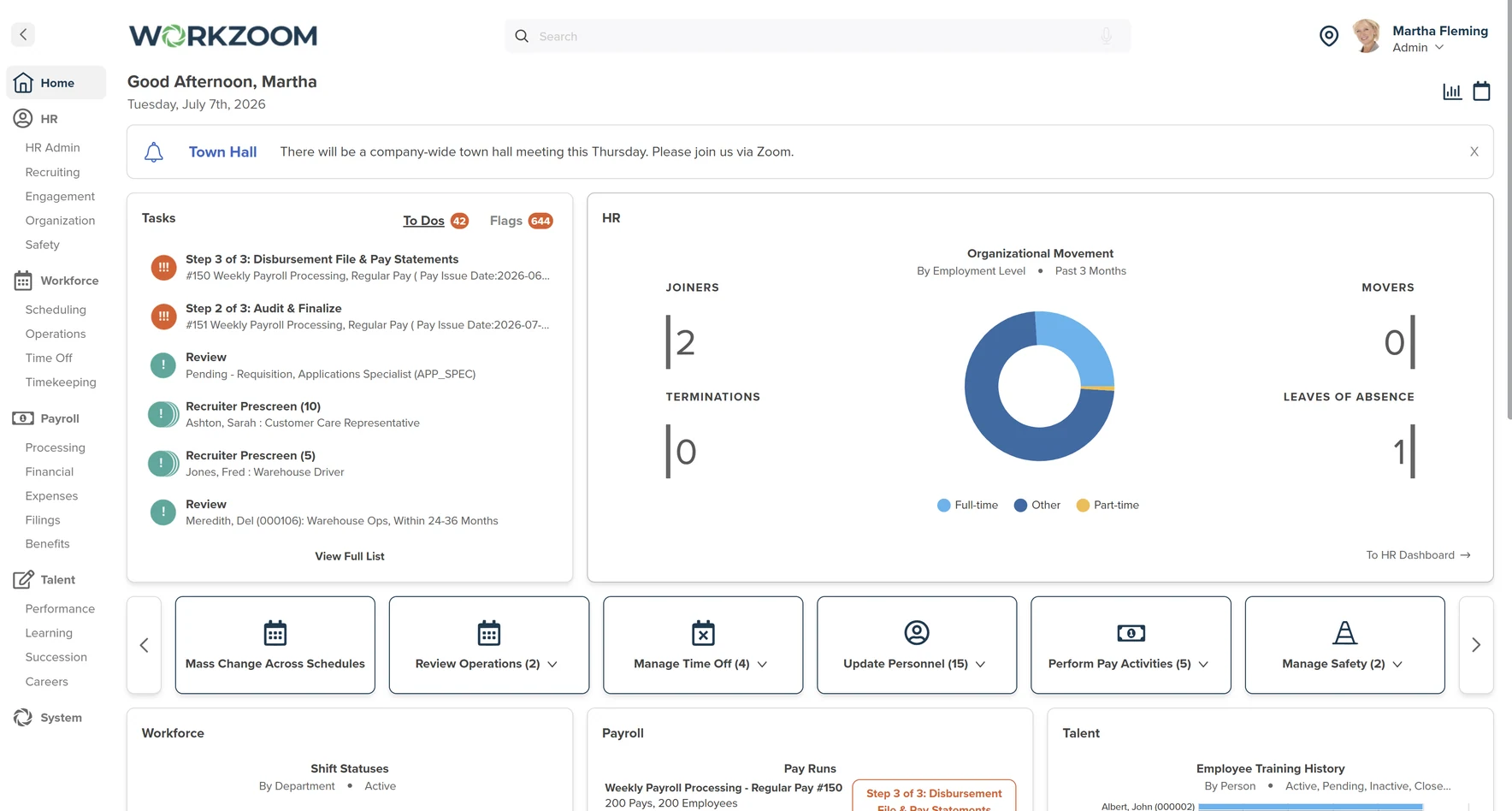
Workzoom runs Bahamas payroll against the Bahamas Employment Act 2001, the primary legislation governing employment relationships in the Bahamas, covering overtime (one and one-half times after forty hours a week or eight hours a day), annual leave, sick leave, maternity protections, termination notice, and severance pay. Minimum wage sits under a separate law, the Minimum Wages Act, enforced by the Department of Labour, not this Act. The Employment Act applies to virtually every employer operating in the country, and its protections are significantly stronger than what most foreign-owned businesses expect.
What the Bahamas Employment Act Actually Covers
- Minimum wage is set under the separate Minimum Wages Act (see the Department of Labour for the current rate). Overtime is one and one-half times after forty hours a week, and twice for overtime worked on a public holiday or day off
- Employees earn two weeks paid annual leave after one year of service, one week paid sick leave after six months, and not less than twelve weeks of maternity leave, with the employer required to pay at least thirty-three and one-third per cent of wages up to the NIB ceiling during that leave
- NIB contributions total 11.3% of insurable wages: 6.65% employer, 4.65% employee. Weekly ceiling is $830, effective July 1, 2026 (up from $810 before that date)
- Termination requires proper notice (from one week to one month, depending on tenure and role) plus severance of two weeks per year of service for non-managerial staff, up to twenty-four weeks
- The Bahamas has 11 public holidays per year. Overtime worked on a holiday or day off is paid at twice the regular rate
The Employment Act 2001 is the foundational employment legislation in the Bahamas. Eighty sections across thirteen Parts, with three Schedules, covering the full employment relationship from hiring to separation. It replaced a patchwork of older statutes and brought Bahamian labour law broadly in line with International Labour Organization (ILO) conventions.
It covers every employer and employee in the Bahamas, with limited exceptions for members of the Defence Force and police. Domestic workers, hotel staff, construction workers, gaming employees. All covered.
And here's the part that surprises people: it's not vague. The notice periods are specified by tenure. The overtime multipliers are fixed. The severance formula is mathematical. There's very little room for interpretation, which means there's very little excuse for getting it wrong.
The Housekeeper's Math
That housekeeper was entitled to severance of two weeks for every year of service. Our hypothetical assumes ten years of service, which works out to twenty weeks of severance, not the two weeks she actually received. The Industrial Tribunal can also order reinstatement, and if the employer refuses to comply, the Tribunal can add a further award of up to twenty-six weeks on top, the maximum on offer for defying a reinstatement order, not a default outcome of every dismissal.
Stacked together, that is where the "46 weeks" in the title comes from. This keeps happening, and the Employment Act has teeth the Tribunal is willing to use.
Here is what we have seen running payroll for Cable Bahamas, Island Luck, and other large Bahamian employers. Most American and Canadian managers don't lose at the Tribunal on the facts. They lose because the severance formula lived in someone's head, as opposed to the engine that cuts the cheque. The Act is mathematical. Your payroll should be too.
Minimum Wage: Governed by a Separate Act
Minimum wage in the Bahamas is not set by the Employment Act. It is set under the separate Minimum Wages Act, administered by the Department of Labour. Employers who assume the Employment Act sets their wage floor are already looking in the wrong statute.
The rate has changed more than once since the Minimum Wages Act first introduced a statutory floor, and the National Tripartite Council has signalled it is reviewing another increase. Confirm the current weekly rate directly with the Department of Labour before running payroll on it. Rates move, and this one has moved before.
Whatever the current rate is, it applies across every industry as a weekly floor. No separate tipped-worker rate. No training wage. No carve-outs for seasonal staff.
Where Employers Get Tripped Up
Employers who pay monthly salaries sometimes lose sight of the weekly minimum. A flat monthly salary can look reasonable until you divide it across a longer work week and realize the hourly rate falls below the floor once overtime is factored in. The Minimum Wages Act calculates the minimum on a weekly basis, and every pay arrangement has to clear that bar, including a flat monthly salary that looks fine on paper.
Overtime Rules That Actually Have Teeth
- Standard workweek: forty hours
- Standard workday: eight hours, extended to twelve hours for industrial, construction, manufacturing, transshipment, essential-service, and law-enforcement work
- Exempt: supervisory and managerial staff, from these hours and overtime provisions entirely
Anything beyond forty hours in a week or eight hours in a day triggers overtime at not less than one and one-half times the regular hourly rate. Overtime work on a public holiday or on the employee's scheduled day off is paid at not less than twice the regular rate, a higher premium than ordinary overtime, not a rate that applies to every hour worked on the holiday.
This is where the hospitality industry bleeds money without realizing it. A front desk clerk on the standard schedule who works a longer week during peak season has crossed the weekly threshold, and the extra hours are owed at the higher rate calculated from their own hourly wage, not a flat guess at what overtime "usually" costs. Employers who calculate overtime off a monthly or weekly salary instead of converting to an actual hourly rate first routinely underpay without realizing it.
Multiply that pattern across a resort running peak-season schedules with dozens of staff in overtime every week, and small computational errors compound into real liability. When employees eventually raise it, that liability is retroactive.
The hotels that get this wrong aren't malicious. They're applying US labour thinking to Bahamian law. Different country. Different rules. The Act doesn't care about your head office's payroll policies.
Annual Leave, Sick Leave, and Maternity: The Entitlements Nobody Can Skip
Leave entitlements under the Bahamas Employment Act are tiered by tenure. They're not generous by European standards, but they're mandatory, and they're more structured than what you'll find across most of the Caribbean.
Annual Leave
Under the Bahamas Employment Act, every employer must give an employee a vacation of at least two weeks on completion of each twelve months of employment. Vacation pay for that vacation is one week's basic pay for an employee employed six months or more but under one year, two weeks' basic pay for one year or more but under seven years, and three weeks' basic pay for seven years or more.
A detail that catches employers off guard: the Act requires vacation pay to be paid before the leave begins, not on the next regular payday after the employee is already gone. Employers who run vacation pay through the normal payroll cycle instead of paying ahead of the leave are technically out of compliance, even if the money arrives only a little late. Confirm the exact timing rule with the Department of Labour before relying on it for a specific case.
Sick Leave
Under the Bahamas Employment Act, an employee who has been employed for at least six months is entitled to one week of paid sick leave in any year where illness prevents the employee from performing duties, except that no payment is due for a period of sick leave that is only one day long, and sick leave does not accumulate from year to year. A medical certificate is required for every period of sick leave except the first day, though the employee is still entitled to be paid for that first day if a medical certificate is presented for it.
Simple, but employers who don't track tenure and usage end up paying for sick days that were never earned, or approving leave that exceeds the entitlement.
Maternity Leave
This is where the Act gets serious about protection.
Under the Bahamas Employment Act, a female employee who has been employed for at least twelve months by the employer from whom she requests leave, and who delivers to the employer a certificate of the expected date of confinement issued by a medical practitioner, or a certificate of the actual date of confinement issued by a medical practitioner or a midwife, is entitled to maternity leave which, except where the employee otherwise desires, is for a period of not less than twelve weeks, arranged as not less than one week before the expected date of confinement and not less than eight weeks after confinement. During that leave, once in every three years, the employer must pay her a minimum sum equal to thirty-three and one-third per cent of the portion of her wages that does not exceed the National Insurance ceiling on insurable wage.
Can You Dismiss a Pregnant Employee?
Dismissal due to pregnancy is automatically unfair under the Act, with no qualifying period. You cannot dismiss someone because they're pregnant. Full stop. Not during probation. Not during their first week. The protection applies from day one of employment, regardless of tenure. Employers who try to work around this by calling it a "performance issue" or a "restructuring" find out at the Industrial Tribunal that the burden of proof shifts to them.
If you're managing leave entitlements across dozens or hundreds of employees, tracking tenure-based accruals manually is where mistakes creep in. One miscalculated start date changes someone's entire leave balance. This is why employers running operations in the Bahamas increasingly rely on systems that automate workforce management rather than spreadsheets that drift.
The 11 Public Holidays (and Why Double Time Matters)
The Bahamas observes 11 public holidays per year:
- New Year's Day (January 1)
- Majority Rule Day (January 10)
- Good Friday
- Easter Monday
- Whit Monday
- Randol Fawkes Labour Day (first Friday in June)
- Independence Day (July 10)
- Emancipation Day (first Monday in August)
- National Heroes Day (second Monday in October)
- Christmas Day (December 25)
- Boxing Day (December 26)
If a public holiday falls on a Sunday, the following Monday is observed. If it falls on a Saturday, the preceding Friday is observed in many workplaces, though the Act itself is less prescriptive on this point than you'd expect.
Overtime work performed on a public holiday, meaning hours beyond the employee's standard hours of work, is paid at twice the regular rate, not the standard overtime premium. For hotels and resorts that operate every day of the year, this is a significant payroll line item that needs to be budgeted, not discovered after the fact.
Probation Periods: What You Can and Can't Do
The Employment Act doesn't set out a separate probation regime with its own rules. Probation is a contractual practice employers use, and it doesn't create a compliance-free zone: whatever notice terms and other rights the written statement of employment sets for a probationary period still have to sit within what the Act allows. During probation, an employer can typically give shorter notice than the standard tiers, but the length and terms belong in the written statement, not assumed.
Probation doesn't exempt you from minimum wage. Doesn't exempt you from overtime. Doesn't exempt you from the prohibition on pregnancy discrimination. And if the probation period isn't specified in the written statement of employment, the default notice rules apply.
There's no fixed statutory maximum for how long probation can run. An unreasonably long probation period can be challenged as an attempt to avoid statutory entitlements. Confirm what counts as reasonable with the Department of Labour before setting a policy, rather than picking a number and assuming it will hold up.
Running HR in the Bahamas shouldn't mean guessing at compliance
Workzoom handles payroll, leave tracking, NIB contributions, and termination calculations for some of the largest Bahamian employers. One platform, $4/employee/month, no setup fees, no contracts.
Book a 30-Minute WalkthroughTermination and Severance: The Expensive Part
This is the section of the Employment Act that generates the most Industrial Tribunal cases. And the reason is almost always the same: employers either don't know what they owe or don't follow the process.
Notice Periods by Tenure
Under the Bahamas Employment Act, the minimum notice an employer must give to terminate an employee's contract of employment is: where the employee holds a supervisory or managerial position, one month's notice or one month's basic pay in lieu of notice, plus one month's basic pay (or a pro rata part) for each year of employment up to forty-eight weeks; where the employee has been employed for six months or more but less than twelve months, one week's notice or one week's basic pay in lieu of notice, plus one week's basic pay (or a pro rata part) for the period between six months and twelve months; and where the employee has been employed for twelve months or more, two weeks' notice or two weeks' basic pay in lieu of notice, plus two weeks' basic pay (or a pro rata part) for each year of employment up to twenty-four weeks.
Pay in lieu of notice must include the full wage package. Base salary, housing allowance, vehicle allowance, regular benefits. Employers who pay base salary only and skip the allowances are making a short payment, and it will be challenged.
Severance Calculation
Under the Bahamas Employment Act, an employee who has been continuously employed for one year or more and is dismissed because of redundancy is entitled, subject to the other provisions of Part VI of the Act, to redundancy pay of two weeks' notice or two weeks' basic pay in lieu of notice, plus two weeks' basic pay (or a pro rata part) for each year of employment, up to a maximum of twenty-four weeks. Where the employee holds a supervisory or managerial position, redundancy pay is one month's notice or one month's basic pay in lieu of notice, plus one month's basic pay (or a pro rata part) for each year of employment, up to a maximum of forty-eight weeks. Where the employer provides a gratuity or a non-contributory pension for the employee, the employee is not entitled to both redundancy pay and the gratuity or non-contributory pension, and must select the one preferred.
Employees dismissed for serious misconduct (theft, fraud, gross insubordination, gross negligence) are not entitled to it.
The calculation uses the employee's average weekly wage over a period before termination, not their current rate and not their starting rate, so raises, bonuses, or variable pay during that window can move the number. Confirm the exact averaging period against the Act's text or with the Department of Labour before running the calculation.
Picture a hypothetical manager with eight years of service. Severance runs one month per year of service under the managerial tier, up to a cap of forty-eight weeks, on top of notice pay. That's separate from an unfair-dismissal award, which starts at three weeks per complete year of employment, capped at twenty-four months for a managerial role, plus up to twenty-six weeks more if the employer then fails to comply with a reinstatement or re-engagement order.
The 2017 Employment Amendment also closed a loophole some employers were using: terminating employees and immediately re-engaging them as independent contractors doing the same work. If you rehire a former employee as a contractor within 12 months of redundancy, the arrangement is deemed employment unless the new terms are more favourable to the worker. The Act anticipated that move and blocked it.
For a deeper look at the specific mistakes that land employers at the Industrial Tribunal, including the redundancy trap and unfair dismissal claims, we've covered that separately.
NIB Contributions: The Payroll Obligation That Never Stops
Every employer in the Bahamas must register with the National Insurance Board and contribute on behalf of every employee. The current rates:
- Employer: 6.65% of insurable wages
- Employee: 4.65% of insurable wages
- Total: 11.3%
- Insurable wage ceiling: $830 per week, effective July 1, 2026 (up from $810 before that date)
NIB contributions fund sickness benefit, maternity benefit, invalidity benefit, retirement pension, and survivors' benefit. The employer portion is not optional. Late payment attracts a penalty. Confirm the current surcharge and interest terms directly with NIB rather than relying on a figure that may be out of date by the time you read this.
New employers must register with NIB, and new hires need to be registered individually. Confirm the current registration deadline and the monthly C10 filing deadline with NIB directly. Miss a filing, and penalties start accruing.
We've written a complete guide to NIB compliance and C10 forms if you need the full breakdown of how Bahamian payroll works in practice.
Why Do Hotels and Resorts Keep Getting This Wrong?
I'll be direct about this. The pattern is specific and it repeats. Large hospitality operations in the Bahamas are frequently managed by executives who built their careers in the US or Canada. They bring management playbooks from Marriott or Hilton corporate. Those playbooks assume at-will employment, FLSA overtime rules, and a legal environment where termination is relatively frictionless.
The Bahamas is not an at-will jurisdiction. There is no at-will employment. Every termination requires either proper notice or pay in lieu. Every employee with one year or more of continuous service is entitled to severance on termination, on the terms set out in the Act. Dismissal without adequate documentation or process can be challenged as unfair, with the Tribunal empowered to order reinstatement or substantial compensation.
If the payroll system is calculating overtime based on US FLSA rules, applying only a weekly threshold and never a daily threshold, it's underpaying on every shift that exceeds eight hours even if the weekly total stays under forty hours. That's a liability building quietly, pay period by pay period, and if you're managing payroll across multiple countries, those differences in overtime, contributions, and termination aren't details you can approximate. They're statutory requirements that vary by jurisdiction.
What Changes Are Coming
The Bahamian government has signalled amendments to the Employment Act expected by mid-2026. Based on what the National Tripartite Council has discussed publicly:
- Statutory paternity leave for the first time
- Expanded maternity benefits
- Alignment with additional ILO conventions
- A further minimum wage increase is under active consideration
For employers still tracking leave and pay manually, each amendment adds complexity that spreadsheets absorb poorly. The pattern with Caribbean labour law is consistent: protections expand, they don't contract. Building compliance infrastructure now means you're ready when the rules change, not scrambling after.
Employers across the Caribbean are dealing with similar dynamics. Jamaica's payroll compliance market has its own complexities, and the trend across the region is toward stronger worker protections.
The Real Compliance Gap
The Bahamas Employment Act isn't ambiguous:
- The notice periods are in the statute
- The overtime multipliers are specified
- The severance formula is arithmetic
- The leave entitlements are tiered by tenure with specific accrual dates
So why do employers keep ending up at the Industrial Tribunal? Not because the law is unclear. Because the systems they use to apply it are inadequate. Paper files, disconnected spreadsheets, verbal agreements, and payroll processes that rely on someone remembering the rules instead of encoding them.
Cable Bahamas runs payroll and HR for 850 employees on Workzoom. Island Luck manages 850 staff across 60+ gaming locations. Both stopped treating compliance as something that happens in someone's head and started treating it as infrastructure.
The Employment Act doesn't reward good intentions. It rewards consistent execution. And consistent execution at scale requires systems, not willpower.
- Employment Act, 2001 (Ch. 321A), ss.8 and 10 in effect since Feb 1, 2003 claim checked Sep 4, 2026
- Employment Act, 2001 (Ch. 321A), ss.8 and 10(a) in effect since Jan 1, 2002 claim checked Sep 4, 2026
- Employment Act, 2001 (Ch. 321A), ss.12-13 in effect since Jan 1, 2002 claim checked Sep 4, 2026
- Employment Act, 2001 (Ch. 321A), s.11 in effect since Jan 1, 2002 claim checked Sep 4, 2026
- Employment Act, 2001 (Ch. 321A), ss.17-18 in effect since Jan 1, 2002 claim checked Sep 4, 2026
- Employment Act, 2001 (Ch. 321A), s.29(1) in effect since Jan 1, 2002 claim checked Sep 4, 2026
- Employment Act, 2001 (Ch. 321A), s.26 in effect since Jan 1, 2002 claim checked Sep 4, 2026
- Employment Act, 2001 (Ch. 321A), ss.44, 46 and 48 in effect since Jan 1, 2002 claim checked Sep 4, 2026
See Workzoom in 30 minutes.
Real product, real questions, no slides. Starts at $4 per employee per month, CAD or USD, with $0 setup fees.
What readers ask after this post on Bahamas employment act.
Our clients
The teams that run their people on Workzoom.













Workzoom handles HR, payroll, workforce, and talent on one employee record. Book a 30-minute walkthrough.