 Canada
 United States
 Bahamas
 Jamaica
 Trinidad & Tobago
 Antigua & Barbuda
 Barbados
 Anguilla
Bahamas Employment Act Termination Rules and Tribunal Risk

Bahamas Employment Act Compliance Mistakes Cost Real Money
Workzoom runs payroll and HR for some of the Bahamas' largest employers, and the pattern holds across all of them: most believe they follow the Bahamas Employment Act. The Industrial Tribunal's docket says otherwise. Case after case, the employer thought they had grounds for dismissal, thought severance didn't apply, thought notice was enough.
The Act, 2001 isn't ambiguous, and it isn't written in legalese that needs a Queen's Counsel to read. The rules on notice, severance, leave, and dismissal are spelled out across eighty sections in thirteen Parts. The mistakes that lose tribunals are almost always the same handful, and they cost far more than getting it right ever would. For the ground rules behind every section here, start with our plain-language Bahamas Employment Act guide.
And yet, employers keep getting it wrong. Consistently. The result is the same every time: reinstatement orders, compensation awards, and legal costs that dwarf whatever the employer was trying to save by cutting corners.
This is a guide to the specific sections that trip employers up, the mistakes that generate Tribunal complaints, and what compliant employment actually looks like on the ground in Nassau, Freeport, and across the Family Islands.
Written Statements of Employment: The Mistake That Starts on Day One
Under the Bahamas Employment Act, an employer must inform an employee, as soon as practicable, of particulars including the employer's and employee's names and place of employment, the nature of the employment, the duration of employment where the person is engaged for a fixed period, the rate of wages and other benefits and the method and period of their payment, and, where work is performed by time rather than by the piece, the number of daily working hours and the hours at which such work begins and ends.
Not a verbal agreement. Not a handshake.
And here's what makes this genuinely worse: many Bahamian employers do issue offer letters. But an offer letter that only states pay, without specifying hours, overtime terms, leave entitlements, and notice periods, is not the full written statement the Act requires. It's a partial document that creates a false sense of compliance.
The fix is simple. Every employee gets a written statement that covers every element the Act requires. And you keep a signed copy on file.
What the Written Statement Must Include
- Employer name and business address
- Employee's job title and description of duties
- Place of work (critical for multi-island operations)
- Date employment began
- Hours of work including daily start and end times
- Rate of wages and method of calculation
- Pay frequency (weekly, bi-weekly, monthly)
- Leave entitlements (annual, sick, maternity)
- Notice period required for termination by either party
- Any collective agreement that applies
Working Hours and Overtime: Where the Math Goes Sideways
Under the Bahamas Employment Act, standard hours of work are eight hours in a day and forty hours in a week; an employee required or permitted to work in excess of those hours must be paid for that work at a rate of wages not less than one and one-half times the regular rate of wages, or not less than twice the regular rate of wages for overtime work performed on a public holiday or day off, except that an employee in a tipped category in the tourism and hospitality industry is paid at the regular rate of pay other than in respect of his second day off in any week. In an industrial, construction, manufacturing or transshipment enterprise, in an essential service, or in law enforcement service, standard hours of work may be extended up to a maximum of twelve hours in a day. Section 8, which sets the standard hours of work, does not apply to an employee who holds a supervisory or managerial position.
The most common overtime violations aren't deliberate. Quite frankly, they're computational. Employers who calculate overtime based on salary rather than converting to an hourly rate first. Employers who average hours across a pay period instead of applying the daily threshold. Employers who pay time-and-a-half on public holidays when the law requires the higher rate for overtime worked that day.
A detail that catches employers by surprise: the minimum wage, set under the separate Minimum Wages Act, applies as a floor for overtime calculations too. A flat weekly rate that looks fine at standard hours doesn't exempt an employer from overtime obligations once actual hours cross the threshold. Confirm the current minimum wage rate with the Department of Labour before running the math.
Leave Entitlements: The Rules at a Glance
- Annual Leave: Under the Bahamas Employment Act, every employer must give an employee a vacation of at least two weeks on completion of each twelve months of employment. Vacation pay for that vacation is one week's basic pay for an employee employed six months or more but under one year, two weeks' basic pay for one year or more but under seven years, and three weeks' basic pay for seven years or more.
- Sick Leave: Under the Bahamas Employment Act, an employee who has been employed for at least six months is entitled to one week of paid sick leave in any year where illness prevents the employee from performing duties, except that no payment is due for a period of sick leave that is only one day long, and sick leave does not accumulate from year to year. A medical certificate is required for every period of sick leave except the first day, though the employee is still entitled to be paid for that first day if a medical certificate is presented for it.
- Maternity Leave: Under the Bahamas Employment Act, a female employee who has been employed for at least twelve months by the employer from whom she requests leave, and who delivers to the employer a certificate of the expected date of confinement issued by a medical practitioner, or a certificate of the actual date of confinement issued by a medical practitioner or a midwife, is entitled to maternity leave which, except where the employee otherwise desires, is for a period of not less than twelve weeks, arranged as not less than one week before the expected date of confinement and not less than eight weeks after confinement. During that leave, once in every three years, the employer must pay her a minimum sum equal to thirty-three and one-third per cent of the portion of her wages that does not exceed the National Insurance ceiling on insurable wage.
Vacation pay must be paid before the leave begins, not folded into the next regular payday. Confirm the exact timing rule with the Department of Labour. See our Bahamas NIB compliance guide for the maternity contribution math. Dismissing an employee because of pregnancy is automatically unfair under the Act, with no qualifying period. It applies from an employee's first day.
The government has announced plans to introduce paternity leave and expand maternity benefits by mid-2026. Employers should be preparing now, not scrambling when the legislation passes.
Termination and Notice: The Section That Generates the Most Tribunal Cases
The Employment Act's notice and severance provisions are, without question, the ones most frequently litigated at the Industrial Tribunal. And the reason is almost always the same: employers either miscalculate what they owe or skip the process entirely.
Notice Periods
Under the Bahamas Employment Act, the minimum notice an employer must give to terminate an employee's contract of employment is: where the employee holds a supervisory or managerial position, one month's notice or one month's basic pay in lieu of notice, plus one month's basic pay (or a pro rata part) for each year of employment up to forty-eight weeks; where the employee has been employed for six months or more but less than twelve months, one week's notice or one week's basic pay in lieu of notice, plus one week's basic pay (or a pro rata part) for the period between six months and twelve months; and where the employee has been employed for twelve months or more, two weeks' notice or two weeks' basic pay in lieu of notice, plus two weeks' basic pay (or a pro rata part) for each year of employment up to twenty-four weeks.
Pay in lieu of notice must equal full wages for the notice period, including regular allowances and benefits. A payment that covers base salary but excludes housing or vehicle allowance is a short payment that can be challenged.
Severance Pay
This is where the real money is. Under the Bahamas Employment Act, an employee who has been continuously employed for one year or more and is dismissed because of redundancy is entitled, subject to the other provisions of Part VI of the Act, to redundancy pay of two weeks' notice or two weeks' basic pay in lieu of notice, plus two weeks' basic pay (or a pro rata part) for each year of employment, up to a maximum of twenty-four weeks. Where the employee holds a supervisory or managerial position, redundancy pay is one month's notice or one month's basic pay in lieu of notice, plus one month's basic pay (or a pro rata part) for each year of employment, up to a maximum of forty-eight weeks. Where the employer provides a gratuity or a non-contributory pension for the employee, the employee is not entitled to both redundancy pay and the gratuity or non-contributory pension, and must select the one preferred.
The basis is the employee's average weekly wage over a period before termination, not their current rate and not their starting rate. Picture a hypothetical manager with eight years of service: severance runs one month per year under the managerial tier, plus notice pay on top.
That's separate from an unfair-dismissal award: a basic award of three weeks per complete year of employment, capped at twenty-four months for a managerial role, plus up to twenty-six weeks more for defying a reinstatement or re-engagement order. The 2017 Employment Amendment closed a loophole too: terminating someone and immediately re-engaging them as an independent contractor doing the same work. Re-engage a former employee as a contractor within 12 months of redundancy, and the arrangement is deemed employment unless the terms are more favourable to the worker.
Unfair Dismissal: The Claim You Didn't See Coming
A block of sections in the Employment Act establishes the unfair dismissal framework, covering both what counts as automatically unfair and what the Tribunal can award. A dismissal is automatically unfair if the principal reason relates to:
- Trade union membership or activity
- Pregnancy or pregnancy-related illness
- Discrimination based on race, creed, sex, marital status, political opinion, age, or HIV/AIDS status
- Exercising a right under the Employment Act
The Redundancy Trap
Honestly, the single most costly mistake employers make with dismissals is misusing the word "redundancy." Redundancy under the Act applies only when the position has genuinely ceased to exist or when the employer's need for that type of work has diminished. It's about the role, not the person.
Here's what employers actually do: they want to dismiss an underperformer but don't want to go through the disciplinary process. So they call it a redundancy, pay the severance, and assume the matter is closed. Then they hire someone else to do the same job three months later.
Quite frankly, that's not a redundancy. That's a termination disguised as one. And when that former employee files a complaint with the Industrial Tribunal, the employer will be ordered to explain why the role that was supposedly eliminated is now being performed by someone new.
When Can You Skip Notice for a Dismissal?
Summary dismissal is permitted only for serious misconduct: theft, fraud, dishonesty, gross insubordination, gross indecency, breach of confidentiality, gross negligence, or gross misconduct. The burden of proof is on the employer. "Gross" is doing a lot of work in that list. An employee who's occasionally late is not grossly negligent. The Tribunal draws these lines carefully.
Even when summary dismissal is justified, procedure still counts:
- Investigate before making any decision
- Notify the employee in writing of the specific allegation
- Give the employee an opportunity to respond
- Consider the explanation before deciding
- Issue a written termination notice with reason and effective date
Skipping these steps doesn't invalidate the dismissal if the misconduct is clear-cut. But it weakens your position enormously at the Tribunal. And cases end up there more often than employers expect.
Record-Keeping: The Silent Compliance Obligation
Under the Bahamas Employment Act, every employer must keep a register of wage payments and accounts for each employee for a period of three years; this requirement does not apply to domestic employees. This is a statutory obligation the Department of Labour enforces through inspection. You need:
- Full name, address, age, and date of birth
- Wages paid, hours worked (daily and weekly), overtime payments
- Leave taken (annual, sick, maternity)
- All deductions made from wages
When a dispute reaches the Tribunal, documentation is the first thing requested. Employers who can't produce records don't just look disorganized. They look like they have something to hide. The Act also prohibits discrimination based on race, creed, sex, marital status, political opinion, age, or HIV/AIDS status, and the burden shifts to the employer once an employee establishes a prima facie case. Your records are your defence.
What Compliant Employers Actually Do Differently
Among Bahamian employers on the platform, from Cable Bahamas with 850 employees to smaller operations on the Family Islands, the pattern we see is the same. The difference between compliant and non-compliant employers isn't knowledge. It genuinely isn't. Everyone knows the Act exists. The difference is systems. You're not the problem. The manual process is.
- Standardized employment contracts generated automatically for each new hire
- Automated leave tracking that calculates entitlements by tenure and flags gaps
- Overtime calculations built into payroll applying the correct multiplier based on when hours were worked
- Termination workflows calculating notice and severance automatically
- Centralized records accessible from any location with a full audit trail
Non-compliant employers have the same obligations. They just meet them with spreadsheets, verbal agreements, and good intentions. And good intentions aren't a defence at the Industrial Tribunal. The same systems gap shows up in the NIB mistakes employers make and across the wider Bahamas HR and payroll picture.
What's Coming: The 2026 Amendments
Amendments to the Employment Act are being drafted for mid-2026. Statutory paternity leave for the first time. Expanded maternity benefits. Alignment with ILO conventions. The National Tripartite Council has also signalled a further minimum wage increase is under consideration.
For employers still tracking leave and pay manually, each new amendment adds another layer of complexity that manual processes struggle to absorb. The time to get your systems in order is before the new rules take effect. Not after.
None of This Is Optional
The Bahamas Employment Act isn't ambiguous. The notice periods are specified. The severance calculations are formulaic. The leave entitlements are tiered by tenure. The grounds for summary dismissal are listed.
Every employer who ends up at the Industrial Tribunal had access to the same statute you just read about. Quite frankly, they didn't fail because the law was unclear. They failed because they didn't have the systems to apply it consistently.
None of this is optional. All of it is manageable, if you stop treating compliance as a manual process and start treating it as infrastructure.
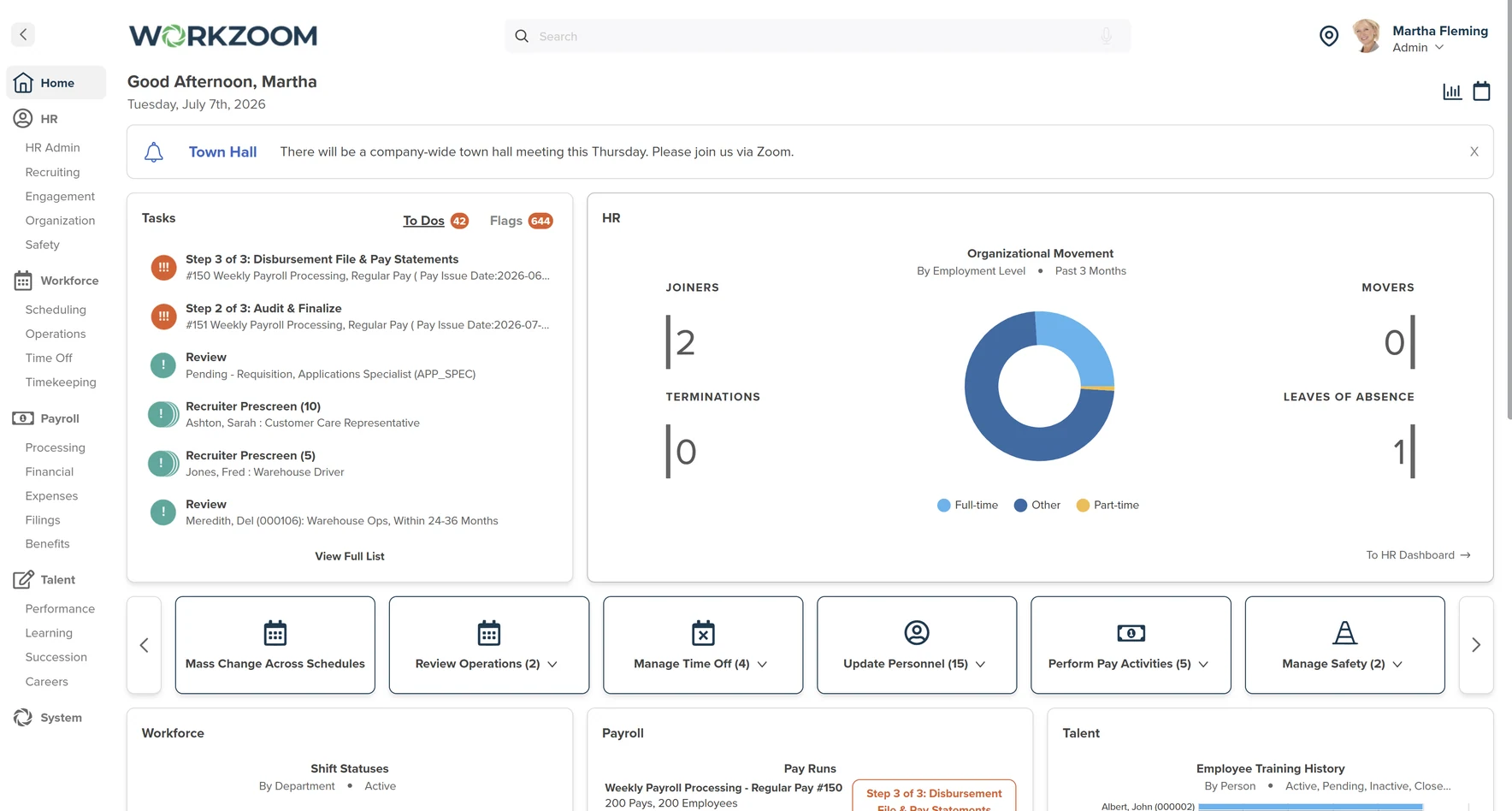
Cable Bahamas and Island Luck already run their HR and payroll on Workzoom. If you're still managing Employment Act compliance with spreadsheets and paper files, we should talk. $4/employee/month. No implementation fees. No contracts.
See what Workzoom looks like for your team →- Employment Act, 2001 (Ch. 321A), ss.44, 46 and 48 in effect since Jan 1, 2002 claim checked Sep 4, 2026
- Employment Act, 2001 (Ch. 321A), s.5 in effect since Jan 1, 2002 claim checked Sep 4, 2026
- Employment Act, 2001 (Ch. 321A), ss.8 and 10 in effect since Feb 1, 2003 claim checked Sep 4, 2026
- Employment Act, 2001 (Ch. 321A), ss.12-13 in effect since Jan 1, 2002 claim checked Sep 4, 2026
- Employment Act, 2001 (Ch. 321A), s.11 in effect since Jan 1, 2002 claim checked Sep 4, 2026
- Employment Act, 2001 (Ch. 321A), ss.17-18 in effect since Jan 1, 2002 claim checked Sep 4, 2026
- Employment Act, 2001 (Ch. 321A), s.29(1) in effect since Jan 1, 2002 claim checked Sep 4, 2026
- Employment Act, 2001 (Ch. 321A), s.26 in effect since Jan 1, 2002 claim checked Sep 4, 2026
- Employment Act, 2001 (Ch. 321A), s.61 in effect since Jan 1, 2002 claim checked Sep 4, 2026
See Workzoom in 30 minutes.
Real product, real questions, no slides. Starts at $4 per employee per month, CAD or USD, with $0 setup fees.
What readers ask after this post on Bahamas employment act.
Our clients
The teams that run their people on Workzoom.













Workzoom handles HR, payroll, workforce, and talent on one employee record. Book a 30-minute walkthrough.