 Canada
 United States
 Bahamas
 Jamaica
 Trinidad & Tobago
 Antigua & Barbuda
 Barbados
 Anguilla
Bahamas Labour Laws: The Employer Compliance Checklist

Bahamas labour laws don't live in one place. Ask a foreign-managed hotel where the minimum wage is set and they'll usually point to the Employment Act. It isn't there. It's in the separate Minimum Wages Act. Ask where NIB registration rules live and the answer is a third statute again, the National Insurance Act, administered by a regulator that updates its own procedures independently of either.
That's not a criticism of the law. Spreading employment obligations across several instruments is normal across the Caribbean. It's a warning about where employers get caught: checking one Act, finding nothing on point, and assuming the obligation doesn't exist.
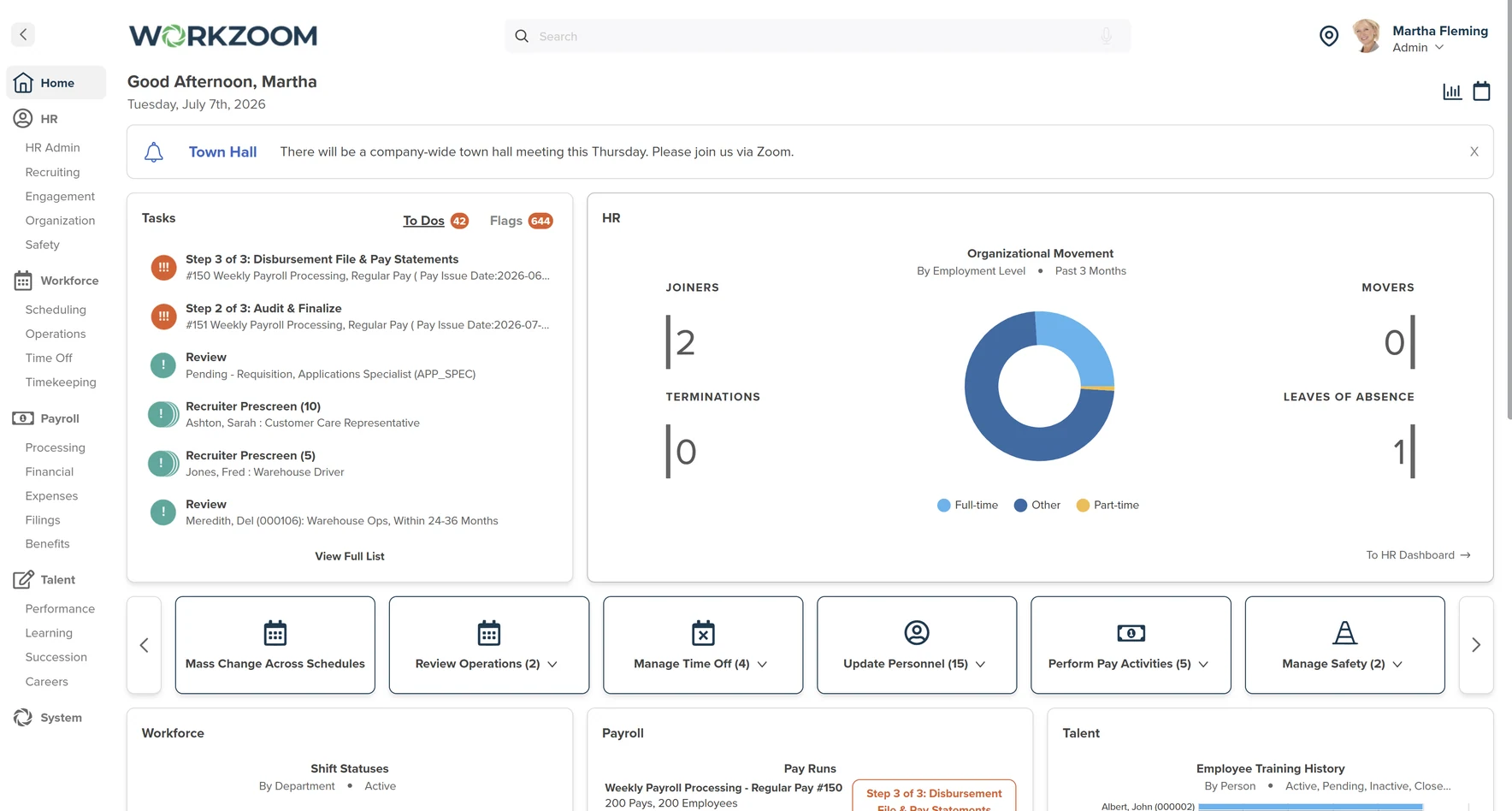
Bahamas labour laws span the Employment Act 2001 (hours, leave, notice, and severance), the Minimum Wages Act (the wage floor), and the National Insurance Act (NIB registration and contributions). Workzoom runs HR and payroll for major Bahamian employers, including Cable Bahamas and Island Luck, automating NIB calculations, leave accrual, termination notice, severance, and the wage register the Act requires, so compliance doesn't depend on knowing which statute to check first.
- Several statutes cover this, not a single Act: the Employment Act, the Minimum Wages Act, and the National Insurance Act each cover a different slice of employer obligations
- NIB contributions total 11.3% of insurable wages, capped at $830 per week, filed monthly on the C10
- 11 public holidays a year, with overtime on a holiday paid at not less than twice the regular rate
- Termination requires notice by tenure, plus severance for staff with one year or more of continuous service
- The wage register must be kept for three years; domestic employees are exempt from that specific rule
The Three Statutes Bahamian Employers Actually Answer To
The Employment Act 2001 is the foundational statute: eighty sections covering hours of work, overtime, leave, notice, and severance for virtually every employer and employee in the country. It does not set the minimum wage. That figure comes from the separate Minimum Wages Act, enforced by the Department of Labour. The rate has moved more than once since the Act introduced a statutory floor, and the National Tripartite Council has signalled it's reviewing another increase, so confirm the current weekly rate with the Department of Labour rather than relying on a number printed somewhere else.
NIB registration and contributions run under the National Insurance Act, administered separately again by the National Insurance Board. For a full walkthrough of the leave entitlements the Employment Act sets, see our Bahamas vacation, sick, and maternity leave guide.
NIB Registration and Contributions
Every employer must register with NIB and contribute on behalf of every employee. Businesses and self-employed persons must register within ten working days of commencing operations, and every person in gainful employment, temporary, probationary, part-time, or permanent, must be registered before, or as soon as possible after, starting work. Confirm the current registration steps directly with NIB, since this is administrative guidance NIB can update independently of the Employment Act.
- Employer contribution: 6.65% of insurable wages
- Employee contribution: 4.65% of insurable wages
- Combined: 11.3%
- Insurable wage ceiling: $830 per week, effective July 1, 2026 (up from $810 before that date)
- Filing: monthly, via the C10 contribution schedule, due by the 15th of the following month
NIB contributions fund sickness, maternity, invalidity, retirement, and survivors' benefits. The employer portion is not optional, and late payment attracts a penalty. Confirm the current surcharge and interest terms directly with NIB rather than relying on a figure that may be out of date. For the mechanics of how a mid-year ceiling change gets applied, see our NIB ceiling change guide.
The 11 Public Holidays
The Bahamas observes 11 public holidays a year: New Year's Day, Majority Rule Day, Good Friday, Easter Monday, Whit Monday, Randol Fawkes Labour Day, Independence Day, Emancipation Day, National Heroes Day, Christmas Day, and Boxing Day. Overtime work performed on a public holiday or an employee's scheduled day off is paid at not less than twice the regular rate, a higher premium than ordinary overtime, applying only to hours worked beyond standard hours, not to every hour on the calendar date.
Termination, Notice, and Severance
Under the Bahamas Employment Act, the minimum notice an employer must give to terminate an employee's contract of employment is: where the employee holds a supervisory or managerial position, one month's notice or one month's basic pay in lieu of notice, plus one month's basic pay (or a pro rata part) for each year of employment up to forty-eight weeks; where the employee has been employed for six months or more but less than twelve months, one week's notice or one week's basic pay in lieu of notice, plus one week's basic pay (or a pro rata part) for the period between six months and twelve months; and where the employee has been employed for twelve months or more, two weeks' notice or two weeks' basic pay in lieu of notice, plus two weeks' basic pay (or a pro rata part) for each year of employment up to twenty-four weeks.
Under the Bahamas Employment Act, an employee who has been continuously employed for one year or more and is dismissed because of redundancy is entitled, subject to the other provisions of Part VI of the Act, to redundancy pay of two weeks' notice or two weeks' basic pay in lieu of notice, plus two weeks' basic pay (or a pro rata part) for each year of employment, up to a maximum of twenty-four weeks. Where the employee holds a supervisory or managerial position, redundancy pay is one month's notice or one month's basic pay in lieu of notice, plus one month's basic pay (or a pro rata part) for each year of employment, up to a maximum of forty-eight weeks. Where the employer provides a gratuity or a non-contributory pension for the employee, the employee is not entitled to both redundancy pay and the gratuity or non-contributory pension, and must select the one preferred.
The calculation uses the employee's average weekly wage over a period before termination, not their current or starting rate, so raises, bonuses, or variable pay during that window can move the number. Employees dismissed for serious misconduct (theft, fraud, gross negligence) are not entitled to severance. Confirm the exact averaging period against the Act's text or with the Department of Labour before running the calculation. For the mistakes that turn a termination into an Industrial Tribunal case, see our Bahamas Employment Act termination guide.
Records: The Obligation Most Employers Forget
Under the Bahamas Employment Act, every employer must keep a register of wage payments and accounts for each employee for a period of three years; this requirement does not apply to domestic employees. This is a statutory duty the Department of Labour enforces through inspection, and it sits alongside, not instead of, the specific written statement of employment every hire is owed. When a dispute reaches the Tribunal, the register is the first thing requested. An employer who can't produce it isn't only disorganized. They're arguing from memory against a specific claim.
Health and Safety: The Gap Employers Assume Is Covered
The Employment Act's focus is hours, leave, notice, and severance, not workplace safety in detail. Health and safety obligations, incident reporting standards, and inspection requirements sit with the Department of Labour and related regulations rather than inside the Employment Act itself. Employers running construction, gaming, hospitality, or industrial operations should confirm current health and safety requirements directly with the Department of Labour rather than assuming one Act covers the full scope. Whatever the process, the underlying discipline is the same one that runs through every section above: a dated, auditable record of what happened, for every employee, that a regulator or a Tribunal can review.
The Compliance Checklist
- Confirm the current minimum wage with the Department of Labour. It's not in the Employment Act, and it has moved before.
- Register the business with NIB within ten working days of commencing operations, and register every new hire before or as soon as possible after they start.
- Apply the current NIB ceiling on every pay run, not a figure carried over from before the last change.
- Track the 11 public holidays and pay overtime worked on them at not less than twice the regular rate.
- Calculate notice and severance from tenure and role, using the employee's average wage, not their current rate.
- Keep the wage register for three years, current and searchable, not archived somewhere nobody can find it during an inspection.
- Confirm health and safety obligations with the Department of Labour directly, rather than assuming the Employment Act covers it.
Cable Bahamas runs payroll and HR for 850 employees on Workzoom. Island Luck manages 850 staff across 60+ gaming locations. Neither treats this checklist as a once-a-year audit. They treat it as infrastructure the payroll system carries on every pay run, which is the actual difference between a Bahamian employer who passes a Department of Labour inspection without a scramble and one who's reconstructing a wage register from memory the week an inspector calls.
Compliance that runs on every pay period, not once a year
Workzoom carries NIB registration, contribution calculations, leave accrual, termination notice, severance, and the wage register in one system, updated when the statute changes rather than when someone notices it's out of date. Starting at $4/employee/month, no setup fees, no contracts.
See Bahamas HR softwareIf Bahamas labour law compliance is still spread across a Minimum Wages Act printout, an NIB portal, and a filing cabinet of written statements, we should talk.
- Employment Act, 2001 (Ch. 321A), ss.8 and 10(a) in effect since Jan 1, 2002 claim checked Sep 4, 2026
- Employment Act, 2001 (Ch. 321A), s.26 in effect since Jan 1, 2002 claim checked Sep 4, 2026
- Employment Act, 2001 (Ch. 321A), s.29(1) in effect since Jan 1, 2002 claim checked Sep 4, 2026
- Employment Act, 2001 (Ch. 321A), s.61 in effect since Jan 1, 2002 claim checked Sep 4, 2026
See Workzoom in 30 minutes.
Real product, real questions, no slides. Starts at $4 per employee per month, CAD or USD, with $0 setup fees.
What readers ask after this post on Bahamas labour laws.
Our clients
The teams that run their people on Workzoom.













Workzoom handles HR, payroll, workforce, and talent on one employee record. Book a 30-minute walkthrough.