 Canada
 United States
 Bahamas
 Jamaica
 Trinidad & Tobago
 Antigua & Barbuda
 Barbados
 Anguilla
Payroll Team Size: How 3 People Run 850 Employees

Every pay cycle at Cable Bahamas used to start with a sheet. It went back and forth between HR and payroll, carrying the changes the pay run needed to know about. Five days later, roughly 850 employees across multiple companies got paid.
Ask a consultant what payroll team size fits an organization like that and you will get a ratio. Cable Bahamas runs it with three people, and the ratio is not the interesting part.
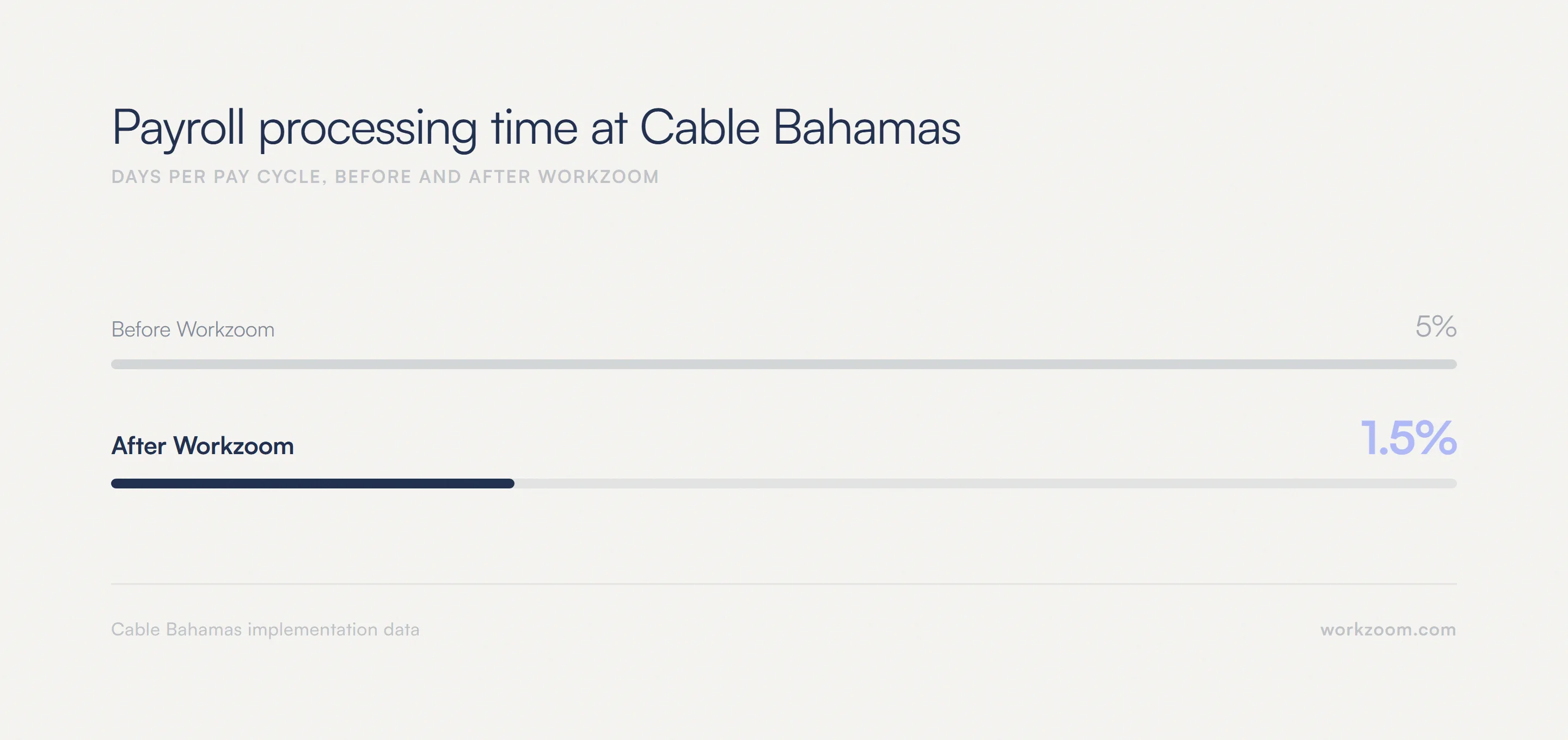
Workzoom lets a three-person payroll team run roughly 850 employees across multiple companies on one employee record. Cable Bahamas cut payroll processing from five days to a day and a half, a 70 percent reduction, because pay data stopped travelling between systems by hand.
When a pay run takes five days, almost nobody asks where the days go. They ask for more checkers. Another reviewer. A fourth administrator. That's not a staffing problem. That's a handoff problem, and headcount has never fixed a handoff.
The sheet that ran payroll
Before Workzoom, the Cable Bahamas process looked like the process at most companies its size. HR owned employee changes. Payroll owned the pay run. Between the two travelled a manual sheet, back and forth, carrying new hires, salary changes, department moves, and overtime corrections.
Each trip was a chance for something quiet to go wrong. A change recorded in HR that never made the sheet. A correction applied on one side and not the other. Numbers re-keyed under deadline pressure. The team caught most of it, which is exactly why the cycle took five days. Checking was the job.
It was not their first system, either. They had payroll software before. The team moved off it because it produced too many inconsistencies and was not giving them everything they needed. Swapping one disconnected tool for another was never going to shorten the route the data had to walk.
Worth being precise here: this was not a broken department. Cable Bahamas paid people accurately and on time. The payroll was dependable. It just cost five days of three professionals' attention, every single cycle, to keep it that way.
What's the right payroll team size?
The honest answer: payroll team size is set by how many handoffs your data makes, not by how many employees you pay. A three-person team can run 850 employees when a change entered once is entered for good. The same three people would drown at 400 if every timesheet, raise, and transfer crossed a desk by hand.
The Cable Bahamas numbers make the case. Three payroll professionals. Roughly 850 employees on the platform. Multiple companies in the group, including the Aliv and Rev brands, all on one Workzoom database. Shanika Pinder, the company's Compensation and Payroll Supervisor, oversees that full scope from a single queue.
And the throughput is not theoretical. Workzoom processes more than 217,000 paycheques annually across Workzoom payrolls in the Bahamas. If you run payroll for several entities and you are wondering whether that requires several systems, the answer in our guide to one-platform Caribbean payroll is the same one Cable Bahamas landed on: it requires one.
What changed: one record, dated changes, early flags
Nothing about the team changed. Three architectural decisions did the work.
One employee record. Timekeeping, HR, and payroll stopped being three systems with a courier between them. Approved hours flow straight into the pay run. A department move updates cost allocation on its own. Every change lands once, in one place. The sheet had no route left to walk, so it disappeared.
Date-effective changes. In Workzoom, a raise entered today with a first-of-the-month effective date applies itself to the right pay period. Nobody holds a change in their head, or on a sticky note, until the moment it is safe to key it in. The history stays queryable in both directions, which is the quiet superpower covered in our guide to date-effective employee records.
Flags before the run, not findings after it. The old process found errors by checking everything. The new one surfaces them. Missing banking details, unapproved time, an entry that does not reconcile: each raises a flag before processing starts.
The run itself is three steps. Validation pulls hours, overtime, and leave into the pay run and checks the entries as they arrive. Audit lays out every employee's gross-to-net path for review, with a recalculate function that confirms a correction's downstream impact before anything is finalized. Disbursement produces the bank file and sends pay statements straight to employee self-service. For 850 employees, the full pipeline closes in a day and a half.
When that flag comes up it gives us a proactive approach and allows us to spot and correct errors before we even run payroll
Shanika Pinder, Compensation & Payroll Supervisor and HR Business Partner, Cable Bahamas
Bahamian compliance rides on the same record. Workzoom calculates National Insurance Board contributions inside the pay run and prepares the contribution data and C10 reporting behind them. The employer files with NIB. If you want the mechanics, our Bahamas NIB compliance guide and our breakdown of Bahamas payroll software and NIB compliance go deep on what employers are on the hook for.
Counting the days your own pay run takes?
Workzoom puts HR, timekeeping, and payroll in one place, starting at $4 per employee per month per suite, $4 to $16 for the full platform, with monthly minimums starting at $400 for teams under 100, no setup fees, and month-to-month terms.
Get a walkthroughWhere the reclaimed days went
Cut a five-day cycle to a day and a half and you hand a three-person team three and a half days back, every cycle. What Cable Bahamas did with them says more about the change than the percentage does.
The interruptions fell first. Employees check pay statements, request leave, and update their own details from any device, so the steady stream of walk-up questions to payroll and HR thinned out. Shanika describes the foot traffic into both departments as tremendously reduced.
Managers got cleaner data, too. They can see updated payroll information in real time rather than working from an outdated export, which heads off discrepancies instead of litigating them after pay day.
Then the work changed shape. Time that went into re-keying and reconciling now goes into the projects that never used to make it off the someday list: consistent onboarding across departments, manager enablement, engagement work the data can measure. You got into payroll to pay people right and to build something, not to chase a printed sheet between departments. The hours came back to the part of the job worth having.
In last pay period I was like I don't feel like I've really worked
Shanika Pinder, Cable Bahamas
A payroll supervisor over a multi-company group does not say that lightly. She is not describing less work getting done. She is describing the absence of friction where friction used to be the texture of the week.
What the switch cost them
Case studies usually skip the part that follows. None of this happened in a week.
The implementation was a real project. Employee master data had to be migrated and cleaned. Pay structures for multiple companies had to be configured. And before go-live, parallel runs, where the old process and the new one both run so the outputs can be compared, are genuine work stacked on top of a team's normal cycle. Cable Bahamas earned the 1.5-day pay run. It was not handed to them at signature.
The view from the director's chair weighs both halves of that trade, the configuration work and what it bought.
Moving to Workzoom was the right move, as it allowed our dynamic report and payment structures the flexibility we needed… at the right price too!
Patrick Fernander, Director Compensation, Benefits & Accounts, Cable Bahamas
It is also worth repeating that they were not rescued. Their payroll worked before Workzoom. What they bought was not competence. It was time, and the compounding things a good team does with it.
Workzoom has truly stepped up our game. Payroll is now seamless, and HR feels less like a grind. It's a game-changer for us.
Shanika Pinder, Cable Bahamas
The full story, including how all four suites share a single employee record, is in the Cable Bahamas case study. The pattern travels well beyond telecom, and beyond the Bahamas: any organization where a sheet still shuttles between HR and payroll is paying a tax measured in days.
So before you post the job ad for a fourth payroll administrator, count your handoffs. If a sheet, an export, or a re-keying step still walks between your HR and payroll teams, we should talk.
See Workzoom in 30 minutes.
Real product, real questions, no slides. Starts at $4 per employee per month, CAD or USD, with $0 setup fees.
What readers ask after this post on payroll team size.
Our clients
The teams that run their people on Workzoom.













Workzoom handles HR, payroll, workforce, and talent on one employee record. Book a 30-minute walkthrough.