 Canada
 United States
 Bahamas
 Jamaica
 Trinidad & Tobago
 Antigua & Barbuda
 Barbados
 Anguilla
2026 Payroll Changes in Canada Add Up to $280 a Head

$280.18. That is the raise one employee at the contribution ceilings handed their employer this year. It isn't the kind of raise anyone announces. It is the extra CPP, CPP2, and EI an employer pays for that person in 2026 compared to 2025, because the 2026 payroll changes in Canada moved three ceilings at once and the bill landed quietly.
The CRA published it as three tables. Your finance lead will meet it as a variance.
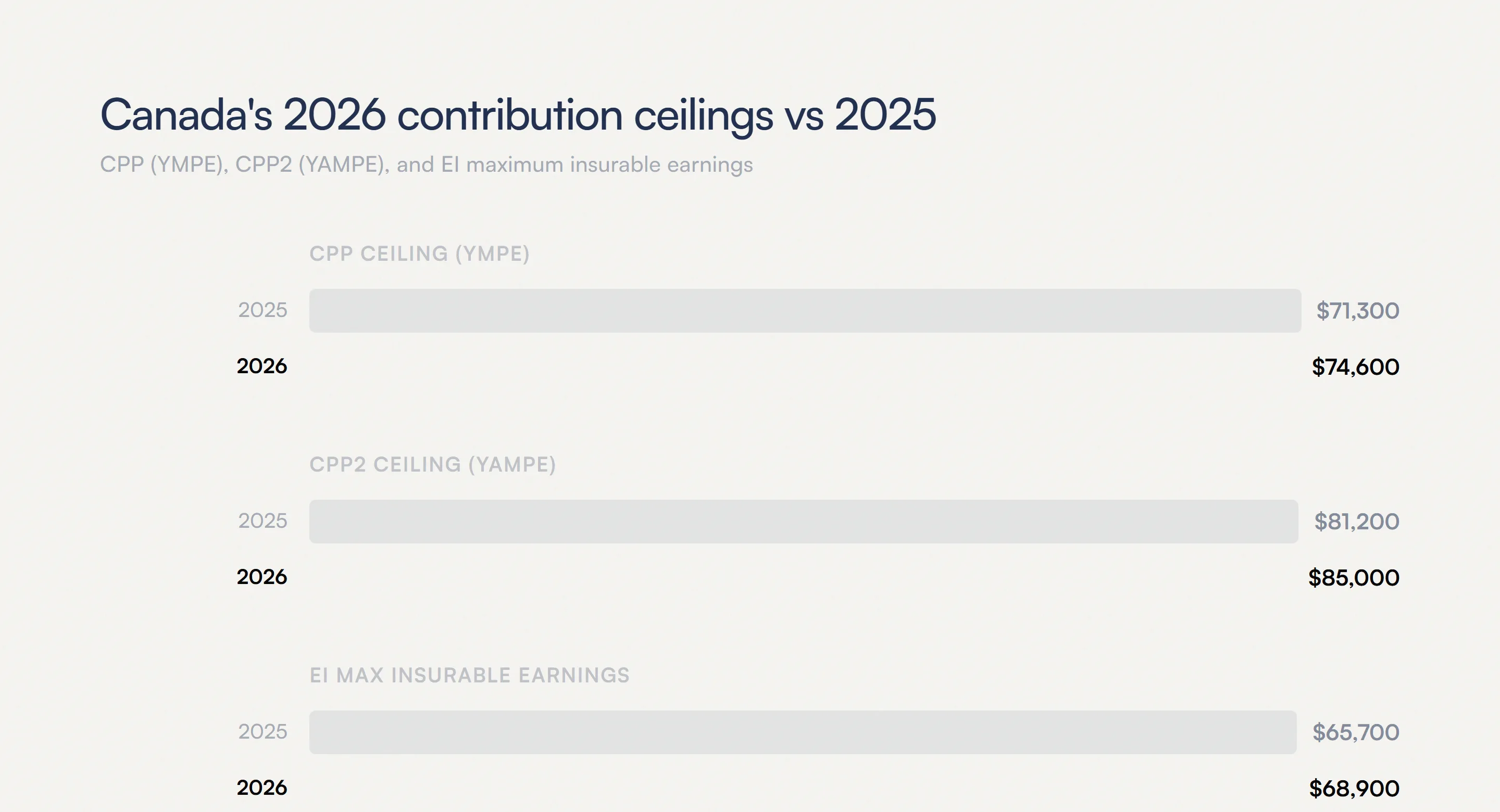
Workzoom applies all three 2026 ceilings in every Canadian pay run. CPP pensionable earnings now cap at $74,600, CPP2 runs to $85,000, and EI insurable earnings stop at $68,900. The employer's job is confirming those figures are loaded in the live system, budgeting the larger match, and briefing anyone above $74,600 before the January deduction restart shrinks their first paycheck.
- The three figures that moved: CPP ceiling (YMPE) $74,600, CPP2 ceiling (YAMPE) $85,000, EI maximum insurable earnings $68,900. All published by the CRA.
- The rates barely moved: CPP holds at 5.95%, CPP2 holds at 4%, EI dipped from 1.64% to 1.63% (Quebec 1.30%). The ceilings are where the money is.
- This guide covers the verification checklist, the per-employee cost math, the January conversation with higher earners, and where software helps versus where it cannot.
- If a ceiling loaded wrong in January, the gap has been compounding every pay run since. Mid-year is the right time to check, not year end.
What are the 2026 payroll changes in Canada?
Three ceilings rose on January 1, 2026. The CRA's CPP contribution table sets the Year's Maximum Pensionable Earnings at $74,600, up $3,300 from $71,300. The basic exemption stays at $3,500 and the rate stays at 5.95%, so the maximum CPP contribution rises to $4,230.45 from each side.
The second ceiling gets less attention and causes more trouble. The CRA's CPP2 table sets the 2026 additional maximum, the YAMPE, at $85,000, up $3,800 from $81,200. CPP2 takes 4% from the employee and 4% from the employer on everything between the two ceilings, a $10,400 band this year, for a maximum of $416 each.
And EI moved too. The CRA's EI premium table puts 2026 maximum insurable earnings at $68,900, up $3,200 from $65,700. The employee rate fell a notch, 1.64% to 1.63%, but the bigger base wins: the maximum employee premium climbs to $1,123.07 and the employer side, at 1.4 times, climbs to $1,572.30. Quebec runs differently on both counts: employees there pay 1.30% EI because the province operates its own parental insurance plan, and QPP applies instead of CPP, with its own published ceilings.
Income-tax rates, basic amounts and some provincial rules also changed for 2026. Review their effective dates separately from CPP and EI ceilings. Our Canada payroll tax rates guide carries the full picture, and the live deductions table keeps every maximum on one page.
The announcement is not the update
Here's the thing. Every payroll lead in the country read some version of those numbers last fall. Reading them changed nothing in the system that cuts the paycheques.
That's not compliance. That's reading.
Compliance is the moment the figure in your live configuration matches the figure in the CRA's table, on the system doing the math, for every pay group. In a hundred payroll conversations we've seen the same pattern: most buyers are stitching together two or three systems that don't share a record, and the new ceiling lands in one of them. The time clock rounds correctly, the HR system knows the new salary, and the payroll engine quietly carries one stale threshold into February. We wrote up the most common version of this, the second ceiling nobody opens, in our CPP2 misconfiguration post.
It gets sharper when the ritual lives in one head. One company we spoke with, a 300-person distributor running payroll across six provinces, had a veteran who carried the January routine from memory for decades. Then they announced their retirement, effective December 31. The successor walks into a January where all three ceilings move and the documentation is a blank page. No checklist. No sense of what normal even looks like. If that sounds familiar, you're not failing. You inherited an undocumented ritual.
So here is the checklist that should outlive any one person. Five steps, once a year, an hour total.
Open the live configuration. Not the vendor bulletin. Confirm $74,600, $85,000, and $68,900 are the figures your system is using right now.
Spot-check one employee per band. Pick someone under $68,900, someone between $74,600 and $85,000, and someone above $85,000. Recalculate their deductions by hand for one pay period. Twenty minutes, three employees, every threshold proven.
Check the restart. Confirm year-to-date counters reset and deductions resumed for everyone who maxed out last year.
Confirm the remittance math followed. Bigger deductions mean bigger remittances. Check CRA’s assigned remitter category and due dates separately from the contribution-rate update. Our CRA remittance guide covers the schedule.
Write it down. The checklist, the figures, the date you verified them, who verified. January 2027 will come with new numbers and possibly a new person.
What one ceiling-level employee now costs
The math is small per line and real at headcount. Take an employee earning $85,000 or more, someone who reaches every ceiling. In 2025 their employer paid at most $4,034.10 in CPP, $396 in CPP2, and $1,508.47 in EI: $5,938.57. In 2026 the same person costs $4,230.45 plus $416 plus $1,572.30: $6,218.75.
Fifty employees at or above the ceilings is roughly $14,000 in new annual employer cost. A hundred is $28,018. None of it appears as a line item anywhere. It surfaces as a payroll expense variance your finance lead asks about in March, and "the CRA moved three ceilings" is a much better answer when you can show the per-employee math.
The employee side moved too. Someone at every ceiling contributes $5,769.52 across CPP, CPP2, and EI in 2026, up $261.94 from 2025. They feel it on one specific payday, and most of them will not know why.
Rates that load themselves
Workzoom applies the CRA's current CPP, CPP2, and EI figures in every Canadian pay run and prepares the filings. Pricing runs $4 to $16 per employee per month with a $400 monthly minimum, no setup fees, month-to-month.
Get a WalkthroughWhy January paycheques shrink, and who asks about it
Every employee who maxed out CPP and EI in 2025 spent the last months of the year taking home more money. Their deductions had stopped. Counters reset in January. CPP and EI can resume on the first pay; CPP2 starts later when cumulative pensionable earnings exceed the current YMPE.
The payroll inbox fills on schedule. Why did my pay drop. Did my raise get reversed. Is this a mistake.
That's not a deduction error. That's the calendar.
The fix costs one paragraph, sent before the first stub of the year: deductions for CPP, CPP2, and EI restart every January, they stop again once employees reach the annual maximums, and this year's maximums are published by the CRA. CPP2 begins only after cumulative pensionable earnings cross the YMPE, so its current-pay amount depends on the pay, year-to-date earnings, and remaining annual maximum.
Here's what's actually going on underneath: payroll earns trust on predictability, not on accuracy alone. A correct deduction that nobody warned anyone about still reads as a mistake. The teams that send the two-line January note field almost nothing. The teams that don't, spend the month explaining the Canada Pension Plan one ticket at a time. The same logic applies at year end, when those deductions have to reconcile to the slip: our T4 guide covers that side.
Where Workzoom fits, and where it does not
Workzoom calculates and applies the current rates and ceilings in every Canadian pay run. The 2026 YMPE, the YAMPE, the EI maximum, the Quebec EI variant, all of it sits in the calculation engine, maintained against the CRA's published tables, and the platform prepares the filings and the bank file when the run closes. That covers Canadian payroll from the first province to the sixth without anyone re-keying a ceiling.
What it does not do is remit for you. The payment to the CRA, the deadlines, and the legal liability stay with the employer. Workzoom does not file with the government on your behalf. And no software can catch an employee assigned to the wrong province of employment, because the system calculates flawlessly against whatever province it was told. The five-step check above stays a human job, even on our platform. It just shrinks from an afternoon to a coffee.
The honest version of the pitch is that software moves the work, it does not delete it. What disappears is the re-keying, the stale threshold hiding in the third system, and the dependence on one person's memory. What remains is an hour of verification a year and the remittance you were always responsible for. We think that trade is the whole point, and at $4 to $16 per employee per month it is a cheap one, but it is a trade, not magic.
Next January the CRA will publish three new figures, and the year after that, three more. The companies that handle it well are not the ones with the best memory. They are the ones where the checklist exists, the system loads the rates itself, and the verification takes an hour because everything lives in one record.
If your January rate check is one person's memory and a sticky note, we should talk. Bring your three test employees to a walkthrough and we will run the math live.
See Workzoom in 30 minutes.
Real product, real questions, no slides. Starts at $4 per employee per month, CAD or USD, with $0 setup fees.
What readers ask after this post on 2026 payroll changes Canada.
Our clients
The teams that run their people on Workzoom.













Workzoom handles HR, payroll, workforce, and talent on one employee record. Book a 30-minute walkthrough.