 Canada
 United States
 Bahamas
 Jamaica
 Trinidad & Tobago
 Antigua & Barbuda
 Barbados
 Anguilla
Payroll Overpayment in Canada: The Complete Fix (2026)

The wire already went out. You're reconciling Thursday's run and there it is: a termination that didn't land in time, and someone who left two weeks ago got a full deposit. Or an employee texts their manager something nobody wants to forward to payroll. "I think my pay is wrong. In a good way." A payroll overpayment has a way of making the whole building look at one desk.
At Workzoom we walk clients through overpayment recovery more often than anyone would like, and the fix is three moves: confirm the amount and the cause in writing, agree on repayment before touching anyone's next cheque, then apply the CRA's rules on net versus gross and the T4. The fix is routine. The panic is optional.
- Why the recovery rules flip depending on which province you're in
- The CRA conditions that decide whether the employee repays net or gross
- What changes when the correction crosses a year-end, and what an amended T4 involves
- The playbook when the overpaid person no longer works for you
- What repeat overpayments are telling you, with Canadian data
Don't Touch the Next Cheque Yet
The instinct is to quietly deduct it from the next pay and move on. Whether that's even legal depends on which province you're standing in.
Ontario's employment standards guidance says a true inadvertent overpayment was never the employee's wages in the first place, so an employer can recover it from a later cheque without written authorization. British Columbia takes the opposite view. Under section 21 of BC's Employment Standards Act, an employer can't unilaterally deduct an overpayment at all. No written consent, no deduction, and your only fallback is a claim.
Same country. Same error. Opposite rules.
Which is exactly why the boring move wins everywhere. Confirm the exact overpayment, gross and net. Confirm the cause: late termination, wrong rate, duplicate hours, a retro change that ran twice. Then get a written repayment agreement regardless of what your province technically allows. Even where a deduction is legal, springing it on someone's grocery money turns a math problem into a trust problem. When the National Payroll Institute asked employed Canadians how disrupted pay would change things, 64% said they would trust their employer less. That trust doesn't come back with the money.
How do you recover a payroll overpayment in Canada?
Once the repayment agreement exists, the mechanics are a decision tree with two branches: what caused the error, and when it gets repaid.
This is where the CRA rules do you a favour, if you know they exist. For an administrative, clerical, or system error, CRA treatment can differ from an amount that changes the employee's entitlement to remuneration. Net versus gross recovery depends on the current CRA election, timing, repayment, and remittance conditions. Use CRA's current correction guidance before calculating a recovery.
If the net-repayment conditions are not met, use the applicable CRA gross-repayment process. A change in entitlement to remuneration has different reporting consequences from an administrative, clerical or system error. Do not assume every repayment reduces the original T4 income or produces a refund of all withholdings.
Separate the repayment calculation from the slip correction. Check the cause of the overpayment, the CRA election and time limits, repayment or arrangement requirements, and whether tax, CPP and EI amounts can be adjusted. A same-year repayment or an already-issued T4 does not by itself decide the treatment. Document the applicable CRA route before amending a slip or adjusting remittances.
| Situation | Next check |
|---|---|
| Clerical, administrative or system error | For the net-repayment election, the business must be operating, no corrected slip must already have removed the overpayment, and repayment or an arrangement plus the election must meet CRA's deadline. |
| Net election unavailable or not chosen | Use the applicable gross-repayment process. Do not assume the same deduction adjustments apply. |
| Changed entitlement to remuneration | Follow the distinct CRA route. The original income and deductions may remain reported, with a repayment letter supporting the employee's tax treatment. |
Use the T4 reporting guide alongside the CRA correction instructions to keep the original payment year and repayment year distinct.
What If They Already Left?
The person who got the money doesn't work for you anymore. You have no cheque to deduct from and no badge to hold hostage.
You still have the same playbook, without a later paycheque to adjust. A clear letter with the amount, the cause, and a proposed repayment plan settles most of these, because most people don't want money that isn't theirs. For the ones who go quiet, you're weighing small claims against write-off, and that's a finance conversation, not a payroll one.
The real lesson from former-employee overpayments is upstream. Nearly every one traces back to a termination that lived in someone's inbox instead of the system that runs the pay.
Why the Same Error Keeps Coming Back
Here's the thing about overpayments. Fixing one is a process. Fixing the third one this year is a diagnosis.
The National Payroll Institute asked 1,550 employed Canadians about pay accuracy in a 2023 Angus Reid survey. 91% said they would look for a new job if their pay was regularly inaccurate. Not late. Inaccurate. And an overpayment is an inaccuracy with a sequel, because the correction reaches into the next cheque too. Employment Hero's 2025 poll shows how common the sequel is: 38% of working Canadians, roughly 7.8 million people, have hit a paycheque error or delay in the past five years.
Your team feels the same math in reverse. Every error means the recovery dance, the CRA mechanics, the careful conversation. Hours of cleanup for seconds of mistake. If the errors are frequent enough that this article feels like a checklist, the signs your payroll system is failing read the same way.
And here's what's actually going on in most repeat cases: the error didn't start in payroll. The rate change sat in a spreadsheet. The termination was approved verbally. The hours lived in one system while the pay ran from another, bridged by a copy-paste on Wednesday nights. That's not a payroll error. That's a systems error that payroll got blamed for.
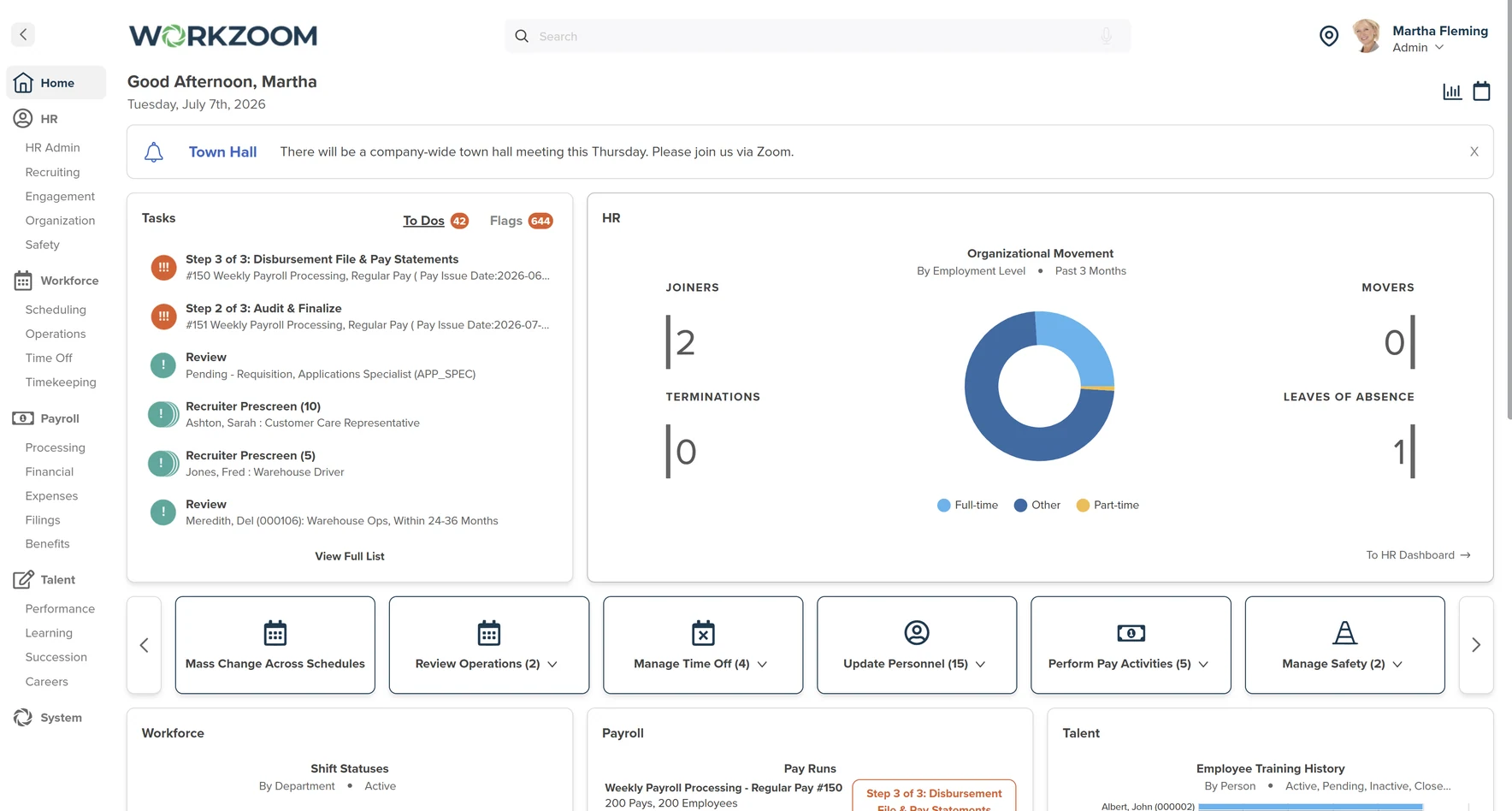
We built Workzoom so the record that hires someone, the record that tracks their time, and the record that pays them are the same record, with every change date-effective. When a termination lands, pay stops. When a rate changes, it changes once. The County of Renfrew, a 900-employee county in Ontario, runs HR and Canadian payroll this way: paper forms, emails, and spreadsheets replaced by one platform, with CRA reporting inside the same system that holds the employee record. The handoffs that create overpayments simply aren't there to fail.
Honest caveat: no software stops a human from keying an extra zero, and we won't pretend otherwise. What a connected system stops is the entire class of overpayments caused by systems that don't talk to each other. In our experience, that's most of them. The rest get caught by comparing this run to the last one before the money moves, which is a habit worth building whatever software you run.
The economics have a floor worth knowing about. Our pricing is $4 per employee per month per suite, $4 to $16 for the full platform, with no setup fees and month-to-month terms. If you're weighing a bigger change anyway, we wrote a separate guide on how to switch payroll providers without dropping a pay run.
If the last three overpayments all started the same way
The problem isn't the person running payroll. It's the handoffs around them. Implementation, data migration, and training are included, and that conversation starts with your process, not our demo script.
Get a WalkthroughFix this one with the playbook above. If there's always a next one, we should talk about why.
See Workzoom in 30 minutes.
Real product, real questions, no slides. Starts at $4 per employee per month, CAD or USD, with $0 setup fees.
What readers ask after this post on payroll overpayment.
Our clients
The teams that run their people on Workzoom.













Workzoom handles HR, payroll, workforce, and talent on one employee record. Book a 30-minute walkthrough.