 Canada
 United States
 Bahamas
 Jamaica
 Trinidad & Tobago
 Antigua & Barbuda
 Barbados
 Anguilla
The HR Compliance Checklist for Canada You Need

An Ontario employer can meet the individual statutory termination-notice schedule and still have other obligations. Ontario statutory severance has a separate eligibility test. Contracts and common-law rights require additional analysis.
What we hear next is some version of the same line: I thought we were following the rules. I didn't realize there were two sets of rules.
That's the sentence that should be printed on every Canadian HR professional's desk. There are always two sets of rules. At least.
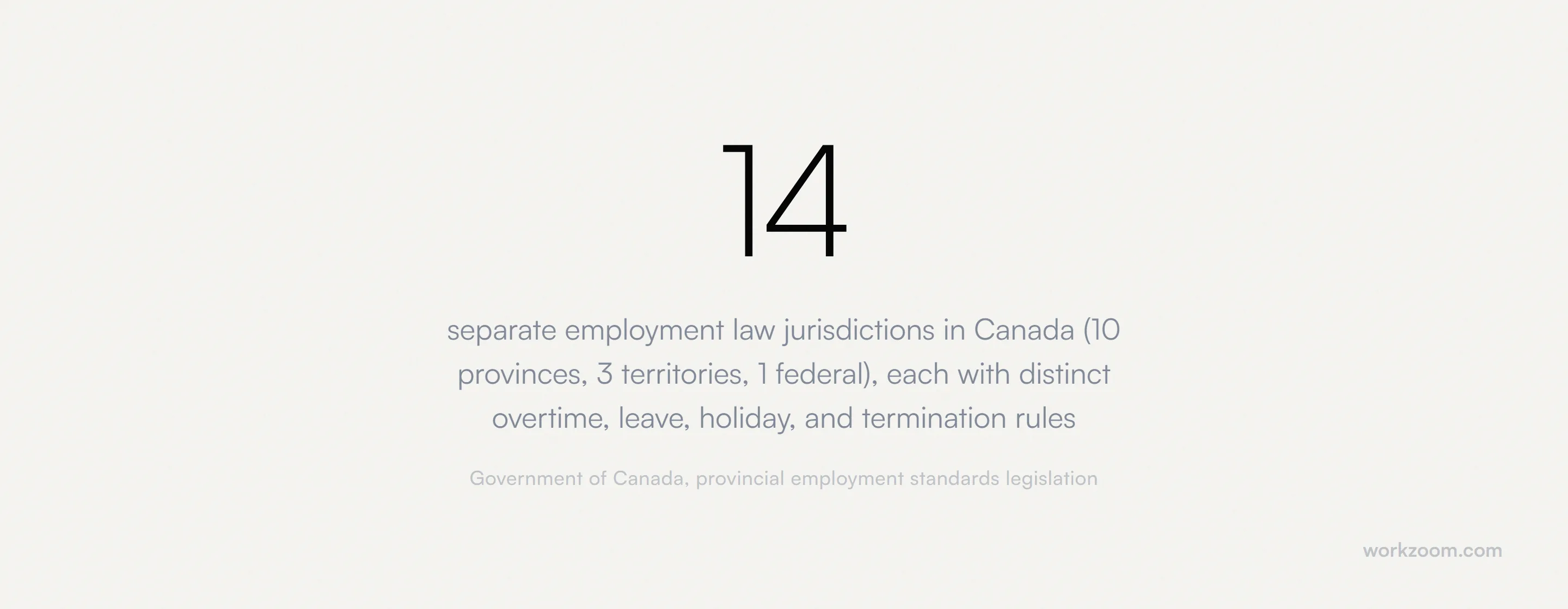
Most employers don't get caught because they ignored the law. They get caught because they followed the wrong copy of it. That's not a knowledge problem. It's a jurisdiction problem, and Canada has fourteen of them.
An HR compliance checklist for Canada needs to cover employment standards, pay equity, privacy, CRA payroll remittances, Service Canada ROEs, and accessibility. Because most employment law is provincial, the specific rules change depending on where employees work, not where the head office sits.
- About 90% of Canadian workers fall under provincial, not federal, employment standards. The rules differ province to province on overtime, leaves, holidays, and termination.
- CRA payroll remittance penalties start at 3% for being one day late and scale to 10% plus compound interest. Getting your remitter type wrong is one of the most common mistakes.
- ROE filing deadlines depend on filing method and pay frequency. Use Service Canada's ROE guide to set the applicable internal deadline.
- PIPEDA and provincial privacy laws govern how you collect, store, and use employee data. Consent requirements are tightening.
- Pay equity, pay transparency, and accessibility compliance are all expanding in scope across provinces through 2026.
Why Compliance in Canada Feels Like a Puzzle With Missing Pieces
Here's what makes Canadian HR compliance uniquely frustrating. Most countries have one set of employment laws. Canada has fourteen. Ten provinces, three territories, and a federal jurisdiction that covers about 6% of the workforce.
And they don't agree on much.
Ontario says overtime kicks in after 44 hours per week. Alberta and BC say 8 hours per day. The federal Canada Labour Code says it depends on whether you've got a modified work schedule. Saskatchewan calculates overtime differently for different industries. Manitoba requires overtime after 8 hours a day but also after 40 hours a week, whichever provides the greater benefit.
That's just overtime. One topic. Now multiply that by leaves of absence, statutory holidays, termination notice, severance pay, vacation accrual, pay frequency requirements, and record-keeping obligations. Each one has provincial variations that trip up even experienced HR teams.
Quite frankly, the system wasn't designed. It evolved. And it evolved in thirteen different directions simultaneously.
The Five Layers of an HR Compliance Checklist for Canada
We've been through enough compliance reviews with Canadian employers to see the pattern. And the pattern we see across our Canadian client base is consistent: the organizations that stay compliant don't try to track every rule individually. They think in layers. Here's the framework we keep coming back to.
Layer 1: Employment Standards (The Foundation)
Every province and territory has an employment standards act. This is the floor. Minimum wage, overtime, hours of work, vacation, public holidays, leaves of absence, termination, and severance. You need to know which act applies to each of your employees based on where they work.
The most common mistake we see: applying head office rules to employees in other provinces. If your company is headquartered in Ontario but you've got three employees in BC, those BC employees are covered by BC's Employment Standards Act. Not Ontario's. It doesn't matter where payroll is processed or where HR sits.
Key areas to audit against your applicable employment standards legislation:
- Overtime thresholds and calculation methods (daily vs. weekly vs. both)
- Vacation entitlement (Ontario: 2 weeks at hire, 3 weeks after 5 years. Saskatchewan: 3 weeks at hire, 4 weeks after 10 years)
- Leave entitlements (sick days, bereavement, family responsibility, domestic violence leave, the list keeps growing)
- Pay frequency and pay statement requirements
- Record retention periods (record-specific periods and start dates, plus separate tax-retention obligations)
Employment standards are the floor, not the ceiling. Additional rights depend on the governing legal regime, contract, collective agreement and facts. Common-law notice is not a fixed number of months per year of service. If you're only budgeting for statutory minimums, your termination costs are going to surprise you.
Layer 2: Pay Equity and Compensation Compliance
This layer has expanded dramatically. Federal pay equity legislation applies to covered federally regulated employers. Confirm whether the employer is subject to the Act and the applicable plan and statement dates. Ontario and Quebec have had pay equity regimes for decades. Ontario's Employment Standards Act job-posting requirements apply to covered publicly advertised postings, with thresholds and exceptions. BC already bans pay history questions.
The checklist here:
- Federal employers: Is your pay equity plan posted and is an annual statement due? Under the federal Act, annual-statement timing depends on when the employer became subject, any valid extension, and the plan-posting date. Subsequent statements are generally due June 30.
- Ontario employers: For publicly advertised Ontario postings, confirm whether the employer has 25 or more Ontario employees and whether an exception applies, including positions with compensation over $200,000. Where the rule applies, the posted range cannot exceed $50,000.
- Quebec employers: Confirm the applicable Quebec pay-equity maintenance obligations and deadlines with CNESST. Do not treat a generic five-year cycle as a national rule.
- All provinces: Do you have documented compensation structures that can withstand scrutiny? Ad hoc pay decisions are becoming a liability.
If pay equity feels like its own separate universe, that's because it practically is. We wrote a full breakdown of the Ontario pay-equity maintenance obligations.
Layer 3: Privacy and Data Protection
PIPEDA governs how you collect, use, and disclose personal information in the course of commercial activity. For federally regulated employers, it covers employee data directly. For provincially regulated employers in most provinces, PIPEDA governs customer and commercial data while employee privacy protections come from common law and employment standards.
Alberta, BC, and Quebec have their own private sector privacy legislation that's been deemed substantially similar to PIPEDA. These provincial laws cover employee information explicitly.
What this means in practice:
- Confirm the legal authority, notice and consent requirements for employee information under the applicable privacy regime. Do not assume every employment-related collection requires consent
- You can only collect information that's reasonably necessary for the employment relationship
- Employees have the right to access their personal information and challenge its accuracy
- You need documented policies for how long you retain data and how you dispose of it
- Data breach notification is mandatory under PIPEDA if there's a real risk of significant harm
The practical gap we see most often: companies that have a privacy policy on their website for customers but nothing governing how they handle employee data internally. Different obligation. Same seriousness.
Layer 4: Payroll Compliance (Where the CRA Gets Involved)
Payroll compliance is where most of the financial risk sits. CRA can assess amounts owing, penalties and interest. Do not rely on receiving a warning before a deadline.
- CPP contributions: Both employer and employee portions. Second ceiling (CPP2) started January 2024 for earnings between the first and second maximums.
- EI premiums: The standard employer EI share is 1.4 times employee premiums, subject to approved reduced-rate arrangements. Quebec has reduced EI premiums and separate QPIP contributions.
- Income tax withholding: Federal and provincial, using the correct TD1 claim codes.
- Remittance deadlines: Based on your remitter type (regular, quarterly, accelerated threshold 1 or 2). Getting your type wrong and remitting late triggers penalties of 3-10% plus daily compound interest.
And then there's the Record of Employment. The ROE deadline depends on filing method and pay frequency. Electronic weekly, biweekly, and semi-monthly payrolls generally use five calendar days after the relevant pay period ends. Monthly and 13-pay-period payrolls use the earlier of that date or 15 calendar days after the interruption begins. Paper ROEs have separate rules. Late ROEs create problems for the employee trying to access EI and problems for the employer when Service Canada comes asking questions.
The version we hear most often on discovery calls goes like this. An employee goes on maternity leave and nobody issues the ROE for three weeks. The employee can apply for EI without waiting for the ROE, but Service Canada still needs the ROE information to process the claim. That is the moment the employer realizes their "system" was one person remembering to do it.
That story repeats everywhere. ROEs are one of those obligations that feels minor until it isn't. If your HR system doesn't trigger ROE generation automatically when an employee's status changes, you're relying on someone remembering. And eventually, someone won't.
Layer 5: Accessibility and Human Rights
The Accessibility for Ontarians with Disabilities Act (AODA) is the most developed provincial accessibility framework, but it's not alone. The federal Accessible Canada Act covers federally regulated employers. Manitoba has The Accessibility for Manitobans Act. Nova Scotia has an accessibility act. More are coming.
Ontario's AODA duties depend on the organization and requirement. For private businesses and nonprofits with 20 or more employees, the current accessibility-report deadline is December 31, 2026. Relevant duties can include:
- File accessibility compliance reports
- Maintain accessible customer service and employment policies
- Provide information and communications in accessible formats
- Meet employment accommodation standards (recruitment, hiring, return to work, performance management)
- Ensure public-facing web content meets WCAG 2.0 Level AA
There is no single January 1, 2025 AODA full-compliance deadline. Private businesses and nonprofits with 20 or more employees must file the 2026 accessibility compliance report by December 31, 2026. Confirm organization-specific standards and reporting duties.
Beyond accessibility legislation, every Canadian employer has human rights obligations under federal or provincial human rights codes. The duty to accommodate to the point of undue hardship applies to disability, religion, family status, and other protected grounds. "We've always done it this way" is not a defence. It never was.
The Part Nobody Talks About: Statutory Holidays
Statutory holidays deserve their own mention because they're one of the most commonly miscalculated compliance items in Canadian payroll. Every province has different holidays. Eligibility rules differ. Premium pay calculations differ.
Ontario has nine public holidays. BC has eleven. Saskatchewan has ten. Alberta has nine but they're not the same nine as Ontario. The federal jurisdiction has ten. And Remembrance Day is a statutory holiday in some provinces, a regular working day in others, and a day where provincial government offices close but private employers aren't required to give time off in yet others.
We put together a full breakdown of statutory holiday pay calculations for 2026 because the number of employers getting this wrong is, in our experience, alarmingly high. Getting holiday pay wrong on one paycheque might cost you $200. Getting it wrong systematically for a year across 150 employees can become a six-figure liability when someone files a complaint.
The biggest compliance risk isn't the rule you've never heard of. It's the rule you think you understand but have been applying incorrectly. Statutory holiday pay, overtime thresholds, and termination notice are the three areas where "close enough" creates the most expensive surprises.
Multi-Province Compliance: Where It Gets Real
If all your employees are in one province, compliance is at least manageable. One employment standards act. One set of holidays. One overtime rule. Painful, but singular.
The moment you hire someone in a second province, the complexity doesn't double. It explodes. Because now you're running two parallel compliance regimes, and they interact in ways that aren't always obvious.
A company headquartered in Alberta with employees in Ontario needs to track two sets of overtime rules, two sets of leave entitlements, two sets of termination requirements, two holiday schedules, and potentially two privacy frameworks. Their BC employee adds a third set. If the employment is federally regulated, identify the applicable federal labour standards instead of treating them as an extra provincial layer.
This is the point where spreadsheets break. Not because spreadsheets can't hold the data, but because nobody maintains thirteen tabs of jurisdiction-specific rules with the kind of precision that keeps you compliant. One missed update to an overtime threshold after a provincial budget announcement, and you're calculating pay wrong for every affected employee until someone notices.
The organizations that handle multi-province compliance well share one trait: they use systems that know the rules by jurisdiction and apply them automatically based on employee work location. Not head office location. Not payroll location. Work location.
Building the Habit, Not Just the Checklist
A checklist is a snapshot. Compliance is continuous. The employers who stay out of trouble don't just audit once a year. They build compliance into their operating rhythm.
What that looks like in practice:
Monthly: Verify payroll remittances against the applicable CRA schedule. Check that ROEs from the prior month met the applicable Service Canada deadline. Review terminations for proper notice and severance documentation.
Quarterly: Review new hires against employment standards for their province. Verify leave entitlements are accruing correctly. Check benefit plan compliance (particularly for provincially mandated coverages).
Annually: Full employment standards audit against each applicable jurisdiction. Review whether a federal pay-equity annual statement is due based on the employer's status and plan date. For Ontario private businesses and nonprofits with 20 or more employees, calendar the December 31, 2026 accessibility-report deadline. Review privacy and legislative changes.
Periodic: Review pay-equity maintenance duties using the applicable federal, Ontario, or Quebec regime. Do not use a generic five-year cycle across jurisdictions. Review the compensation structure when job classes, comparators, or pay practices change.
None of this is glamorous. None of it makes the annual report. But the company that does this consistently is the one that doesn't get the letter from the Ministry of Labour, the assessment from the CRA, or the demand letter from an employment lawyer that makes the CFO's eye twitch.
The Real Risk Isn't the Fine
Compliance failures can produce wage orders, required adjustments, assessments and other remedies under the governing law. Avoid using a single penalty amount to budget for every employer or violation.
The real cost of non-compliance is the time it consumes. The employment lawyer on retainer who's now billing you for something that should have been prevented. The HR manager spending three weeks gathering documentation for a Ministry investigation instead of running a benefits enrollment. The executive team in emergency meetings about a wrongful dismissal claim instead of working on the things that grow the business.
Compliance failures don't just cost money. They cost attention. And attention is the one resource mid-size companies can't afford to waste.
The goal isn't to memorize fourteen rulebooks. The goal is to run compliance as something the system handles in the background, as opposed to something one person holds in their head until the day they forget.
We built Workzoom to handle the jurisdictional complexity that makes Canadian compliance so demanding. Provincial employment standards built into the system. Payroll remittances calculated and tracked automatically. ROE generation triggered by status changes. $4 per employee per month per suite, no implementation fees, month-to-month. Because the cost of staying compliant should be predictable, even if the rules aren't.
See Workzoom in 30 minutes.
Real product, real questions, no slides. Starts at $4 per employee per month, CAD or USD, with $0 setup fees.
What readers ask after this post on HR compliance checklist Canada.
Our clients
The teams that run their people on Workzoom.













Workzoom handles HR, payroll, workforce, and talent on one employee record. Book a 30-minute walkthrough.