 Canada
 United States
 Bahamas
 Jamaica
 Trinidad & Tobago
 Antigua & Barbuda
 Barbados
 Anguilla
Workforce
Workforce management, in plain English.
Book a Workzoom walkthrough → 25+ years of HR and payroll production. Live in Canada, the US, and the Bahamas.
Workforce management covers scheduling, time and attendance, and time off in one place, so the hours an employee works and the hours they're paid for are the same number, computed once instead of reconciled twice.
Read the full answer
Clock-ins from terminals, mobile apps, kiosks, or manual timesheets all feed one approved-hours record. Workzoom connects all three to a single employee record; payroll reads from it separately.
Two numbers that are supposed to be one.
Until they are. That gap, usually found at payday, is what workforce management exists to close. Most mid-market employers name time tracking as their single biggest operational pain. Not payroll calculation. Not benefits administration. Time tracking.
The reason is almost always structure. Scheduling lives in one place. Clock-ins live in another. Time-off requests travel by email or through a separate portal. At the end of a pay period, someone reconciles all three, then types the total into whatever feeds the pay run. Every step is a chance for the number to change.
What workforce management covers.
Workforce management, as a discipline, is the operating layer that runs between "I need staff on Tuesday" and "the pay run is approved." It has three components.
Scheduling. Who works which shift, which role, which location. The published schedule is what makes attendance measurable.
Time and attendance. The actual record of when work started and ended. Clock-ins arrive from wall-mounted terminals, mobile apps, web kiosks, or supervisor-entered manual timesheets, and all of them land in the same attendance ledger.
Accruals, approvals, and balances. Requests submitted by employees, routed to managers for a decision, and posted against a running balance. When time is taken, the balance updates automatically.
The point of bringing all three together is not convenience. It is accuracy. The hours an employee works and the hours they are paid for become the same number, computed once, not reconciled twice.
Mistakes that show up in audits.
- Manual re-entry between time and payroll. A manager approves 80 hours in the time system. Someone types 80 into a payroll spreadsheet. The number changes somewhere in transit. Nobody knows when or why.
- Leave balances calculated outside the system. A single employee record should carry the accrual and the deduction. When balances live in a separate spreadsheet, a missed row or a formula error creates a liability that only appears at termination.
- Clock-in data with no schedule to compare against. Without a schedule, attendance data is a log, not a report. There is no way to flag a two-hour late arrival if the system does not know when the shift was supposed to start.
- Unapproved time cards at period close. Timesheets that sit unsigned get paid as submitted or dropped from the run. Both outcomes are wrong, and both are common.
How Workzoom runs it.
Workzoom's Workforce suite starts with the schedule, and the reason is upstream. A clock-in without a scheduled shift tells you almost nothing. Measured against an expected shift, that same clock-in tells you exactly what you need.
From the schedule, time moves through clock-ins collected across terminals, mobile apps, and kiosks, through manager approval, and directly into the pay run. No export step, no transfer file, no re-entry. The hours live on the same employee record that carries the pay rate, the deduction rules, and the time-off policy.
That is not a workflow integration. That is one system.
Workzoom has been building it this way since 2001, founded by a family that still runs it today. The platform was designed as a single system, not assembled by acquisition. County of Renfrew and Silvera for Seniors use it in Canada. Cable Bahamas uses it in the Bahamas. In every case, the hours approved in Workforce feed the same payroll run that produces the remittance extracts and the EFT file the client's bank submits. One database, one calculation, one approval.
- 2000 Running payroll since Workzoom has run Canadian payroll for 25+ years.
- Canadian data residency AWS Canada (ca-central-1). Canadian customer data stays in Canada.
- SOC 2-aligned controls Encrypted at rest, role-based access, immutable audit logs.
- Trusted in production County of Renfrew, Silvera for Seniors, and Cable Bahamas. Built for 50 to 5,000 employees.
In the product
How Workforce management runs on Workzoom.
Workforce management is part of the Workzoom Workforce Suite. Workzoom runs HR, workforce, and talent on a single employee record across ten countries: Canada, the United States, the Bahamas, Jamaica, Trinidad and Tobago, Barbados, Antigua and Barbuda, Anguilla, the Cayman Islands, and the United Kingdom. Full gross-to-net payroll runs live in Canada, the United States, and the Bahamas. Pricing starts at $4 per employee per suite per month.
Questions about Workforce management
More on Workforce management
Playbooks and teardowns from teams putting it into production.

Best HR Software for Barbados Employers (2026 Guide)
The best HR software for Barbados compliance: Employment Rights Act, NIS, BRA payroll. See how Workzoom handles the Caribbean workforce.
Read article →
Shift Premium Payroll Software for Union Manufacturing
Shift premium payroll software must test seniority and differentials before a grievance surfaces eight weeks late.
Read article →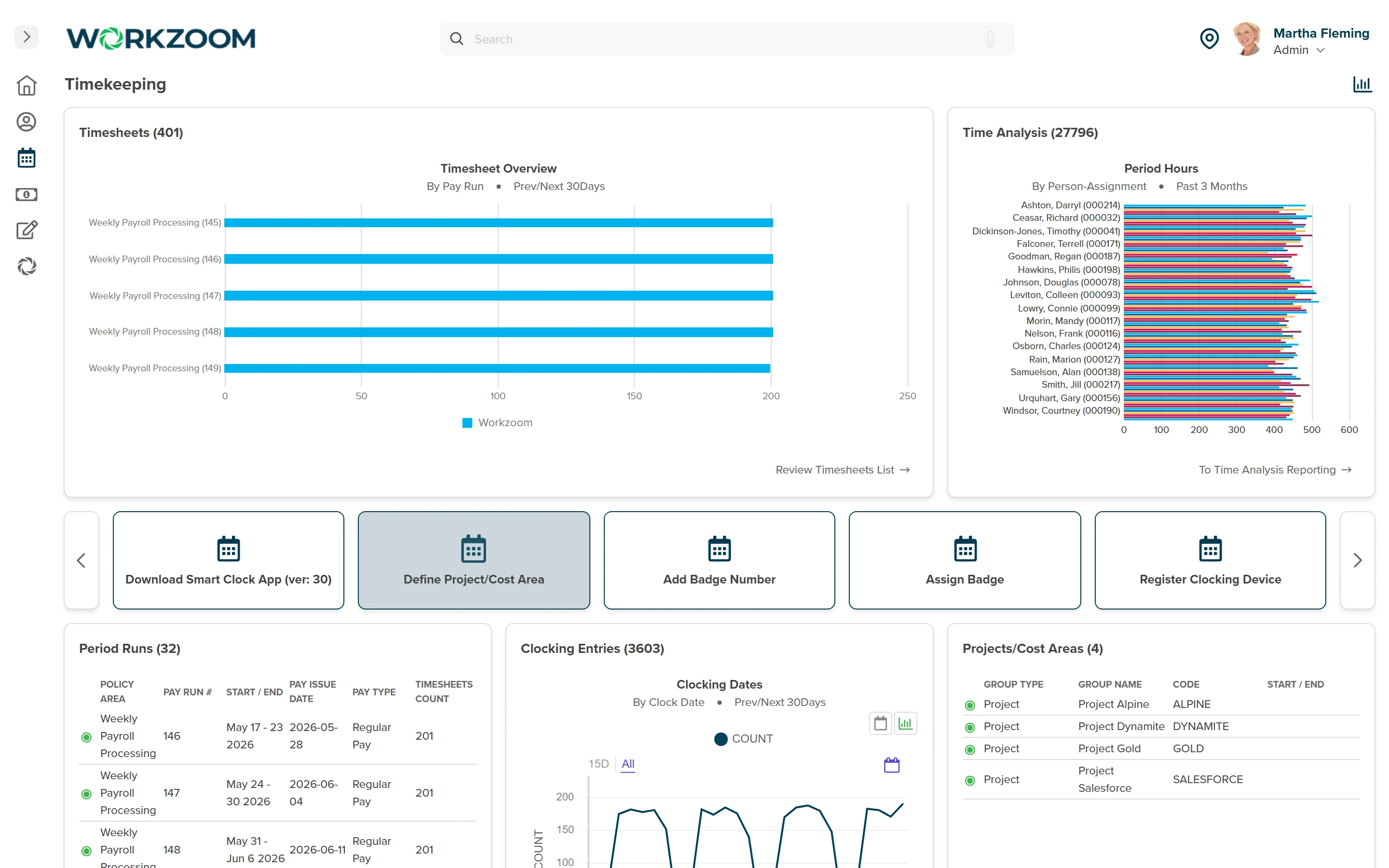
Time Tracking Software in Canada: Compare Payroll Fit
Compare time tracking software in Canada by payroll fit, approvals, overtime rules and total cost. Use practical demo tests before choosing...
Read article →
Canadian Payroll 2026: What Changes When Quebec Joins
Adding a Quebec employee to Canadian payroll changes the EI rate, remittance form and leave entitlement, and this guide names each shift.
Read article →Run HR, payroll, workforce, and talent on one platform.
$4 per employee per suite. 50 to 5,000 employees. Sprint-based, client-paced go-live.