 Canada
 United States
 Bahamas
 Jamaica
 Trinidad & Tobago
 Antigua & Barbuda
 Barbados
 Anguilla
Workforce
Time and attendance, in plain English.
Book a Workzoom walkthrough → 25+ years of HR and payroll production. Live in Canada, the US, and the Bahamas.
Time and attendance is the capture and validation of when employees work.
Read the full answer
It includes clocking, scheduling, breaks, overtime, and approvals. Approved hours flow directly into payroll. Workzoom supports seven clocking methods: employee self-service, the mobile app, a web clock, facial recognition terminals, biometric fingerprint terminals, badge clocking at kiosk stations, and manual timesheet entry, with no exports between time and pay.
How Time and attendance works.
Time and attendance captures when employees worked, applies the rules that turn raw punches into payable time, then hands the result to payroll. The rules layer is where the complexity sits: rounding, grace periods, break deduction, shift differentials, and overtime thresholds that may be daily, weekly, or averaged across a period. Identical punch data produces different pay under different rule sets, which is why the rules configuration matters as much as the clock itself.
Where Time and attendance goes wrong.
- Rounding rules that are lawful in one jurisdiction cause problems when applied to employees working in another, especially for multi-location employers.
- A second issue is timesheets approved after payroll has already calculated, so corrections land a period late instead of in the run they belong to.
- A third is breaks deducted from the schedule by default where the jurisdiction requires evidence the break was taken, which creates exposure in an audit.
- 2000 Running payroll since Workzoom has run Canadian payroll for 25+ years.
- Canadian data residency AWS Canada (ca-central-1). Canadian customer data stays in Canada.
- SOC 2-aligned controls Encrypted at rest, role-based access, immutable audit logs.
- Trusted in production County of Renfrew, Silvera for Seniors, and Cable Bahamas. Built for 50 to 5,000 employees.
In the product
How Time and attendance runs on Workzoom.
Time and attendance is part of the Workzoom Workforce Suite. Workzoom runs HR, workforce, and talent on a single employee record across ten countries: Canada, the United States, the Bahamas, Jamaica, Trinidad and Tobago, Barbados, Antigua and Barbuda, Anguilla, the Cayman Islands, and the United Kingdom. Full gross-to-net payroll runs live in Canada, the United States, and the Bahamas. Pricing starts at $4 per employee per suite per month.
Questions about Time and attendance
More on Time and attendance
Playbooks and teardowns from teams putting it into production.

Best HR Software for Barbados Employers (2026 Guide)
The best HR software for Barbados compliance: Employment Rights Act, NIS, BRA payroll. See how Workzoom handles the Caribbean workforce.
Read article →
Shift Premium Payroll Software for Union Manufacturing
Shift premium payroll software must test seniority and differentials before a grievance surfaces eight weeks late.
Read article →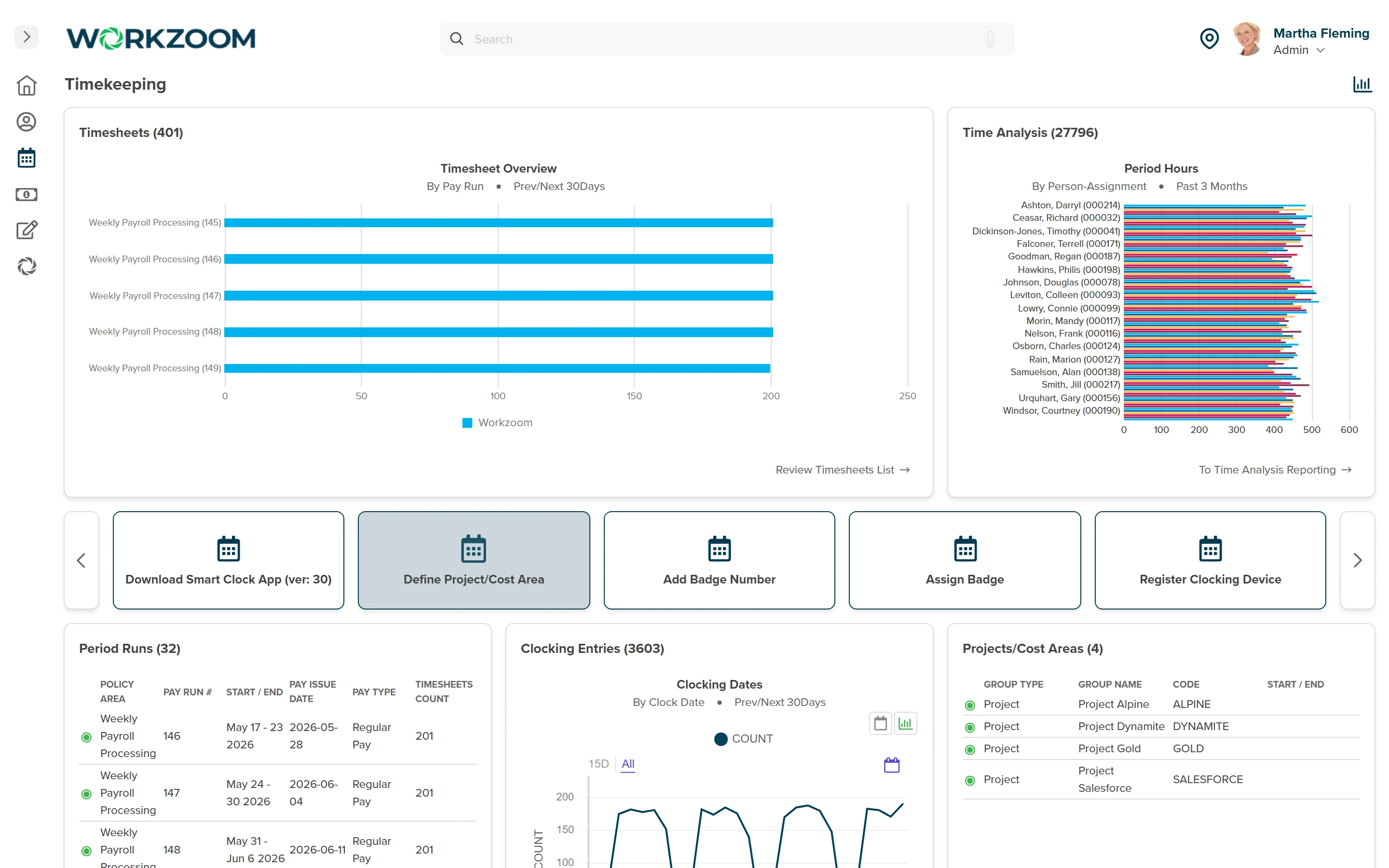
Time Tracking Software in Canada: Compare Payroll Fit
Compare time tracking software in Canada by payroll fit, approvals, overtime rules and total cost. Use practical demo tests before choosing...
Read article →
Canadian Payroll 2026: What Changes When Quebec Joins
Adding a Quebec employee to Canadian payroll changes the EI rate, remittance form and leave entitlement, and this guide names each shift.
Read article →Run HR, payroll, workforce, and talent on one platform.
$4 per employee per suite. 50 to 5,000 employees. Sprint-based, client-paced go-live.