 Canada
 United States
 Bahamas
 Jamaica
 Trinidad & Tobago
 Antigua & Barbuda
 Barbados
 Anguilla
HR Payroll Jamaica: Redundancy Sits on Six Deductions

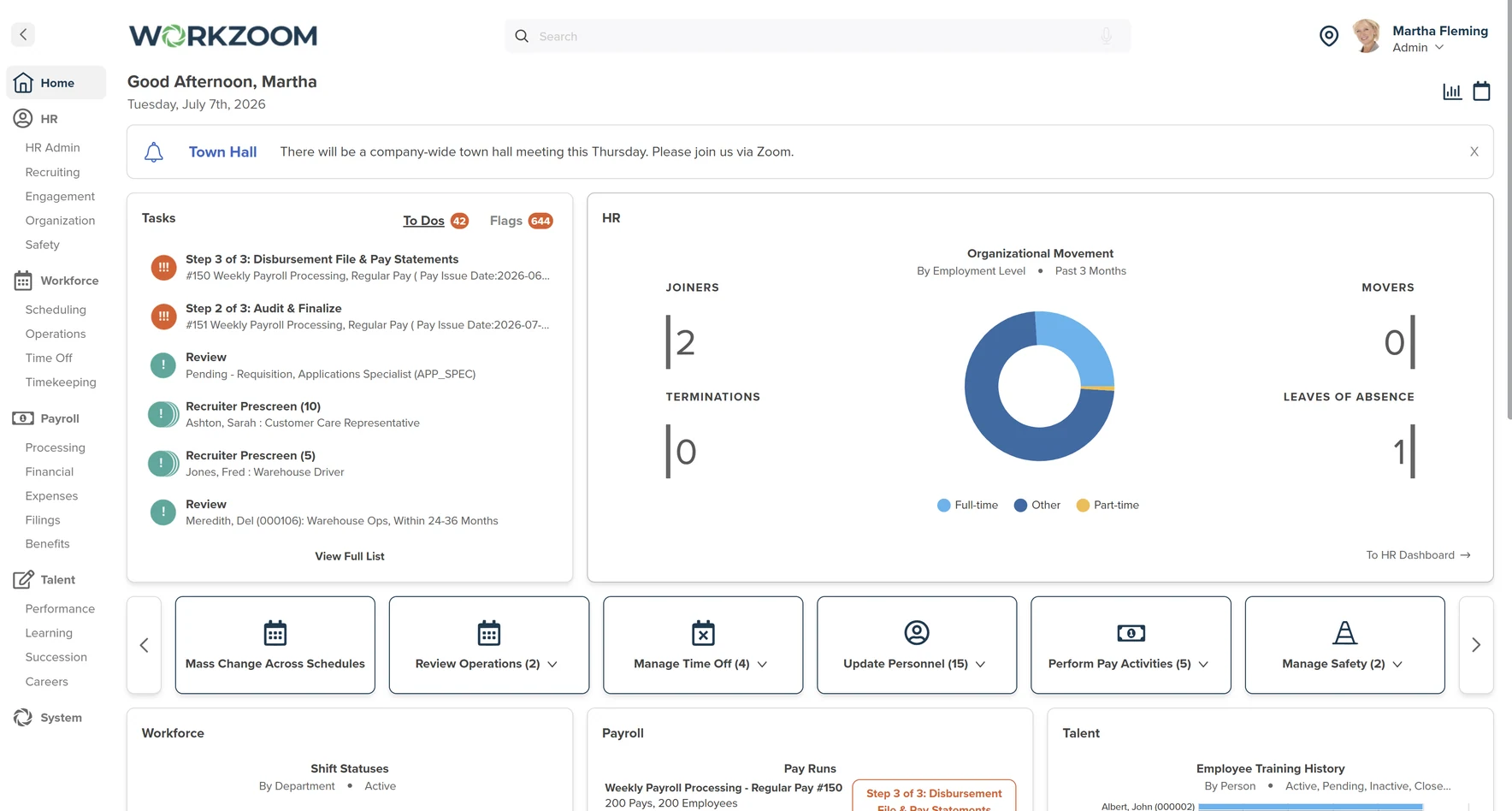
HR and payroll in Jamaica means six statutory deductions running at once: PAYE, NIS, NHT, Education Tax, HEART/NTA, and employee obligations. Miss the math by a fraction of a percent and it compounds across every employee until Tax Administration Jamaica sends the assessment. Workzoom runs HR, Workforce, and Talent for Jamaican employers today, with payroll arriving through its launch partner program.
One late remittance triggers a 25% surcharge from day one, no grace period, on top of six statutory deductions coming off every Jamaican paycheque. Run HR and payroll in Jamaica and you already know the math is half the job. Here is the half nobody writes about. It is keeping the supervisor you trained for two years from walking across town to the firm that offered group health.
HR and payroll in Jamaica means six layered statutory deductions: PAYE income tax, NIS, NHT, Education Tax, HEART/NTA, and other employee-specific duties. Jamaica HR, Workforce, and Talent are available on Workzoom today. Employers must withhold and remit all six deductions correctly. They must also follow the Labour Relations and Industrial Disputes Act for every employment relationship. Statutory leave applies too: vacation, sick leave, and maternity leave. Termination and redundancy follow specific rules. In a mobile workforce, benefits often decide who stays. Get the payroll math wrong, even by a fraction of a percent. The error compounds across every employee and pay period, until Tax Administration Jamaica sends the assessment.
- Jamaica has six mandatory payroll deductions: PAYE (25-30%), NIS (3% + 3%), NHT (2% + 3%), Education Tax (2.25% + 3.5%), HEART/NTA (3% employer only), plus employee-specific duties
- The annual income tax threshold is J$1,799,376 (effective April 2025; rises to J$1,902,360 April 2026). Income above is taxed at 25% up to J$6M, then 30% above that.
- Late remittance penalty: 25% surcharge from day one, plus monthly interest. No grace period.
- Minimum wage is J$13,000/week (effective April 2024). Employers in the hospitality sector face extra service charge rules.
- Total employer-side statutory contribution burden: about 12.5% of gross payroll before any voluntary benefits
HR Payroll Jamaica: The Labour Relations Framework
Several statutes govern employment in Jamaica. The main ones are the Labour Relations and Industrial Disputes Act (LRIDA), the Employment (Termination and Redundancy Payments) Act, the Minimum Wage Act, the Holidays with Pay Act, and the Maternity Leave Act. Some countries cover employment law in one act. Jamaica spreads it across several.
The Ministry of Labour and Social Security oversees enforcement. The Industrial Disputes Tribunal steps in when conciliation fails. The system favours workers more than most employers expect, especially on termination and redundancy.
In practice, you need to get three things right at once. First, the payroll math: six deduction layers. Second, the employment relationship: contracts, leave, and termination procedures. Third, competitive positioning: benefits that retain people. Miss any one. You risk penalties, a lost Tribunal case, or watching your talent walk to the employer who got it right first.
Most Jamaican employers don't lose their best people to higher salaries. They lose them to the firm down the road that offered group health and a clear path up. Compliance keeps you out of the Tribunal. It does nothing for the resignation letter already sitting in someone's drafts. Two different jobs, and most payroll setups only do the first one.
The Deduction Stack: Six Layers on Every Pay Run
We call it the Deduction Stack because that is what it is. Six calculations stack on top of each other, every pay period, for every employee. Each one has its own rate. Each has its own ceiling, or none at all. Each has its own filing deadline and its own penalty. Most employers we talk to get at least one layer wrong.
Key Terms in This Guide
- PAYE: Pay As You Earn, Jamaica's payroll income tax, deducted at source from every paycheque.
- NIS: the National Insurance Scheme, Jamaica's social security program. It covers retirement pensions, sickness benefits, maternity, and injury on the job.
- NHT: the National Housing Trust, which funds housing loans for workers. Every dollar of gross pay owes NHT; there is no ceiling.
- HEART/NTA: the Human Employment and Resource Training Trust, which funds vocational training once monthly payroll passes J$292,300.
PAYE (Pay As You Earn)
Jamaica's income tax structure for 2026:
- Annual tax threshold: J$1,799,376 (effective April 2025; about J$149,948/month tax-free), rising to J$1,902,360 on April 1, 2026. Source: Tax Administration Jamaica
- 25% rate: Income above threshold to J$6,000,000
- 30% rate: Income exceeding J$6,000,000
The threshold is the number employers get wrong most often. This happens most with irregular earnings, bonuses, or a salary change mid-year. The classic mistake: treating each pay period alone instead of looking at the whole year.
NIS (National Insurance Scheme)
Employee: 3%. Employer: 3%. Total: 6%. Ceiling: J$5,000,000/year. The NIS covers retirement pensions, sickness benefits, maternity, and injury on the job. Register new hires right away. Say someone starts on Monday and gets injured on Wednesday, before you have registered them. You are personally liable for the benefits they would have received.
NHT (National Housing Trust)
Employee: 2%. Employer: 3%. There is no earnings ceiling: every dollar of gross pay owes NHT. Some employers apply the NIS ceiling to NHT by mistake. That is a common error, and it means under-remitting. The assessment that follows includes back payments plus penalties.
Education Tax
Employee: 2.25%. Employer: 3.5%. No ceiling. The uneven rates trip people up. Picture someone building a deductions spreadsheet at 11 PM. Those two rates get swapped, or flattened into one blended number. That is how errors start.
HEART/NTA Levy
Employer only: 3%. It applies once monthly payroll exceeds J$292,300. Nobody sends you a letter when you cross that line. Growing from 10 employees to 15 can trigger this obligation quietly.
Our Jamaica payroll compliance guide breaks down each deduction layer in detail. It covers filing deadlines, penalty math, and the spreadsheet mistakes that turn into large TAJ back-assessments.
Filing Deadlines and Penalties
All statutory deductions are due by the 14th of the month following the pay period. Tax Administration Jamaica doesn't send gentle reminders. The penalty structure is designed to hurt:
- Late filing surcharge: 25% of the outstanding amount, from day one
- Interest: Accrues monthly on the unpaid balance
- Prosecution: Persistent non-compliance can result in criminal charges under the Revenue Administration Act
Twenty-five percent. Immediately. No grace period. Compare that to the Bahamas (10% NIB surcharge) or Canada (3% for amounts 1-3 days late). Jamaica's penalty regime is among the steepest in the Caribbean.
Minimum Wage and Employment Terms
The national minimum wage in Jamaica is J$13,000 per week, effective April 2024, up from J$9,000. For security guards, it is J$13,500. The Minister of Labour reviews these rates from time to time. The trend keeps going up.
Employment contracts in Jamaica should be in writing. They should cover job title and duties, pay and pay frequency, working hours, leave entitlements, notice period, and any probation terms. The law does not require a written contract for every employee. But skipping one creates ambiguity. That ambiguity almost always works against the employer in a dispute.
Leave Entitlements
Vacation Leave
Under the Holidays with Pay Act, employees earn paid vacation after 12 months of continuous work. The minimum is 2 working weeks, or 10 days, per year. If you terminate someone who has not taken their accrued vacation, the employer's statutory obligation is to pay that vacation in lieu.
Sick Leave
Most employers provide 10 to 14 days of paid sick leave per year. A medical certificate is required after two days in a row. NIS pays a sickness benefit to insured workers from the fourth day of illness, for up to 26 weeks. That benefit supplements the employer's sick leave. It does not replace it.
Maternity Leave
The Maternity Leave Act guarantees a minimum of 12 weeks of maternity leave, with at least 8 weeks after delivery. Employees qualify after 12 months of continuous service. Employers must pay at least the regular rate for the first 8 weeks. NIS also pays a maternity allowance to insured women.
Dismissing someone because of pregnancy will generate a claim under the Employment (Termination and Redundancy Payments) Act. Don't do it. And don't attempt the "restructuring" version either.
Termination and Redundancy
Jamaica's Employment (Termination and Redundancy Payments) Act sets specific rules for ending employment. It draws a clear line between the two. Termination is individual. Redundancy is a role being eliminated.
Notice Periods
Notice periods depend on pay frequency and length of service:
- Less than 5 years (weekly paid): 2 weeks' notice
- 5 to 10 years (weekly paid): 4 weeks' notice
- 10 to 15 years (weekly paid): 6 weeks' notice
- 15 to 20 years (weekly paid): 8 weeks' notice
- 20+ years (weekly paid): 12 weeks' notice
Monthly paid employees have different scales. Pay in lieu of notice is permitted but must include the full compensation package.
Redundancy Payments
When a role is genuinely eliminated, employees with 2 or more years of service earn redundancy pay:
- 2 to 10 years: 2 weeks' pay per year of service
- 10 to 20 years: 3 weeks' pay per year
- 20+ years: additional weeks calculated on a sliding scale
The employer must show the redundancy is real. Say you "restructure" someone out of a role. Then you hire a replacement for that same position a few months later. That counts as unfair dismissal, not redundancy.
Beyond Compliance: The Benefits Gap
Here is where Jamaica's HR landscape gets interesting. The statutory floor is already high. Employer contributions run about 12.5%, before you add a single dollar of voluntary benefits. But that floor does not set you apart. Every employer in Kingston meets the same rules, because the law demands it.
Employers who win the talent game offer more. Group health insurance sets employers apart the most. Only about 20% of private-sector workers in Jamaica get health coverage from their employer. Offer it, and you are instantly in a different category. Extra pension plans, training budgets, and flexible work round out what competitive employers are doing.
Our Jamaica employee benefits guide covers the three-tier "Benefits Ladder" framework: statutory floor, competitive middle, and employer-of-choice. Real cost numbers included for each tier.
Jamaica HR, Workforce, and Talent, available on Workzoom
HR, Workforce, and Talent are available for Jamaica employers. The payroll engine is capable of handling Jamaica's statutory stack and has been validated against real payroll cycles. If payroll is part of your evaluation, bring it to your walkthrough. $4/employee/month, no implementation fees, no contracts.
Book a 30-Minute WalkthroughChoosing HR Software for Jamaica
Many HR platforms claim Caribbean coverage. Few handle Jamaica's six-layer Deduction Stack natively. Here is the real test. Does the system handle PAYE, NIS, NHT, Education Tax, and HEART/NTA on their own, with the right rates and ceilings for each? Does it generate remittance reports that match what Tax Administration Jamaica expects?
If any step means opening a spreadsheet and typing in a number, you are carrying risk. Our HR software guide for Jamaica evaluates platforms on exactly this: their ability to handle it.
Operating Across the Caribbean
Employers running operations in Jamaica and other Caribbean markets face more complexity. Jamaica's NIS system, the Bahamas' NIB system, and Trinidad's NIS all calculate differently. The penalty structures differ. The filing deadlines differ. The leave entitlements and termination rules differ.
The Bahamas, for example, runs a different overtime system, with daily and weekly triggers at different multipliers. It also has its own NIB contribution rules. Run parallel payroll on disconnected systems across borders, and errors compound.
Cable Bahamas is an 850-employee telecom operating across the Bahamas. It cut payroll processing time by 70% with Workzoom, from 5 days to 1.5 days. A 3-person payroll team now handles close to 1,000 people. Island Luck is an 850-employee gaming operator running 60-plus locations across the Bahamas. It runs 8 separate payrolls per week on the same platform. Both are Bahamas clients, not Jamaica clients. But the parallel for Jamaica employers holds: the six-layer deduction stack is not a spreadsheet problem. It is a system problem.
What's Ahead for Jamaica Employment Law
The Jamaican government has been signalling several changes to the labour framework:
- Potential minimum wage adjustments following the April 2024 increase
- Expanded parental leave provisions beyond the current maternity framework
- Updates to the NIS contribution ceiling to reflect wage growth
- Alignment with ILO conventions on workplace protections and occupational safety
- Possible digital filing mandates for all statutory remittances
The direction is the same across the Caribbean: worker protections expand, contribution obligations grow, and enforcement gets more digital and immediate. Employers who handle these changes well are the ones whose systems adapt to new rates and rules. Nobody has to rebuild a spreadsheet by hand.
That BPO in Kingston eventually overhauled its benefits package. It added group health. It started a training budget. Turnover dropped by a third within two quarters. But the 11 people it had already lost were not coming back. The lesson: in Jamaica, compliance gets you to the starting line. What you do beyond the statutory minimum decides whether you keep the people you have trained.
Jamaica's HR and payroll landscape combines steep compliance rules, six deduction layers, and 25% late penalties, with specific termination rules. It also has a competitive talent market, where benefits matter as much as the payroll math. Employers who succeed treat compliance as infrastructure and benefits as strategy. The ones who struggle treat both as an afterthought.
See Workzoom in 30 minutes.
Real product, real questions, no slides. Starts at $4 per employee per month, CAD or USD, with $0 setup fees.
What readers ask after this post on HR payroll Jamaica.
Our clients
The teams that run their people on Workzoom.













Workzoom handles HR, payroll, workforce, and talent on one employee record. Book a 30-minute walkthrough.