 Canada
 United States
 Bahamas
 Jamaica
 Trinidad & Tobago
 Antigua & Barbuda
 Barbados
 Anguilla
HR Software Trinidad and Tobago: Three Ways to Get Fined

The best HR software for Trinidad and Tobago employers handles NIS band calculations at the new 16.2% rate, automates PAYE with the correct NIS deduction sequence, tracks leave against T&T-specific qualifying rules like the 220-day threshold for vacation, and manages all 14 statutory public holidays with double-time pay. Look for a platform with pre-built Caribbean compliance rather than a US or UK system you will need to configure yourself.
HR Software Trinidad and Tobago: The Employment Laws That Govern Every T&T Workplace
Before we get into payroll specifics, every employer in Trinidad and Tobago needs a working understanding of the statutes that shape the employment relationship. Getting payroll right means nothing if you are violating the laws that govern how you hire, manage, and separate employees.
The Industrial Relations Act
This is the foundation of labour relations in T&T. It governs union recognition, collective bargaining, and the resolution of trade disputes. The Industrial Court, established under this Act, has the authority to hear and determine trade disputes, interpret collective agreements, and make binding orders.
For non-unionized employers, the Act still matters. It defines what constitutes an unfair labour practice, sets out procedures for recognition of trade unions, and establishes the framework for how workplace disputes are resolved. If a group of your employees decides to seek union representation, this Act dictates every step of that process.
The Minimum Wages Act
The national minimum wage in Trinidad and Tobago is TT$20.50 per hour, effective December 2023. For a standard 40-hour work week, that translates to TT$820/week or approximately TT$3,553/month.
The minimum wage applies across all sectors. There are no separate rates for hospitality, retail, or agriculture. If you have employees earning near the floor, your payroll system needs to flag any calculation that would drop someone below TT$20.50/hour when you factor in overtime averaging or irregular schedules.
The Maternity Protection Act
Female employees are entitled to 14 weeks of paid maternity leave after one year of continuous employment. The leave can be split before and after delivery, with a minimum of six weeks taken after the birth. During maternity leave, the employee receives her full pay.
The Act also provides job protection. An employer cannot terminate a woman because of her pregnancy, and she has the right to return to her position (or a comparable one) after maternity leave. Violating these protections leads to claims before the Industrial Court.
The Retrenchment and Severance Benefits Act
This Act governs what happens when you need to reduce your workforce. If you are terminating employees due to redundancy, the rules are specific and the penalties for non-compliance are real.
Key requirements:
- Written notice to the Minister of Labour at least 45 days before planned retrenchments
- Last in, first out (LIFO) within each job category, unless you can justify a different approach
- Severance pay: generally two weeks' pay per year of continuous service for employees with one or more years of tenure
- Consultation: if employees are unionized, the employer must consult with the recognized union before proceeding
An employer with 75 employees who needs to retrench 10 people, each averaging 8 years of service and earning TT$5,000/month, is looking at approximately TT$200,000 in severance alone. That is before legal costs if anyone disputes the process.
The Occupational Safety and Health Act
This Act requires employers to ensure the health, safety, and welfare of all employees at work. It mandates risk assessments, safety committees for workplaces above a certain size, and reporting of workplace injuries. Penalties for non-compliance include fines and, in serious cases, criminal prosecution.
Employment Contracts: What the Law Expects
T&T does not have a single statute mandating written employment contracts in all cases, but the common law position and various Acts create strong expectations. In practice, every employer should provide written terms of employment covering:
- Job title and description of duties
- Start date and whether the position is permanent, temporary, or fixed-term
- Compensation, including base pay, overtime rates, and any allowances
- Working hours and days
- Leave entitlements (vacation, sick, maternity)
- Notice period for termination
- Any probationary period and its terms
Without written terms, disputes default to the employee's version of events more often than employers would like. The Industrial Court has consistently ruled in favour of employees when employers cannot produce written documentation of agreed terms.
The NIS Increase Nobody Was Ready For
On January 5, 2026, the NIBTT raised NIS contributions from 13.2% to 16.2%. For an employer with 200 people, that is tens of thousands of extra dollars per year in remittances that need to be calculated correctly, deducted properly, and filed on time.
And it is only the first half. Another 3% increase lands in January 2027, bringing the total to 19.2%.
If your payroll operation still runs on spreadsheets or a patchwork of disconnected tools, this is the kind of regulatory change that breaks things. Not because the math is hard. Because getting it wrong compounds fast when the NIBTT comes looking.
A half-percent miscalculation across 100 employees over 12 months does not stay small. It multiplies. And every rate increase raises the stakes on every existing gap in your process.
Three Deductions. Three Ways to Get Fined.
Trinidad and Tobago payroll compliance comes down to three mandatory deductions. They sound simple. The sequencing is where employers trip up.
NIS Contributions (16.2%, Rising to 19.2%)
The NIBTT uses weekly earnings bands, not a flat percentage of gross pay. Each band has a fixed contribution amount, split two-thirds employer and one-third employee. Maximum insurable earnings are capped at TT$13,600/month.
If your payroll treats NIS as a simple percentage calculation, it is getting the numbers wrong. The band system means every employee's deduction depends on which earnings bracket they fall into, and those brackets shift when rates change.
PAYE Income Tax
Two brackets: 25% up to TT$1 million chargeable income, 30% above. Personal allowance is TT$90,000/year.
Here is the catch most people miss. Seventy percent of an employee's NIS contribution is tax-deductible. That means your PAYE calculation must account for the NIS deduction before determining taxable income. Get that sequence wrong and you are either over-deducting from employees or under-remitting to the BIR. Neither ends well.
Health Surcharge
TT$8.25/week for employees earning over TT$469.99/month, TT$4.80/week for everyone else. Small number. Still a line item auditors will check.
All three must be remitted to the Board of Inland Revenue (BIR) by the 15th of the month following the pay period. No exceptions. The BIR also requires employers to file annual PAYE returns (the TD4 form) summarizing all employee earnings and deductions for the year. Late filing attracts penalties, and persistent non-compliance can result in prosecution.
Overtime: The Rules Most Employers Get Wrong
Overtime in Trinidad and Tobago is not a flat time-and-a-half across the board. The rules have tiers, and the rates depend on when the overtime is worked.
| Overtime Type | Rate |
|---|---|
| Weekday overtime (beyond 40 hours/week) | 150% of normal rate |
| Overtime beyond 4 extra hours in a day | 200% of normal rate |
| Sunday work | 200% of normal rate |
| Public holiday work | 200% of normal rate + a day off in lieu |
For shift workers and operations that run 24/7, calculating overtime correctly is a genuine challenge. An employee who works 48 hours in a week, including 4 hours on a Sunday, has three different rate calculations in a single pay period: regular time for the first 40 hours, 150% for the weekday overtime, and 200% for the Sunday hours.
If your payroll system cannot handle tiered overtime with day-of-week awareness, you are either overpaying (which your finance team will eventually notice) or underpaying (which your employees and the Industrial Court will notice first).
The 220-Day Rule and Other Leave Traps
This is where generic HR software fails hardest.
Trinidad and Tobago's leave entitlements come with qualifying conditions that platforms built for the US or UK simply do not understand. An employee qualifies for 14 days of paid vacation after one year of continuous employment, but only if they have worked at least 220 days in that year. Your system either tracks qualifying days against the 220-day threshold or it does not. There is no halfway.
Sick leave: 14 days after six months. Maternity leave: 14 weeks after one year (per the Maternity Protection Act). Straightforward rules, but rules your platform needs to enforce automatically.
Then there are the public holidays. T&T observes 17 per year, reflecting the country's cultural and religious diversity: Carnival Monday and Tuesday, Divali, Eid-ul-Fitr, Indian Arrival Day, Emancipation Day, and more. If an employee works a public holiday, they get double pay plus a day off in lieu. Your HR system needs to know which days are public holidays in T&T (not Canada, not the US) and calculate the premium pay automatically.
If you are evaluating HR software, test the leave module first. Ask the vendor: does your system track the 220-day qualifying period? Can it calculate double-time plus lieu days for T&T public holidays? If they hesitate, that tells you everything about how seriously they take Caribbean compliance. Similar issues come up across the region, as employers in the Bahamas dealing with NIB compliance and Antigua navigating local labour law can confirm.
Termination: Where the Money Goes
Letting someone go in Trinidad and Tobago requires more than a conversation and a final cheque. The process depends on the reason for termination, and the financial exposure varies accordingly.
Termination for Cause
If an employee is dismissed for misconduct or poor performance, the employer must be able to demonstrate just cause. This means documented warnings, a fair investigation, and an opportunity for the employee to respond. The Industrial Court regularly reinstates employees with back pay when employers cannot demonstrate a proper disciplinary process.
Termination Without Cause (Retrenchment)
Redundancy triggers the Retrenchment and Severance Benefits Act. The 45-day notice to the Minister, LIFO selection, and severance calculations all apply. For a company with long-tenure employees, the severance bill adds up fast.
Example: 5 employees retrenched, each with 12 years of service and earning TT$6,000/month. At two weeks per year of service, severance per employee is approximately TT$36,000. Total: TT$180,000, before any legal or administrative costs.
Notice Periods
Where no collective agreement or individual contract specifies a notice period, reasonable notice applies. Courts in T&T have interpreted "reasonable" based on the employee's role, seniority, and length of service. For senior employees with long tenure, reasonable notice can extend to several months.
Board of Inland Revenue: Filing Obligations
Beyond monthly PAYE remittances, employers in Trinidad and Tobago have several obligations to the BIR:
- Monthly PAYE and Health Surcharge remittance by the 15th of the following month
- Monthly NIS remittance to the NIBTT by the 14th of the following month
- Annual TD4 returns summarizing each employee's earnings, deductions, and tax withheld for the calendar year
- Business Levy for companies with gross revenue exceeding TT$360,000 per year (0.6% of gross revenue)
- Green Fund Levy of 0.3% on gross revenue for all companies
The BIR has been tightening enforcement. Electronic filing is now expected for larger employers, and the penalties for late or incorrect returns have increased. If your payroll process cannot produce a clean TD4 at year-end without days of manual reconciliation, that is a problem that only gets worse as your headcount grows.
The Real Cost of Spreadsheet Payroll
Spreadsheets work fine at 10 employees. Maybe even 25. But somewhere between 30 and 50, the manual approach starts generating errors faster than anyone can catch them.
Do the math on what your payroll clerk is doing every cycle:
NIS band lookups for 50 employees. Leave balances that drift when someone forgets to log a sick day. Overtime tier calculations across shift workers for a full month. Employee records scattered across email threads, paper files, and personal folders.
When an audit arrives, reconstructing a complete employee file takes days. The NIBTT has authority to audit employer records, assess back-contributions, and apply penalties. At the new 16.2% rate, the dollar value of any miscalculation got larger.
Why the Status Quo Got More Expensive
Finance Minister Davendranath Tancoo has been clear: the changes are necessary because NIS benefit recipients are growing while the contributor pool shrinks. For employers, this means payroll costs are climbing and not coming back down.
At 16.2%, employers bear roughly 10.8% of insurable earnings. Next year, that climbs to approximately 12.8%. Every manual process that barely kept up at the old rate is now running at a deficit.
Your employees feel it too. The 2026 adjustment represents a 23% increase in what employees pay out of pocket. Higher earners could see monthly deductions jump by up to TT$271.70 by 2027. When pay stubs look wrong, or when employees cannot verify their own deductions, you spend time fielding questions instead of running the business.
This is the same pattern we see everywhere. In our experience, the signs of a failing payroll system show up gradually, then all at once when regulations change and the old process cannot keep up.
The Five-Question Vendor Test
Not all HR platforms are capable of handling Caribbean payroll. Many global names treat the region as an afterthought, which means you end up doing the localization yourself. Here is a framework for cutting through the sales pitch.
Question 1: When the NIS rate changed on January 5, 2026, did your system update automatically? If the vendor says "we provide the tools for you to update rates," that is vendor-speak for "you do it yourself." Pre-built compliance means the update happens without you lifting a finger.
Question 2: How does your system handle NIS earnings bands? A flat-percentage calculation is wrong. The system needs to map each employee's earnings to the correct NIBTT band and apply the corresponding fixed contribution. If the vendor does not know what NIS bands are, walk away.
Question 3: Does your PAYE calculation account for the NIS deduction sequence? Remember: 70% of the employee's NIS contribution is tax-deductible before calculating PAYE. Systems that apply PAYE to gross pay without this step are over-deducting from your employees.
Question 4: Can you show me the 220-day qualifying period for vacation leave? If the leave module does not track qualifying days, it is not built for T&T. End of conversation.
Question 5: What happens when I need to run payroll across multiple countries? If you have operations in T&T plus Canada, the Bahamas, or elsewhere, you need one platform that handles all jurisdictions natively. Running separate systems for each country creates exactly the kind of data silos that make consolidation worth the effort.
Any vendor who cannot answer these five questions with specific T&T examples is selling you a generic platform and hoping you will do the hard part.
What Matters When You Are Choosing
The platforms that work in T&T share a few traits. They have pre-built compliance rules that update when regulations change, not rate tables you maintain yourself. They handle multi-country payroll from a single employee record instead of forcing you to maintain parallel systems. They produce audit-ready records at the push of a button, not after days of file reconstruction.
Cable Bahamas, a roughly 850-person telecom operation in the Bahamas, cut payroll processing from 5 days to 1.5 days, a 70% reduction, after consolidating to a single platform. That is a Bahamas result, not a T&T result, and that distinction matters. The mechanism, one employee record, no cross-system reconciliation, applies to any multi-territory Caribbean operation.
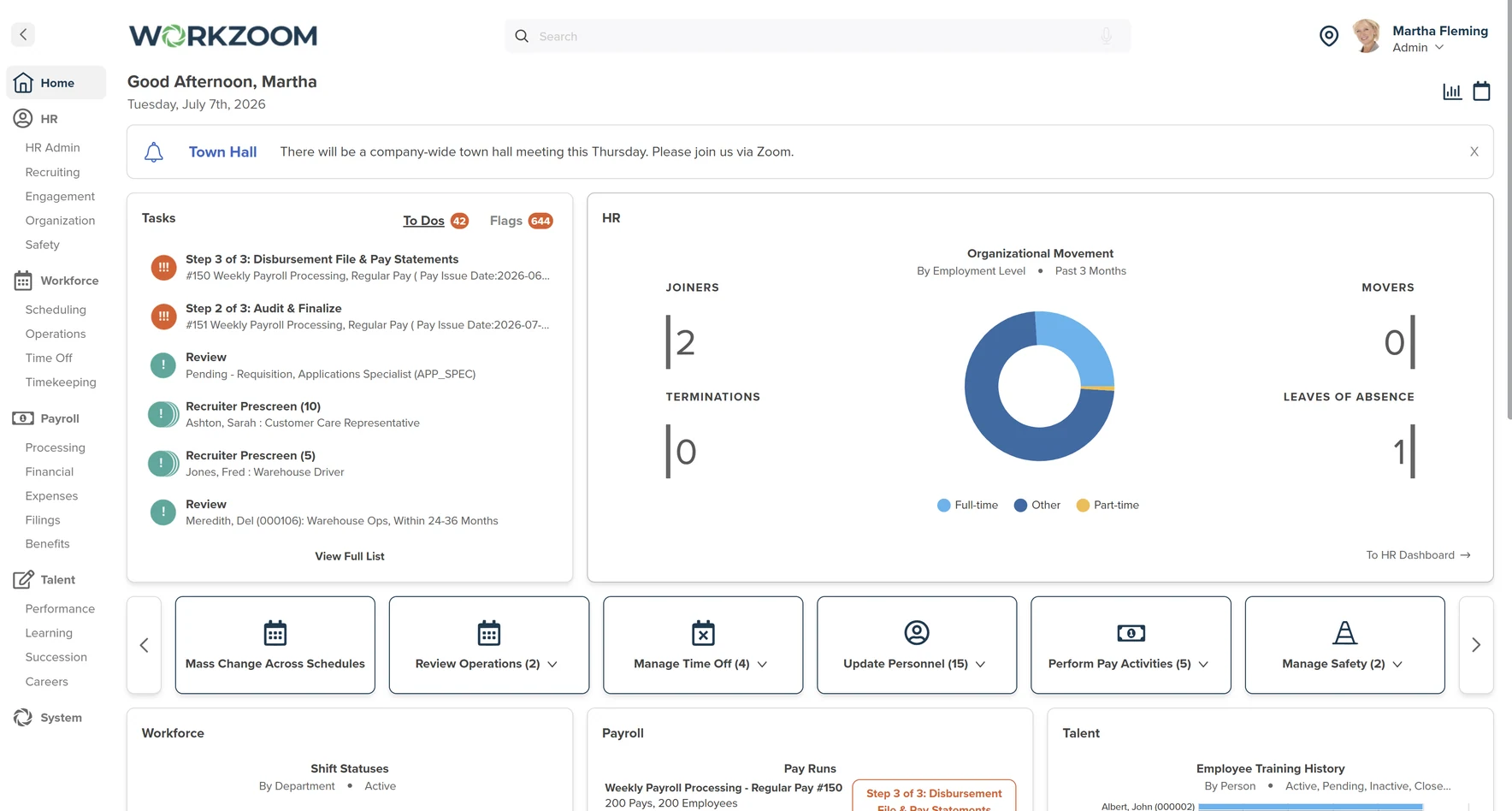
Workzoom handles HR, Workforce, and Talent for T&T employers today. The payroll engine is capable of handling T&T's statutory stack, validated against real payroll cycles, covering the NIS band engine, PAYE sequencing, Health Surcharge, and TD4 generation. If payroll is part of your evaluation, bring it to your walkthrough and we will tell you honestly whether the timing works for your rollout. $4 per employee per month, no implementation fees, no annual contracts.
If you want to see how it works for T&T in particular, a 30-minute conversation is the fastest way to find out.
If you are still early in the process, the guide on switching payroll providers covers the practical steps without the sales pressure.
See Workzoom in 30 minutes.
Real product, real questions, no slides. Starts at $4 per employee per month, CAD or USD, with $0 setup fees.
What readers ask after this post on HR software Trinidad and Tobago.
Our clients
The teams that run their people on Workzoom.













Workzoom handles HR, payroll, workforce, and talent on one employee record. Book a 30-minute walkthrough.