 Canada
 United States
 Bahamas
 Jamaica
 Trinidad & Tobago
 Antigua & Barbuda
 Barbados
 Anguilla
Jamaica Employee Benefits After the Statutory 12 Weeks

A Kingston accounting firm lost their senior accountant last year. Not to a bigger salary. Not to a move abroad. She left for a competitor across town who offered group health insurance. The salary was nearly identical. The difference was a benefits package that said, "We actually thought about what you need."
Jamaica employee benefits fall into three tiers: the statutory floor (NIS, NHT, vacation, sick leave, maternity), competitive extras like group health insurance and pension top-ups, and employer-of-choice perks that separate the best workplaces from the rest. Most Jamaican employers meet the legal minimum and stop there, which is exactly why the ones who go further have their pick of talent.
- Statutory benefits in Jamaica include NIS (employer pays 3%), NHT (employer pays 3%), minimum vacation leave, sick leave, and 12 weeks maternity leave
- A small percentage of Jamaican private-sector employees have employer-provided health insurance, creating a significant competitive advantage for those who do
- The "Benefits Ladder" framework: statutory floor, competitive middle (health, pension, training), employer-of-choice top (flexible work, wellness, career development)
- Tracking multi-tier benefits manually breaks down fast, especially as your team grows past 50 employees
The Benefits Ladder: A Framework for Jamaica Employee Benefits
We've worked with employers in the Bahamas and spoken with many more across the Caribbean, and the pattern repeats. Benefits strategy tends to fall into three rungs, and most companies are stuck on the first one.
Rung 1: The Statutory Floor. NIS contributions. NHT deductions. Minimum vacation. Sick leave. Maternity leave. This is what the law requires. Meeting it keeps you out of trouble. It doesn't make you attractive.
Rung 2: The Competitive Middle. Group health insurance. Pension plans beyond NIS. Training budgets. These are the benefits that make someone think twice before accepting a competitor's offer.
Rung 3: Employer of Choice. Flexible work arrangements. Wellness programmes. Career development paths. Paid study leave. These are the benefits that make people turn down higher salaries to stay.
The accounting firm that lost their senior accountant? They were solidly on Rung 1. Their competitor was on Rung 2. The salary difference was negligible. The benefits gap wasn't.
The Statutory Floor: What Jamaican Law Actually Requires
NIS and NHT Contributions
Every employer in Jamaica is required to make contributions to the National Insurance Scheme (NIS) and the National Housing Trust (NHT). These aren't optional. They're deducted at source and remitted monthly.
NIS: The employer contributes 3% of the employee's gross earnings (up to the insurable wage ceiling), and the employee contributes 3%. NIS covers retirement pensions, disability benefits, employment injury, maternity allowance, funeral grants, and more. The current insurable wage ceiling is J$5 million annually.
NHT: Employers pay 3% of total emoluments. Employees pay 2%. The NHT funds housing solutions, and employees can access NHT benefits (mortgage assistance, refunds) after a qualifying period. Most employees don't fully understand their NHT entitlements, which is a missed opportunity for employers who want to demonstrate they care about financial wellbeing.
Education Tax rounds out the statutory deductions: 3.5% from the employer, 2.25% from the employee.
Vacation Leave
Under the Holidays with Pay Act, employees are entitled to paid vacation after 12 months of continuous employment. The minimum is two working weeks (10 days) per year. Some collective agreements and company policies offer more, but two weeks is the floor.
Vacation pay must be at least the employee's regular rate. And here's a detail some employers miss: if you terminate an employee who has not taken their accrued vacation, the employer's statutory obligation is to pay that vacation in lieu. Not optional.
Sick Leave
Jamaica doesn't have a single consolidated sick leave statute the way some countries do. In practice, most employers provide 10-14 days of paid sick leave per year, with medical certification required after two consecutive days. The Employment (Termination and Redundancy Payments) Act and common law establish that dismissal for legitimate illness, without reasonable accommodation, can trigger claims.
The NIS provides sickness benefit for insured workers, payable from the fourth day of illness for up to 26 weeks, at a rate based on the employee's average insurable earnings. But NIS sickness benefit doesn't replace the employer's obligation to provide sick leave. It supplements it.
Maternity Leave
Female employees are entitled to a minimum of 12 weeks' maternity leave (8 weeks after delivery) once they've completed 12 months of continuous employment. The Maternity Leave Act requires the employer to pay the employee during this period at no less than her regular rate for the first 8 weeks.
NIS also provides a maternity allowance for insured women, which can offset the employer's cost. But the obligation to hold the position and maintain employment is on the employer regardless.
Dismissing someone because of pregnancy is a fast track to a claim under the Employment (Termination and Redundancy Payments) Act. Don't do it. And don't do the version where you "restructure" her role while she's on leave either. Tribunals see through that.
The Competitive Middle: Where Good Employers Separate Themselves
Here's the thing about the statutory floor: everyone's standing on it. NIS, NHT, minimum vacation, maternity leave. Your competitor down the road offers the same thing because the law requires it. None of that differentiates you in a job interview.
The competitive middle is where you start winning the talent game. And in Jamaica, the bar is surprisingly achievable.
Group Health Insurance
This is the single biggest differentiator for Jamaican employers. Jamaica has a public health system, but anyone who's sat in a public hospital waiting room at 6 AM knows the reality. Private health coverage isn't a luxury. For many employees, it's the benefit that matters most.
"We started offering group health three years ago. Our turnover dropped by almost a third. I didn't expect that kind of impact from one benefit, but when you're the only company in your sector offering coverage, people notice."
HR Manager, Kingston-based logistics company (180 employees)
Group health plans from providers like Sagicor, Guardian Life, and British Caribbean Insurance Company (BCIC) typically cover hospital, surgical, prescription drugs, and sometimes dental and vision. Employer contributions vary, but even a 50/50 cost-sharing arrangement puts you ahead of most competitors.
For a company with 100 employees, the employer's share of a basic group health plan varies by provider and plan level. But compare it to the cost of replacing a skilled employee who leaves for better benefits. Recruitment, training, lost productivity. You'll spend more replacing two people than you'd spend insuring fifty.
Pension Plans Beyond NIS
NIS retirement pension provides a base, but it's not enough to live on comfortably. Employers who offer supplementary pension plans, either defined contribution or defined benefit, signal that they're thinking about their employees' long-term wellbeing.
A common structure: the employer matches employee contributions up to 5% of salary. It's straightforward, relatively affordable, and it creates a retention mechanism. Employees who've built up pension value think harder before leaving.
If you're already managing payroll compliance in Jamaica, adding pension administration into the same system saves the dual-tracking headache.
Training and Professional Development
Jamaica's HEART/NSTA Trust levy (3% of payroll) already funds national training programmes. Smart employers go beyond the levy. Annual training budgets. Conference attendance. Certification support. Tuition reimbursement for relevant degrees.
This is particularly effective for retaining mid-career professionals who might otherwise look overseas. When someone can grow their skills without leaving the country, you've addressed one of the biggest drivers of brain drain.
Rung 3: What Employer-of-Choice Companies Actually Do
A few Jamaican employers, mostly in financial services, telecoms, and BPO, have moved to the top rung. What they offer isn't extravagant by North American standards. But in the Jamaican market, it's a significant differentiator.
Flexible work arrangements. Post-pandemic, remote and hybrid options are no longer exotic. Companies offering flexibility in when and where work gets done are attracting candidates who'd otherwise chase opportunities abroad or in the gig economy.
Wellness programmes. Gym subsidies, mental health support through EAPs (Employee Assistance Programmes), and wellness days. Mental health is still stigmatized in parts of Jamaican culture, so an employer who normalizes it through a formal programme is doing something meaningful. Not just ticking a box.
Career pathing. Written career development plans with clear milestones. Not just annual reviews, but structured paths showing what the next two to three years could look like. In a market where ambitious employees often feel the only way up is out, visible career paths are retention gold.
"We lost three developers in one quarter to remote jobs with US companies. That's when we overhauled everything. Flexible hours, professional development budget, health coverage. It's not cheap. But replacing developers is more expensive."
CTO, Montego Bay tech company (65 employees)
Paid study leave. Jamaica produces strong graduates who want to keep learning. Offering paid leave for professional exams or further education builds loyalty in a way that a 5% raise simply can't match.
The Real Cost of Bare-Minimum Benefits
Let's do the math. Not in theory. In practice.
Say you lose one mid-level employee per quarter because your benefits package is indistinguishable from every other employer in Kingston. Conservative replacement cost: 50% of annual salary. For someone earning J$3 million per year, that's J$1.5 million per departure. Four departures: J$6 million.
Now price out a competitive benefits upgrade. Group health at J$20,000/month employer share for 100 employees: J$24 million per year. Pension matching at 5% for the same group: roughly J$15 million. Training budget: J$5 million.
Total: about J$44 million per year for 100 employees. That sounds like a lot until you realize you're spending J$6 million replacing four people, and the real number is probably higher because you're also losing institutional knowledge, client relationships, and team morale every time someone walks out.
The employers who get this aren't spending more. They're spending differently.
Managing Benefits Without Losing Your Mind
Here's where it gets practical. Statutory deductions alone require tracking NIS, NHT, Education Tax, and HEART contributions for every employee, every pay period. Add group health premiums, pension contributions, vacation accruals, sick leave balances, and maternity tracking, and the administrative load multiplies.
Most Jamaican employers under 100 employees manage this with spreadsheets. And it works. Until it doesn't. Until someone's NIS contribution gets miscalculated, or a maternity leave return date gets missed, or vacation accruals don't reconcile at year-end.
If you're exploring HR software options in Jamaica, the key question isn't whether the system handles payroll. It's whether it handles the full benefits picture: statutory deductions, voluntary benefits, leave tracking, and reporting, in one place.
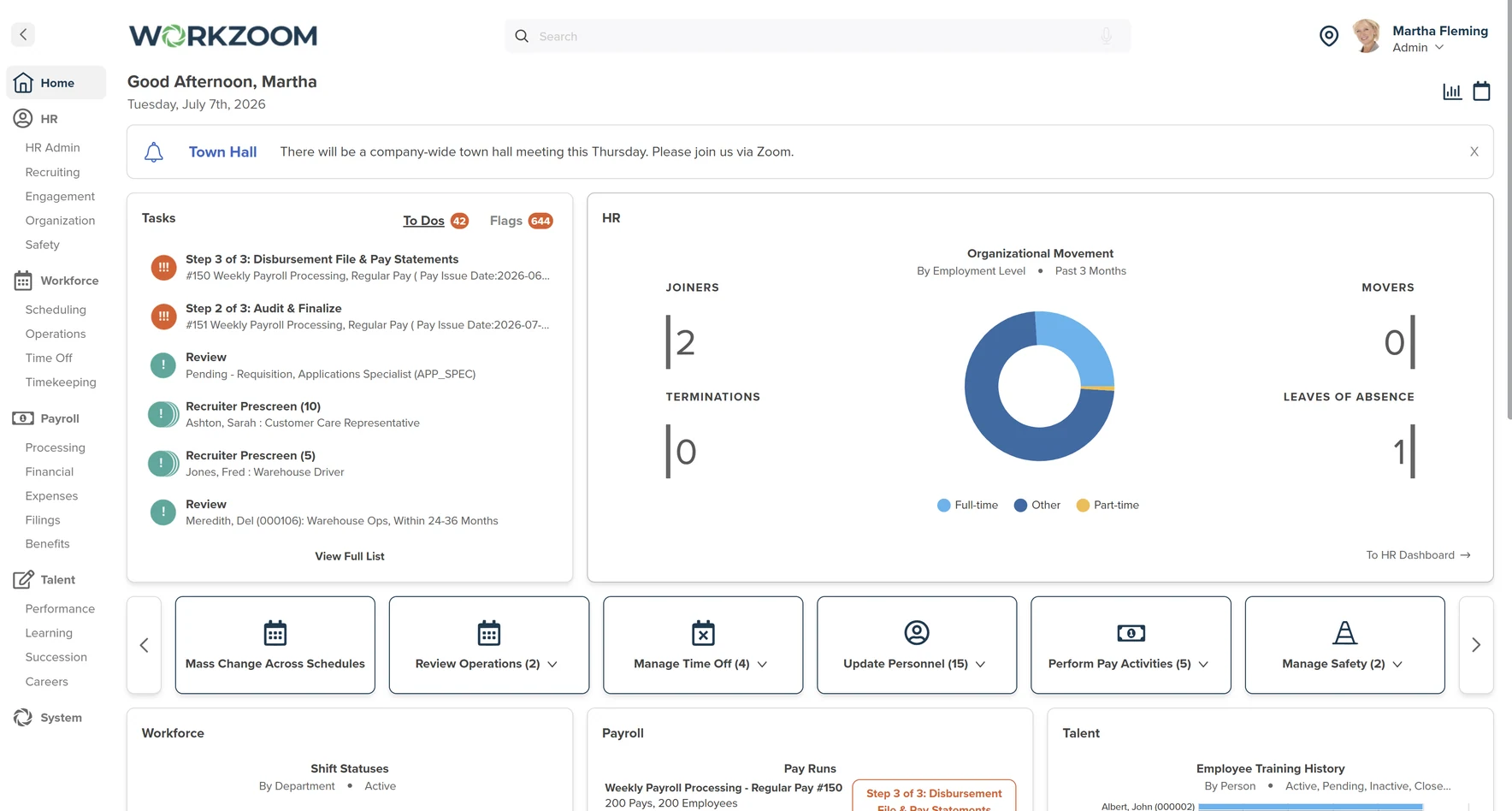
The nearest-Caribbean proof of what that looks like in practice: Cable Bahamas, an 850-employee telecom in the Bahamas, cut payroll processing time by 70% with Workzoom, going from 5 days to 1.5 days with a 3-person team. Island Luck, an 850-employee gaming operator across 60-plus Bahamas locations, runs 8 separate payrolls per week on the same platform. Both are Bahamas clients. The benefits-plus-compliance architecture that makes that possible is the same one available to Jamaica employers for HR, Workforce, and Talent today.
HR and benefits administration for Jamaica employers
Workzoom handles NIS, NHT, Education Tax, leave tracking, and benefits administration in one platform. Starting at $4 per employee per month, no implementation fees, no contracts.
See What It Looks Like for Your TeamThe same applies if you're running operations across the Caribbean. We've written about the parallels in Bahamas payroll and NIB compliance, people management in Antigua and Barbuda, and the broader question of PEO vs. HR software for growing companies.
What Comes Next
The Jamaican government has been signalling changes to labour legislation. Expanded parental leave. Potential updates to minimum wage. Alignment with ILO conventions on workplace protections. These changes will raise the statutory floor, which means what's "competitive" today becomes the new minimum tomorrow.
Employers who are already on Rung 2 or 3 of the Benefits Ladder won't feel the impact much. They've built infrastructure that can absorb new requirements. The ones who'll scramble are the companies still treating benefits as a compliance checkbox rather than a talent strategy.
That accounting firm in Kingston? They eventually upgraded their benefits package. Added group health. Started a training budget. But they never got their senior accountant back. She'd already signed with the competitor who thought about benefits before it became urgent.
The employers who win in Jamaica's talent market aren't necessarily the ones paying the highest salaries. They're the ones who've climbed the Benefits Ladder before their best people started looking around.
See Workzoom in 30 minutes.
Real product, real questions, no slides. Starts at $4 per employee per month, CAD or USD, with $0 setup fees.
What readers ask after this post on Jamaica employee benefits.
Our clients
The teams that run their people on Workzoom.













Workzoom handles HR, payroll, workforce, and talent on one employee record. Book a 30-minute walkthrough.