 Canada
 United States
 Bahamas
 Jamaica
 Trinidad & Tobago
 Antigua & Barbuda
 Barbados
 Anguilla
Workforce
Manager self-service, in plain English.
Book a Workzoom walkthrough → 25+ years of HR and payroll production. Live in Canada, the US, and the Bahamas.
Manager self-service gives a people manager the tools to run their own team: approving time off, reviewing schedules and timekeeping, raising job requisitions, requesting compensation changes, and overseeing recruiting, all scoped strictly to their own department.
Read the full answer
Access is governed by position in the system, so no manager ever sees payroll records or another team's data. The boundary is enforced at the record level. Workzoom has delivered this from a single employee database since 2001.
The shift-change request sits in the HR inbox all afternoon. The manager who knows the answer is two desks away, waiting for a call that will not come before five. That is not a workload problem. That is a routing problem.
Manager self-service fixes the routing.
What the manager actually controls.
A people manager gets a purpose-built toolkit scoped precisely to their own team. Approve or decline time-off requests. Review schedules and timekeeping records. Raise job requisitions when headcount opens. Request compensation changes for direct reports. Oversee recruiting for their department. All of it in one view, with no path into payroll and no window into another team's data.
The boundary is not a button a system administrator enables manually, person by person. It is governed by the position itself. The role determines what is visible. A team lead sees what that level is authorized to see. A department head sees what their scope requires. Both see exactly what they need, and the limit holds at the record level, not at the surface of the screen.
That distinction is worth sitting with. A surface-level restriction can be clicked around. A record-level restriction cannot.
Where the gaps tend to appear.
Four pitfalls tend to undercut self-service in practice:
- Workflow not configured after access is granted. The manager can log in. Time-off requests still route to the HR team instead of the direct manager. The tool exists. The routing never changed.
- Permissions left too broad at the position level. A supervisor can see records for teams they do not manage. The default was never tightened to the correct scope, and no one noticed until an audit.
- Job requisitions excluded from the manager portal. Headcount requests still travel by email. The recruiting module is live, but managers are still working outside the system, in a spreadsheet or a thread.
- Training did not follow the launch. The portal went live. Managers were not shown it. Adoption stayed at zero, and HR kept handling requests the managers were now technically empowered to handle themselves.
How Workzoom governs it.
Workzoom has been building integrated HR since 2001, family-owned and founder-led, without an acquisition trail forcing disconnected tools into a single login. The manager self-service suite is not a bolt-on. It was built as part of the same system that runs payroll, benefits, recruiting, and time management from day one.
That architecture shapes how access works. Every action a manager takes in their portal, an approved time-off request, a submitted job requisition, a flagged compensation change, writes back to the same employee record that the rest of the organization already uses. One database. No re-keying. No syncing between systems that have quietly diverged overnight.
Position-based permissions are enforced at the database level because there is only one record per employee. A manager at Cable Bahamas approving a shift change sees only their team's timekeeping data. A department head at County of Renfrew reviewing a job requisition sees only the roles that report to them. The separation is structural. It cannot be toggled off by a user who knows where to look.
In practice, managers walk through the full scope: time off, schedules, requisitions, compensation requests. Everything surfaces by role. Nothing bleeds across department lines. Payroll stays out of the picture entirely, which is how managers should be working with their teams, and exactly how Workzoom built it.
- 2000 Running payroll since Workzoom has run Canadian payroll for 25+ years.
- Canadian data residency AWS Canada (ca-central-1). Canadian customer data stays in Canada.
- SOC 2-aligned controls Encrypted at rest, role-based access, immutable audit logs.
- Trusted in production County of Renfrew, Silvera for Seniors, and Cable Bahamas. Built for 50 to 5,000 employees.
In the product
How Manager self-service runs on Workzoom.
Manager self-service is part of the Workzoom Workforce Suite. Workzoom runs HR, workforce, and talent on a single employee record across ten countries: Canada, the United States, the Bahamas, Jamaica, Trinidad and Tobago, Barbados, Antigua and Barbuda, Anguilla, the Cayman Islands, and the United Kingdom. Full gross-to-net payroll runs live in Canada, the United States, and the Bahamas. Pricing starts at $4 per employee per suite per month.
Questions about Manager self-service
More on Manager self-service
Playbooks and teardowns from teams putting it into production.

Best HR Software for Barbados Employers (2026 Guide)
The best HR software for Barbados compliance: Employment Rights Act, NIS, BRA payroll. See how Workzoom handles the Caribbean workforce.
Read article →
Shift Premium Payroll Software for Union Manufacturing
Shift premium payroll software must test seniority and differentials before a grievance surfaces eight weeks late.
Read article →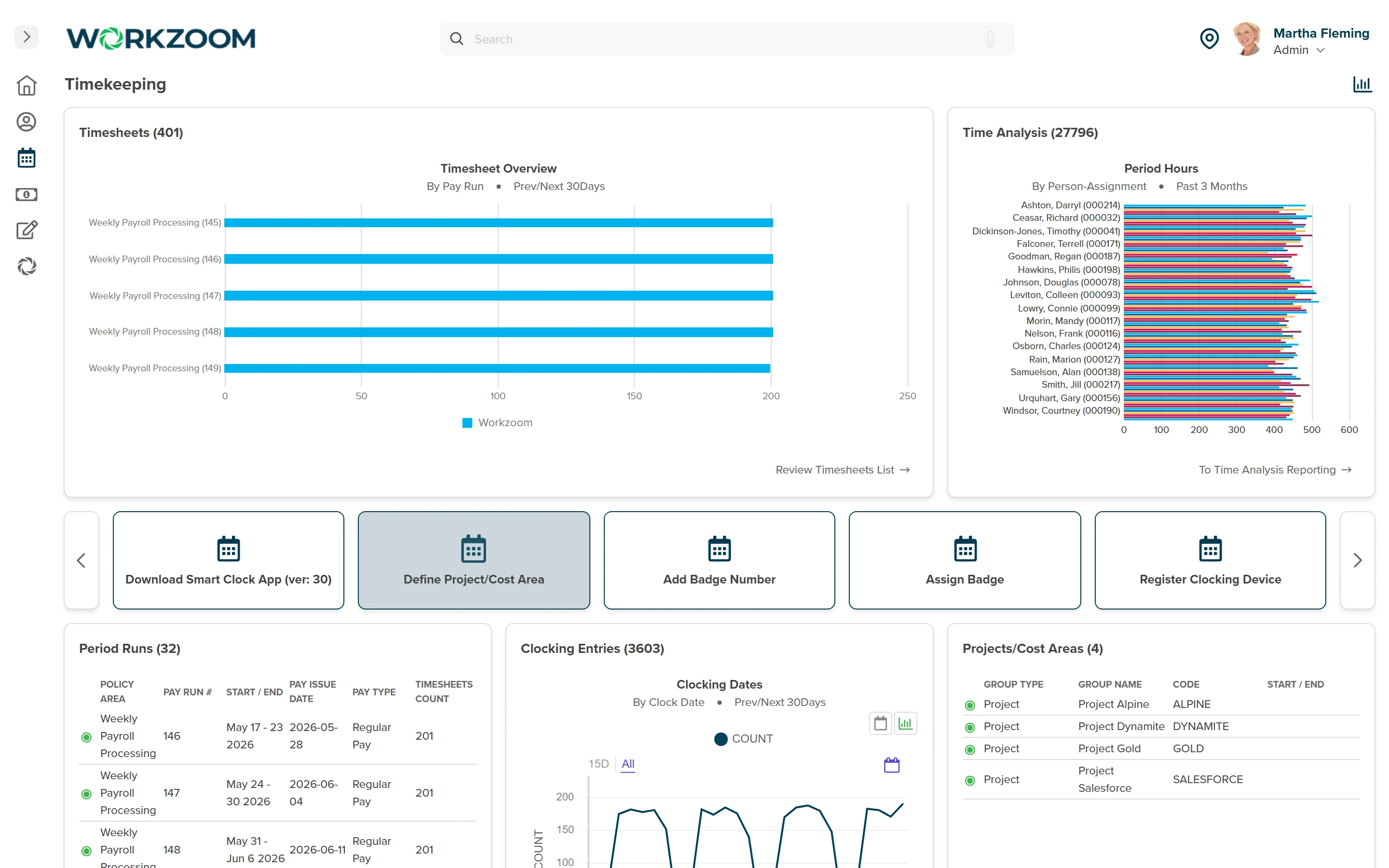
Time Tracking Software in Canada: Compare Payroll Fit
Compare time tracking software in Canada by payroll fit, approvals, overtime rules and total cost. Use practical demo tests before choosing...
Read article →
Canadian Payroll 2026: What Changes When Quebec Joins
Adding a Quebec employee to Canadian payroll changes the EI rate, remittance form and leave entitlement, and this guide names each shift.
Read article →Run HR, payroll, workforce, and talent on one platform.
$4 per employee per suite. 50 to 5,000 employees. Sprint-based, client-paced go-live.