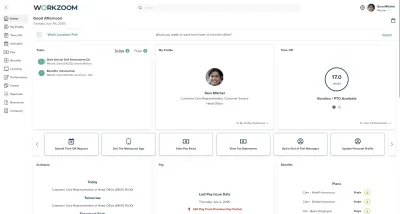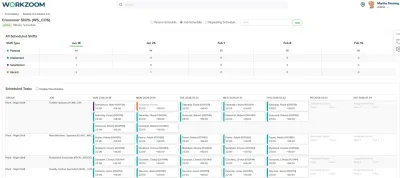

Workday is built for global enterprise. Workzoom is built for you.
Workday is the enterprise HCM standard for very large, global organizations, and this page will not pretend otherwise. For 50 to 5,000-employee teams, Workzoom delivers HR, payroll, workforce, and talent on one record, live in four to twelve weeks (twelve to thirty-six for large or complex rollouts), training included.
Workzoom vs Workday is a fit decision, not a feature war. Workday is the enterprise HCM standard: a genuinely unified platform, native payroll in the US, Canada, the UK, France, and Australia, quote-based pricing, and consultant-led implementations that commonly run twelve months or more at enterprise scale. Workzoom is the published-price alternative for employers with 50 to 5,000 employees in Canada, the US, and the Caribbean: HR, payroll, workforce, and talent on one employee record at $4 per suite per month, live in four to twelve weeks with implementation included. Global enterprises tend to fit Workday; mid-market teams that want enterprise-grade consolidation without enterprise overhead tend to fit Workzoom.
workzoom vs workday, Workday alternative, Workday alternative for midsize companies, Workday pricing, Workday alternative Canada, Workday HCM review
Workzoom vs Workday is usually settled by scale before features. Workday is the reference HCM for global enterprise: quote-based, negotiated per module, implemented by specialist consulting partners over engagements that commonly run twelve months or more. That model is right for a multinational; for a mid-market team shopping for a Workday alternative, it can mean enterprise cost and enterprise project overhead for depth the team will never operate.
Workzoom is a published-price Workday alternative built for 50-to-5,000-employee organizations: live in four to twelve weeks (twelve to thirty-six for large or complex rollouts, depending on size, scope, and how quickly your team can meet and decide), $4 per employee per month per suite, no module add-ons, no setup fees, month-to-month contracts, and full Canadian compliance. The Workzoom vs Workday decision compresses to fit at your scale, not a claim that Workzoom out-features the enterprise standard.
"We wouldn’t be able to hire the people that we do anymore with the same resources we already had. It’s allowed us to keep our headcount consistent without needing to increase, saving us time and money."
GGreg Belmore · Manager of Human Resources, County of Renfrew
Feature comparison
Every platform says it does it all.Here is how they compare.
Workday is the reference HCM for global enterprise, and this is an honest comparison, not a takedown. Every Workzoom claim links to an independent source; every Workday claim links to Workday's own material, with the date we checked it. Where Workday is stronger, enterprise scale, native payroll in five countries, deep planning and analytics, the table says so. Workzoom's case is fit for the 50 to 5,000 mid-market: a published price, implementation included, and native Caribbean payroll. Read the footnotes.
Decision criteriaWorkzoomWorkday
Database architectureSingle employee recordSync layer across separate databases
Scale and complexity fit50 to 5,000 mid-marketLarge global enterprise
Workday keeps HR, payroll, and scheduling in separate tools.One record changes everything.
The feature gaps above all trace to one root difference. Workday keeps HR in its own database while payroll, scheduling, and talent live in other tools. Workzoom runs all four together, so the work that happens between systems simply disappears.
Workday + a payroll tool + a scheduling tool + a learning system
The stitched stack
Re-key every new hire, raise, and termination into each separate system.
Export from HR and import to payroll every single pay cycle.
Reconcile the mismatches when two systems disagree on one employee.
Build and maintain integration middleware between tools never meant to talk.
No single source of truth, so the reports never quite agree.
An audit trail scattered in pieces across four vendors.
Workzoom
One employee record
HR, payroll, scheduling, and talent all work from one record.
No exports, no imports, no sync layer between HR and payroll.
A change in one place is true everywhere, instantly.
One source of truth across HR, payroll, scheduling, and talent.
One audit trail for the entire employee lifecycle.
One login, one bill, one team that configured it all.
Why Workzoom
Every platform does something well.Here is where Workzoom stands out.
Sized for the job you have
Workday's depth is real, and it is priced, implemented, and governed for global enterprise. A 500-employee organization on Workday carries enterprise overhead: consultant-led changes, module-by-module negotiation, and a platform surface designed for a much larger operating team. Workzoom is built for 50 to 5,000 employees, so the configuration, the price, and the support model match the size of the team running it.
A published price and an included implementation
Workday pricing is quote-based and negotiated, with implementation delivered by consulting partners as a separate engagement that commonly runs twelve months or more at enterprise scale. Workzoom is $4 per employee per month per suite, published, $16 all-in, with implementation and training included and the same specialists staying on your account after go-live. You deal directly with the people who configured your system, not a rotating consulting bench.
Native Caribbean payroll on the same record
Workday runs native payroll in five countries and reaches the rest of the world through partners, which suits a multinational. Workzoom runs live NIB and C10 in the Bahamas at Cable Bahamas (850 employees, payroll cut from 5 days to 1.5) and Island Luck (850 across 60+ gaming locations), on the same employee record as Canadian and US payroll, with engines capable of handling the wider Caribbean.
Under the hood
One platform, or a rollup?
Two questions a feature table skips: is this built as one system, and who owns it today. Here is the honest answer for both.
Workzoom
Architecture
One unified employee record across HR, payroll, workforce, and talent.
Built or acquired
Built in-house on the Curos Technology Platform (2009 to 2010), not assembled from acquired products.
Ownership today
Privately held, Canadian-owned, founded 2000.
One system, one owner
Workday
Architecture
A genuine single cloud platform for HCM, payroll, and finance, built organically rather than assembled by acquisition. On architecture this is a match, and one of Workday's real strengths.
Built or acquired
Founded in 2005 by PeopleSoft veterans and built as one system from the start.
Ownership today
Publicly traded (NASDAQ: WDAY).
Also one platform (a match)
Architecture and ownership facts above, sourced: [1]
We won't pretend otherwise: Workday is genuinely unified, and at global enterprise scale it is the reference platform. The difference here is fit, price, and time-to-value for the mid-market, not stitched-together software.
Live on Workzoom right now. North America and the Caribbean.
$4 per suite per month. All four suites = $16/employee/month. No setup fees, no contracts.
Workday
Custom
quote-based
Workday does not publish a public rate card; pricing is quote-based and negotiated per module and headcount, with implementation delivered by specialist consulting partners as a separate engagement. Enterprise deployments commonly run twelve months or more.
How this is calculated. Modeled at 200 employees, all four suites, over three years. Workzoom's figure is its published ratepm1; competitor ranges are quote-based and include typical setup, migration, and implementation fees. Send your real headcount and country mix for a vendor-specific total.
The honest fit
Who Workzoom is for, and who it is not.
Picking the right system is as much about ruling out a wrong fit as finding a right one. Here is where Workzoom fits, and where it does not.
Built for you
Workzoom is the right call if
You have 50 to 5,000 employees and want HR, payroll, workforce, and talent on one employee record.
You operate across the Caribbean, Canada, the US, or some mix of them, and want one system instead of two.
You want your own team running payroll, with Workzoom specialists configuring your statutory rules and staying on after go-live.
You want published, predictable per-employee pricing you can model on day one.
You want named-client proof with real production numbers, not a logo wall.
Be honest with yourself
Workzoom is not the fit if
You want payroll handled for you by a bureau.
Workzoom is the platform your own team runs: it calculates and prepares statutory output, and your team submits. If you would rather hand payroll off entirely, a managed-payroll service is the better fit, not us.
You are a 20,000-plus employee global enterprise needing deep multi-entity configuration and a large consultant programme.
That is Workday and SAP SuccessFactors territory, and we are honest about it. Workzoom is built for the 50 to 5,000 range where fit, speed, and a real relationship beat raw configuration depth.
Switching
How do you switch from Workday?
Most teams are live within four to twelve weeks (twelve to thirty-six for large or complex rollouts), depending on size, scope, and how quickly your team can meet and decide, with dedicated implementation support.
01
Export from Workday
We work with your existing Workday data export. Employee records, pay history, and leave balances transfer across.
02
Parallel payroll run
Both systems run simultaneously for 2-3 pay periods. Your team validates that Workzoom numbers match Workday before committing to cutover.
03
Cutover
When your team is confident, you decommission Workday. We help manage the transition timeline. Most migrations complete in four to twelve weeks (twelve to thirty-six for large or complex rollouts).
Specifics on switching from Workday to Workzoom: pricing, data migration, timeline, and what is actually different in day-to-day use.
Fit and pricing
Yes, that is exactly the segment Workzoom serves. Workzoom covers HR, payroll, workforce, and talent on one employee record for organizations with 50 to 5,000 employees, at a published $4 per employee per month per suite with implementation included. Workday is built and priced for large global enterprise; for a mid-market team, Workzoom fits the actual job.
For large, global enterprises: tens of thousands of employees, operations across many countries, deep planning and analytics requirements, and the internal teams to run an enterprise platform. That is Workday's territory and we say so. Workzoom serves the 50 to 5,000 mid-market, where Workday's depth typically exceeds what the team needs or can operate.
For mid-market organizations, substantially. Workzoom is $4 per employee per month per suite, $16 all-in, with $0 setup fees. Workday pricing is quote-based and negotiated, with no public rate card, and implementation is a separate consulting engagement. The honest comparison is total cost over three years: subscription, implementation, and the internal or consulting effort to run changes.
It happens; Workday and its implementation partners focus on enterprise-scale deployments. If your organization is in the 50 to 5,000 range, that is not a gap in your requirements, it is a fit signal. Workzoom is built for that band: the same unified-record model, sized, priced, and supported for a mid-market team.
Migration
Most migrations complete in four to twelve weeks (twelve to thirty-six for large or complex rollouts). We run Workzoom in parallel with Workday for 2-3 pay periods so your team can validate before switching over.
Yes. Workzoom migrates employee records, pay history, leave balances, org structure, and historical reporting from Workday. You provide the Workday data export and we handle the import.
Workzoom runs in parallel with Workday for 2 or 3 full pay periods. Both systems process every employee on every cycle; our team reconciles the gross-to-net to the cent on each run. Cutover only happens after a clean reconciliation; if either side disagrees, the issue is fixed before going live.
That is between you and Workday. Workzoom is month-to-month so you can start at any point. Many clients run both systems during the parallel period.
Capabilities
Yes for Canadian organizations. Workzoom handles CPP, EI, provincial tax, T4, ROE, union agreements, provincial labour standards, and bilingual access. Canada is also one of Workday's native payroll countries, so the difference is fit and price, not compliance coverage.
Not natively. Workday's native payroll covers the US, Canada, the UK, France, and Australia; other countries, including the Caribbean, are served through partner payroll providers. Workzoom runs live NIB and C10 payroll in the Bahamas and ships statutory engines capable of handling Jamaica, Trinidad and Tobago, Barbados, Antigua, and Anguilla.
Workday's analytics and planning depth is enterprise-grade and genuinely strong, particularly where HR and finance planning converge. Workzoom ships pre-built reports for payroll, labour cost, headcount, statutory compliance, and ESS adoption out of the box, with a no-code report builder for custom needs, which is the reporting surface most mid-market teams operate day to day.
Deep dive
Workzoom vs Workday, the Workday alternative.
01
Workzoom vs Workday: strengths and trade-offs
Workday earned its position as the enterprise HCM standard. The platform was built as one cloud system from its 2005 founding, its configuration depth is real, and for global organizations with tens of thousands of employees it is often the right answer. Any honest Workday review at that scale will say so, and this one does.
The trade-offs are the enterprise model itself: quote-based pricing negotiated per module, implementations delivered by specialist consulting partners over twelve or more months, and a platform surface that assumes a dedicated HRIS team to operate it. None of that is a flaw at 30,000 employees. At 800 employees it is overhead: the depth being paid for exceeds the depth being used, and every configuration change routes through a consulting relationship. That is the Workzoom vs Workday trade-off in one sentence.
02
The scale question, answered honestly
Some comparison pages pretend every buyer is a fit for their product. This one will not. If your organization runs 20,000 employees across a dozen countries with deep planning, analytics, and global mobility requirements, Workday is built for you and Workzoom is not. We would rather say that plainly than win a deal that churns.
The reverse is equally true and less often said: Workday is not sized for the 50 to 5,000 band. Mid-market organizations that buy enterprise HCM inherit enterprise overhead without enterprise staffing, and the platform's depth becomes the reason changes are slow rather than the reason they are possible. Buyers told they are too small for Workday, or quoted an implementation that dwarfs the subscription, are not hearing a requirements gap; they are hearing a fit signal.
03
Workzoom vs Workday pricing at the mid-market line
Workday does not publish a rate card. Pricing is negotiated per module and headcount, and the implementation is a separate consulting engagement whose cost at enterprise scale is commonly a multiple of the first-year subscription. For an enterprise with a procurement team, that is a normal Tuesday. For a mid-market buyer, it means the real number arrives months into the cycle.
Workzoom's published $4 per suite per month, $16 maximum for all four suites, with implementation and training included, is a number a finance team can model before the first call. Workday would tell you its quote buys enterprise depth, and at the right scale it does. For organizations between 50 and 5,000 employees focused on Canada, the US, and the Caribbean, the honest way to settle Workzoom vs Workday on cost is to price the full three-year picture: subscription, implementation, and the consulting or internal staffing needed to operate change.
04
Migration considerations
Migrations from Workday to Workzoom follow a structured export and import pattern. Employee records, compensation history, position data, and payroll configuration each have established export paths. Workzoom's implementation team works through the data validation cycle, with parallel pay runs validating the new system against the legacy before cutover.
Mid-market organizations leaving Workday are usually simplifying, not replicating: the goal is the unified record and the core workflows, without the enterprise configuration layers that required consulting support to maintain. That is why these migrations typically land in the standard four-to-twelve-week window; the complexity being retired is precisely the complexity that made the legacy platform heavy to run.
05
When does Workzoom vs Workday still favour Workday?
Global enterprises with tens of thousands of employees, multi-country operations beyond Workzoom's native payroll markets, deep financial planning integration, and a staffed HRIS function are Workday's home turf. At that tier the platform's depth, partner network, and governance model earn their cost, and a mid-market platform would be the wrong tool.
For organizations between 50 and 5,000 employees with operations focused on Canada, the US, and the Caribbean, Workzoom is the Workday alternative that matches the actual job: the same unified-record architecture at mid-market scale, a published price, an included implementation, and a team you deal with directly after go-live. The conversation worth having is whether enterprise depth is capability you would use or overhead you would carry. For most mid-market teams, the honest answer decides the comparison.
Live walkthrough
See Workzoom in 30 minutes.
Real product, real questions, no slides. Starts at $4 per employee per month, CAD or USD, with $0 setup fees.