 Canada
 United States
 Bahamas
 Jamaica
 Trinidad & Tobago
 Antigua & Barbuda
 Barbados
 Anguilla
HR Software Implementation: 20 to 25 Hours per Module

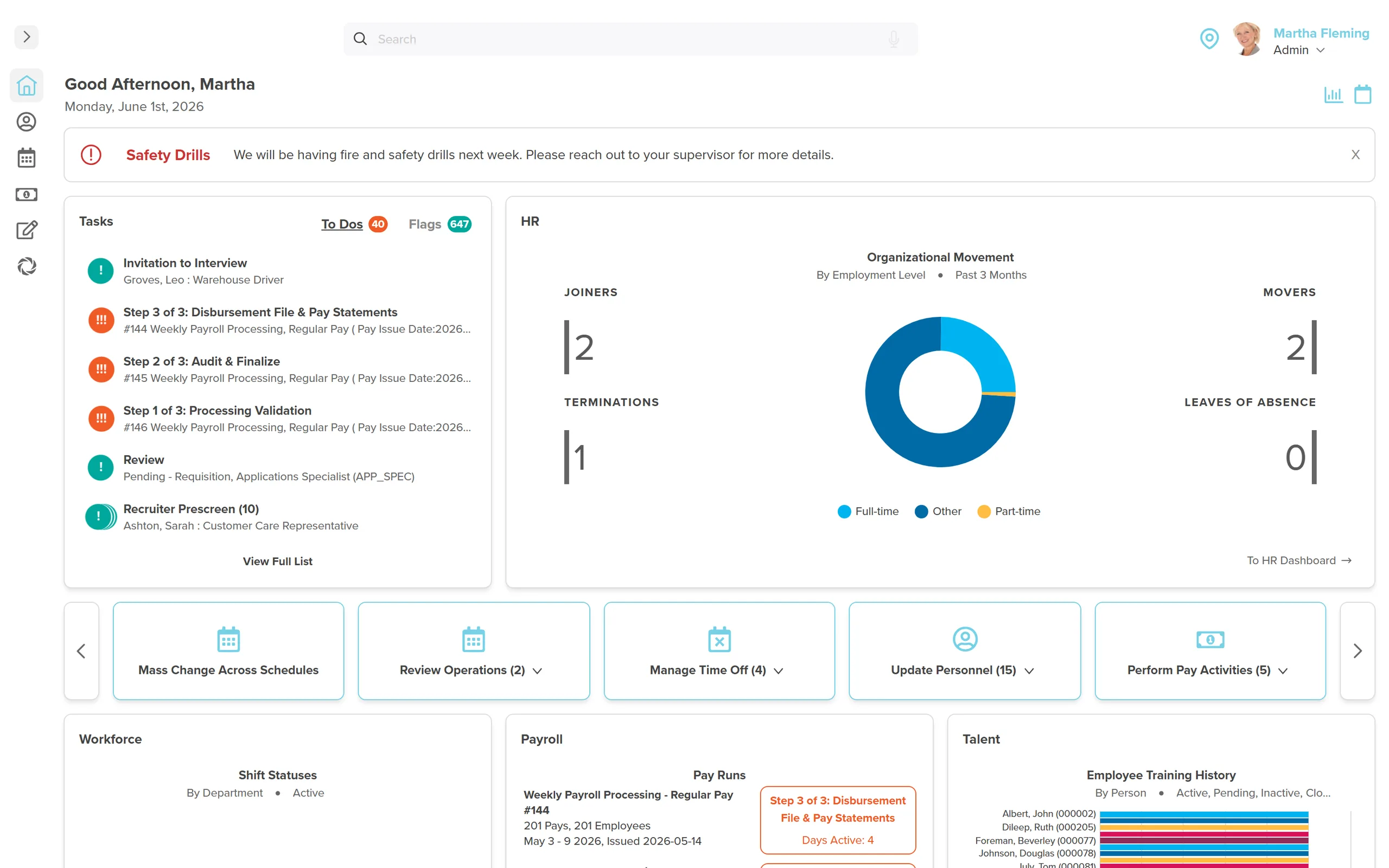
Most HR software implementations fail because organizations treat them as IT projects, leaving stakeholder involvement too thin and timelines too optimistic. A phased approach, starting with your biggest pain point and adding modules over 6 to 12 months, cuts go-live risk sharply. Your payroll lead, HR team, and frontline managers need roughly 20 to 25 hours over eight weeks per module. The vendor who includes implementation in the subscription has the right incentive structure. The one billing hourly does not.
Nearly one in four organizations report their HR technology implementations failed to meet adoption expectations, according to Sapient Insights Group. Gartner puts the broader enterprise software failure rate between 50% and 75%. And a Gartner survey found the average HRIS is actively used by only 32% of employees.
Those numbers aren't about bad software. They're about bad process. In particular, they're about what happens when a vendor builds your system in a room you never walked into, based on conversations you half-remembered, configured by consultants who've never watched your payroll team actually run payroll.
If you want your HR software to actually work, you have to show up. Here's what that looks like in 2026.
- Most HR software implementations fail because organizations treat them as IT projects and skip the genuine stakeholder involvement configuration actually requires
- Traditional big-bang go-lives typically run 14 to 22 months. A modular, progressive approach gets the first priority module live in four to twelve weeks (twelve to thirty-six for large or complex rollouts)
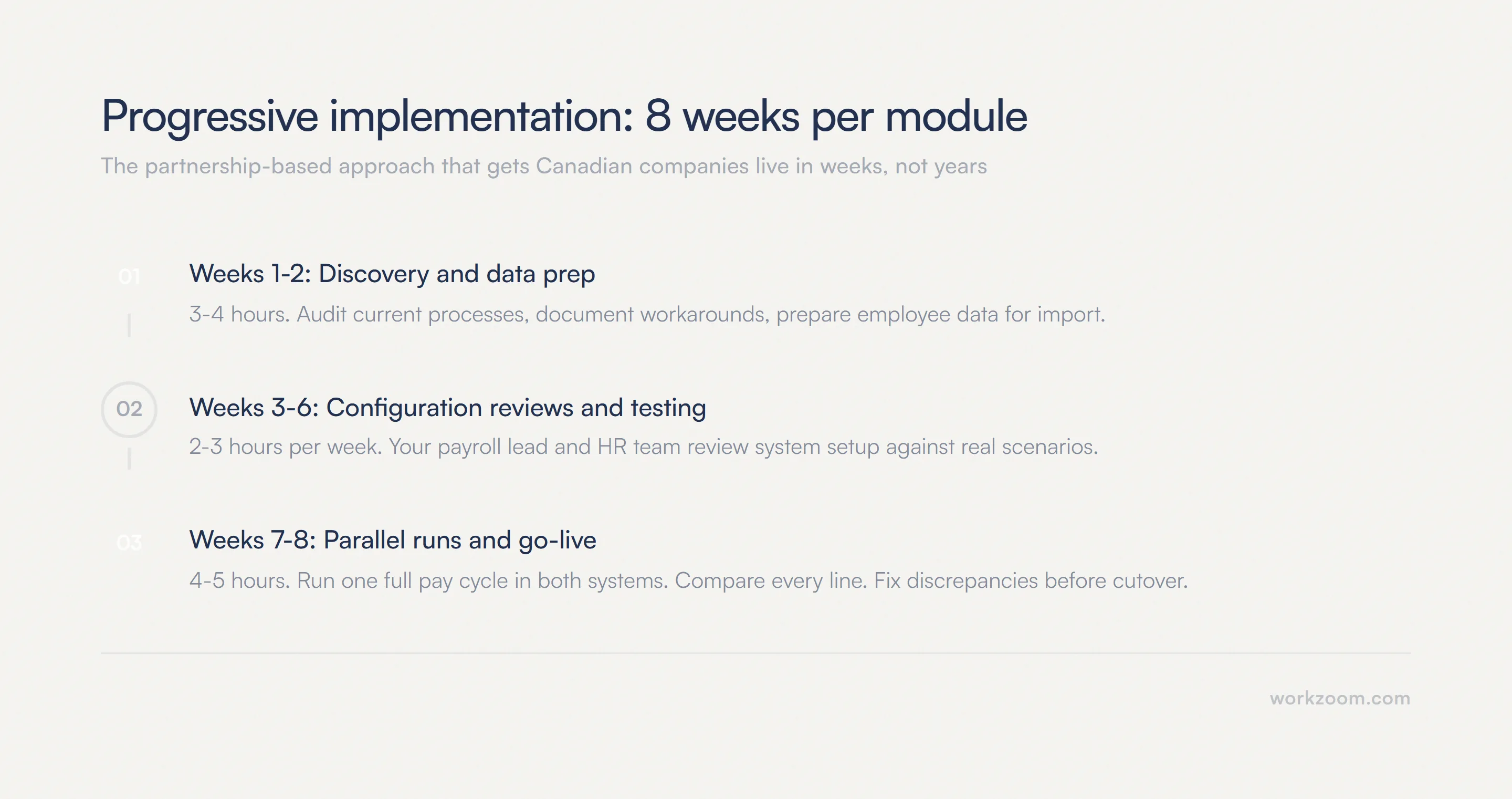
- Total time investment from your team is roughly 20 to 25 hours over 8 weeks per module, focused on validation rather than configuration
- The payroll lead, HR team, and frontline managers must all be in the configuration room. Consultants working from notes alone produce systems that fail at go-live
- Workzoom uses progressive, partnership-based implementation with no separate professional services fees
Why Most HR Software Implementations Fail
The root cause is almost always the same: lack of genuine stakeholder involvement. Not "we had a kickoff meeting" involvement. Not "we filled out the requirements questionnaire" involvement. Real, sustained, show-up-every-week involvement from the people who actually do the work.
Here's what happens without it. Consultants run discovery workshops. They interview a few managers. They take notes. Then they disappear for three months and build a system based on those notes. When they come back with a finished configuration, the overtime rules are wrong, the approval chains don't match reality, and half the report fields your payroll lead needs are missing.
This isn't a technology problem. It's a partnership problem. And it's why the biggest HR software buying mistakes happen long before anyone logs in for the first time.
Your World, Not Ours
Every organization thinks their processes are "pretty standard." They're not. Alberta handles statutory holidays differently than Ontario. Nassau NIB contribution calculations vary from head office. Your overtime rules have three exceptions nobody wrote down because "everyone just knows."
Only your people understand these details. No vendor, no matter how experienced, can configure a system that matches your operational reality without your operational people in the room. That means:
- Your payroll lead needs to be in the configuration reviews. Not a junior analyst. Not someone "taking notes for the team." The person who actually processes payroll.
- Your HR team needs dedicated time for data validation. Employee records have errors. Everyone knows this. The question is whether you find them before go-live or after.
- Your managers need to test actual workflows. Not watch a demo. Not read a user guide. Submit a real time-off request, approve a real timesheet, run a real report.
Implementation isn't something that happens to you. It's something you do together with your vendor. Organizations that treat it as a side project get side-project results.
What Your Team Actually Needs to Invest
Let's be honest about the time commitment. Nobody wants to hear "this will take effort," but pretending otherwise is how you end up 14 months into a project that was supposed to take six.
A realistic implementation timeline with a progressive approach looks like this:
- Weeks 1-2: 3-4 hours for discovery and data preparation
- Weeks 3-6: 2-3 hours weekly for configuration reviews and testing
- Weeks 7-8: 4-5 hours for parallel runs and go-live validation
Total: roughly 20-25 hours over 8 weeks. That's a fraction of the 14-22 months traditional implementations demand. But those hours need to be real, focused hours. Not squeezed between three other meetings with your laptop half-closed.
You also need to be willing to have uncomfortable conversations. Why does your approval chain skip two levels for this department? Why are there three different overtime calculations for the same job title? Why hasn't anyone reconciled those leave balances since 2023? Those are the questions that surface the misalignments before they become system failures.
Start With What Hurts Most
The traditional approach to HR software implementation is the "big bang": configure everything, test everything, launch everything on a Monday morning, and pray. It's also the approach most likely to fail.
A smarter path is progressive implementation. Identify your biggest pain point and solve that first. Is payroll taking five days when it should take one? Start there. Are timesheets still on spreadsheets? Start there. Is scheduling consuming your managers' weekends? Start there.
When your HR software is modular and priced per suite, this approach actually makes financial sense too. You're not paying for modules you haven't deployed yet. You prove value with the first module, build internal confidence, and expand from a position of success rather than hope.
How Progressive Implementation Actually Works
Here's what a phase-by-phase go-live looks like in practice:
- Week 1: Employee data validation. Import your records, catch errors immediately, fix them while the data is fresh.
- Week 3: Time-off management testing. Real requests, real approvals, real workflows. Not a demo environment with fake employees.
- Week 5: Timekeeping deployment. Managers start approving actual timesheets. Issues surface early when there's time to adjust.
- Week 7: Parallel payroll processing. Run your old system and the new one side by side. Compare every number. Build confidence through verification, not faith.
Each step surfaces problems when they're small and cheap to fix. The big-bang approach surfaces them all at once, on go-live day, when your payroll deadline is 48 hours away and 500 employees are waiting to get paid.
The Implementation Fee Racket
Let's talk about the part nobody in this industry likes to discuss: the economics of implementation.
The typical enterprise HR software deal looks like this: $8 per employee per month for the software, plus $35,000 for discovery, plus $25,000 for configuration, plus $15,000 for training, plus $10,000 for data migration. That's $85,000 before a single employee logs in. For a 250-person company, the first-year cost is $109,000.
Here's the problem with that model. When a vendor makes $85,000 from implementation, their consultants have a direct financial incentive to extend the timeline. Every "change request" is billable. Every scope expansion is revenue. Every complication is opportunity.
Workzoom flipped that model entirely. Implementation, configuration, training, and data migration are all included in the monthly subscription. $4 per employee per month per suite. No setup fees. No surprise invoices for "additional configuration." Month-to-month terms, so if it doesn't work, you leave.
That structure aligns incentives. We make money when you go live successfully and stay. We lose money when implementations drag on. So we have every reason to get you running as quickly and smoothly as possible.
See what implementation looks like when it's actually included
Workzoom includes implementation, training, configuration, and data migration in every subscription. $4/employee/month per suite, no implementation fees, month-to-month. Book a 30-Minute Discovery Call to walk through a realistic timeline for your organization.
Book a 30-Minute Discovery CallWhat Success Actually Looks Like
Theory is nice. Results are better. Here are three organizations that did the work and got the outcome.
County of Renfrew, Ontario
County of Renfrew had clear requirements going into implementation. Their payroll administrator wasn't going to accept anything less than full compliance coverage. She tested every configuration, challenged every assumption, and pushed back when something didn't match her reality. The result: improved payroll accuracy and onboarding 32 new hires in three months without paper.
Cable Bahamas (850 Employees)
Cable Bahamas had 850 employees across multiple companies, with three payroll professionals drowning in five-day payroll cycles. Their team validated employee records line by line during implementation. The outcome: payroll went from five days to a day and a half. A 70% reduction.
Silvera for Seniors
Silvera for Seniors operates across Calgary with 400 staff. Before Workzoom, nothing spoke to each other. A lot of manual work, a lot of spreadsheets, and no real way to trust the data. Consolidating HR, payroll, and scheduling onto one platform cut the admin load and put hours back into resident-facing work.
What the System Needs to Know Before It Can Run Payroll
The minimum required data to get a Workzoom environment stood up is smaller than most teams expect: legal name, hire date, and position. Everything else loads progressively. The reason: Workzoom's payroll engine is built around effective dating and a person-position model. Every compensation change, every rate update, every leave adjustment records when it happened, not only what the current value is. That date-stamped history is what lets payroll calculate correctly without a separate YTD import for every pay element.
What this means practically: you can stand up a Sandbox environment with the core employee records, configure your pay rules against real data, and validate the setup before you ever touch the Production environment. The parallel cycle you run in week seven is a comparison, not a leap of faith.
Workzoom calculates and prepares payroll filings. The client submits to the relevant authority. That distinction matters for your compliance team because your sign-off process stays intact and your payroll team reviews the outputs before anything leaves the building.
Your Implementation Checklist
If you're evaluating HR software right now, or about to start an implementation, here's what you need to have ready.
Data Readiness
- Pull your current employee roster with verified job titles and manager assignments
- Export historical payroll data for parallel run comparison
- Document leave balances and accrual rules, especially the exceptions nobody wrote down
Team Availability
- Payroll lead: 2-3 hours weekly of blocked, uninterrupted time
- HR team: dedicated hours for data validation (not "whenever they can fit it in")
- 2-3 managers willing to test workflows honestly and report what doesn't work
Process Documentation
- Write out your overtime rules, including every exception
- Map approval chains for time off, expenses, and payroll changes
- List regional compliance requirements and location-specific rules
Success Criteria
- Define what "working" means before you start. Not after.
- Identify the specific pain points you need solved in the first 90 days
- Align your timeline expectations with your vendor upfront. If they say 18 months, ask why.
The organizations that succeed at HR software implementation aren't the ones with the biggest budgets or the most IT support. They're the ones that commit their best operational people for 20-25 hours over 8 weeks and refuse to treat the project as someone else's problem.
Stop Paying for Failure by Design
Most HR software implementations fail because the economic model rewards failure. Vendors profit from extended timelines. Consultants bill for scope creep. And organizations sign three-year contracts before they know whether the system actually works.
There's a different way. One where the vendor includes implementation in the subscription, goes live in weeks instead of years, starts with your biggest pain point instead of trying to boil the ocean, and lets you leave month-to-month if it doesn't deliver.
That's not a pitch. It's how Workzoom has operated for over 25 years. We don't charge you $85,000 for the privilege of doing the work together.
See Workzoom in 30 minutes.
Real product, real questions, no slides. Starts at $4 per employee per month, CAD or USD, with $0 setup fees.
What readers ask after this post on HR software implementation.
Our clients
The teams that run their people on Workzoom.













Workzoom handles HR, payroll, workforce, and talent on one employee record. Book a 30-minute walkthrough.