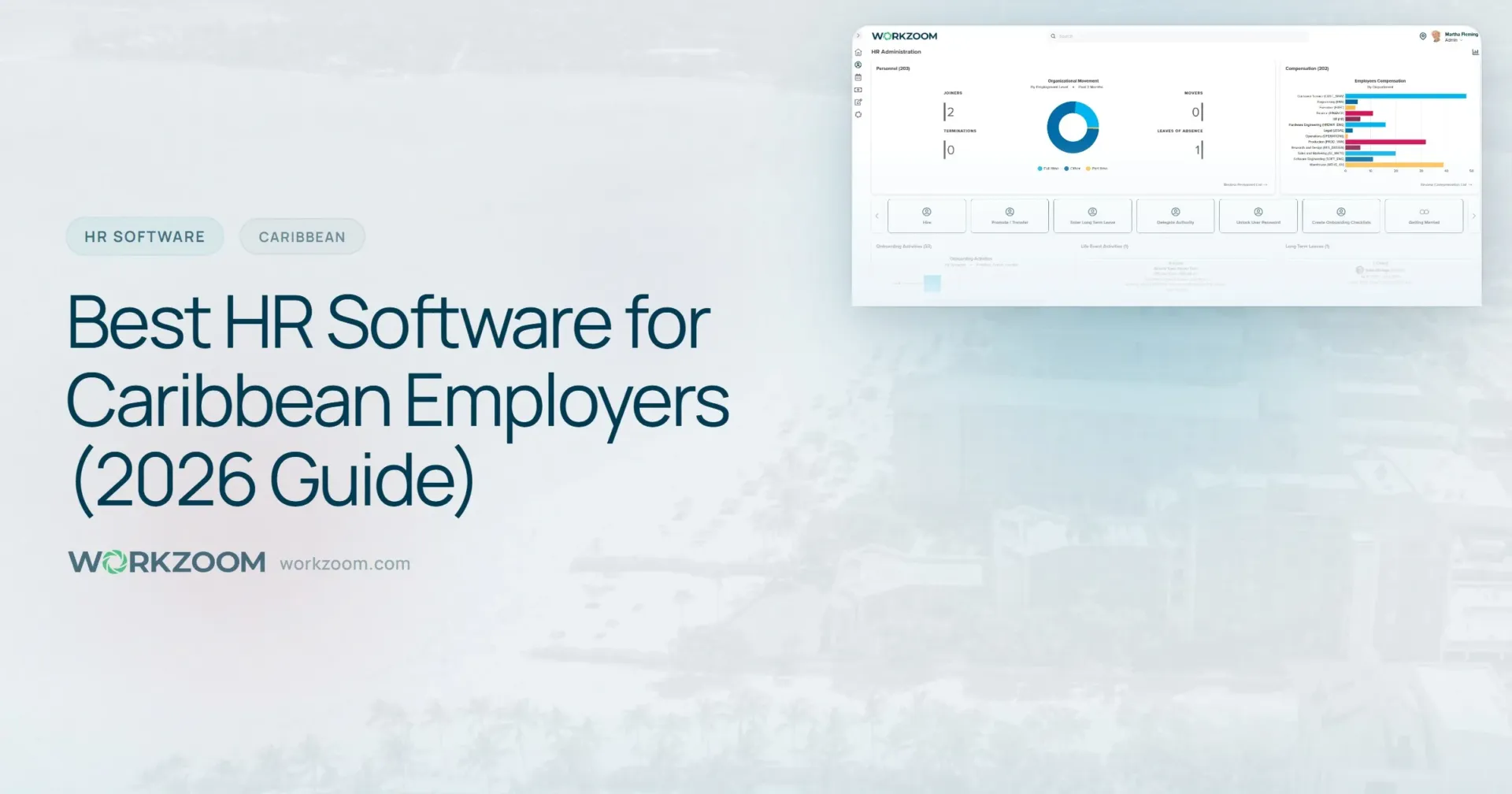
Best HR Software for Caribbean Employers (2026 Guide)
HR software built for Caribbean compliance. NIB in the Bahamas, NIS in Jamaica and Trinidad, NHT, Green Fund levies, and the Employment Rights Act in Barbados, in one platform. From $4/employee/month.
The best HR software for Caribbean organizations is not a North American platform with a Caribbean settings page. It is a platform built from the ground up to understand NIB in the Bahamas, NIS in Jamaica and Trinidad, NHT contributions, Green Fund levies, and the Employment Rights Act in Barbados. These are not edge cases. They are the core of what Caribbean payroll compliance means.
This guide breaks down what Caribbean employers need from an HR system, how the major island markets differ in their compliance requirements, and what to look for when evaluating platforms that claim Caribbean capability.
HR software built for the Caribbean, all islands, one platform
Workzoom is live across the Bahamas and expanding through the Caribbean. Jamaica and Trinidad and Tobago HR, Workforce, and Talent are fully live, payroll rolling out via launch partner program. $4/employee/month, no setup fees, no contracts.
Why Caribbean Employers Need Regionally-Built HR Software
The fundamental problem with US and UK HR platforms in the Caribbean is not that they lack features. It is that their compliance logic was not written for the region. When a platform lists “international payroll” as a capability, it usually means they can process a payroll run in multiple currencies. It does not mean they have NIB contribution tables, NHT loan deductions, or Green Fund calculations built into their payroll engine.
Caribbean employers who use generic international platforms spend significant time maintaining compliance workarounds. Their payroll teams build custom spreadsheets to catch what the software misses. When regulatory rates change, those spreadsheets break and no one notices until the remittance is wrong.
A platform built specifically for the Caribbean treats regional compliance as a product priority, not a configuration exercise. That means rate updates come from the vendor, not from your IT team. It means NIS is a native payroll calculation, not a custom field. It means the platform works the way Caribbean payroll actually works.
Country-by-Country Caribbean Compliance: What Your HR System Must Handle
Bahamas: NIB and the National Insurance Board
The Bahamas National Insurance Board administers social security contributions for all employed persons. Key employer requirements:
- NIB contribution rate: Combined employer and employee contributions applied to insurable earnings up to the weekly ceiling
- Insurable earnings ceiling: Updated periodically; your payroll system must track and apply the current ceiling without manual intervention
- Employer registration: Required for all employers; the NIB number must appear on payroll records and remittances
- Remittance deadlines: Monthly, with penalties for late payment that compound quickly
Jamaica: NIS, NHT, and Education Tax
Jamaica has one of the more complex payroll compliance frameworks in the region. Every payroll run involves multiple statutory deductions beyond income tax:
- NIS (National Insurance Scheme): Contributions on insurable earnings for both employee and employer
- NHT (National Housing Trust): Employee and employer contributions used to fund housing schemes; employees can access their accumulated NHT funds for home purchases
- Education Tax: Employer and employee contributions to fund public education
- HEART levy: Employer-only contribution to the HEART Trust workforce development fund (applies above certain payroll thresholds)
- Income Tax / PAYE: Withheld at source based on the employee’s tax code and annual threshold
A payroll system that handles Jamaica correctly is running five or six separate calculations on every pay stub. A generic international platform handles income tax. The rest becomes a manual process.
Trinidad and Tobago: NIS and the Green Fund
- NIS contributions: Applied to insurable earnings for both employee and employer, with rates and ceilings set by the National Insurance Board of Trinidad and Tobago
- Green Fund Levy: An environmental levy on gross revenue; applies to businesses and requires tracking and remittance separate from payroll
- Health Surcharge: A statutory deduction on employment income that goes toward public health services
- PAYE: Income tax withheld at source following the personal income tax schedule
Barbados: ERA and BRA PAYE
- NIS contributions: National Insurance scheme contributions with employer and employee rates applied to insurable earnings
- Employment Rights Act 2012: Governs termination, notice periods, severance, and leave entitlements; must be reflected in HR workflows, not just payroll calculations
- BRA PAYE: Income tax withholding administered by the Barbados Revenue Authority
Every Caribbean market has its own statutory contribution structure. An HR platform that handles one island’s requirements natively may handle another’s as a manual workaround. Before choosing a platform, ask: which of these compliance calculations are native features, and which require custom configuration maintained by my team?
Workzoom’s Caribbean Coverage
Workzoom is currently live across the Bahamas, Jamaica, and Trinidad and Tobago, with Barbados actively expanding. Here is what that means in practice:
- Bahamas: NIB calculations, insurable earnings tracking, and remittance schedules are native payroll features. Live clients include organizations from 50 to 850 employees across Nassau and the Family Islands.
- Jamaica: HR, Workforce, and Talent are fully live. Payroll, NIS, NHT, Education Tax, HEART, PAYE, is rolling out through our launch partner program. If payroll is part of your evaluation, mention it at your walkthrough.
- Trinidad and Tobago: HR, Workforce, and Talent are fully live. Payroll, NIS, Health Surcharge, PAYE, is rolling out through our launch partner program. Mention it at your walkthrough.
- Barbados: Newer to Workzoom, with NIS and BRA PAYE configuration available. ERA 2012 compliance workflows are in active deployment.
- Antigua and Barbuda: Available via Workzoom’s OECS compliance framework.
What Caribbean-First Means in Practice
Caribbean-first is not a marketing phrase. It describes a specific set of product and support decisions:
Compliance updates come from the vendor. When Jamaica changes NHT rates or Trinidad revises NIS ceilings, Workzoom’s compliance team updates the platform. You receive the change in a system update, not an email asking you to reconfigure your custom fields.
Support understands the region. When a Bahamian employer calls about NIB insurable earnings ceilings, they are talking to a team that knows what NIB is. Not a North American support centre looking it up.
Multi-country in one system. Organizations operating across multiple islands, a reality for many Caribbean employers in hospitality, financial services, and government, manage all jurisdictions from a single platform with separate compliance configurations per country.
Regional Case Study: Cable Bahamas
Cable Bahamas, one of the Bahamas’ largest employers with approximately 850 employees, implemented Workzoom to replace a fragmented collection of spreadsheet-based processes and legacy payroll tools. After implementation, their payroll processing time dropped by 70%, and compliance reporting that previously required dedicated manual effort became automated.
The NIB contribution tracking, which had been a recurring point of manual error in their previous system, now runs automatically within the payroll engine. Their HR team spends less time on compliance maintenance and more time on the people work that actually matters.
Feature Comparison by Employer Type
| Employer Type | Priority Features | Workzoom Fit |
|---|---|---|
| Small business (50-200 employees) | Simple payroll, compliance automation, leave tracking | Strong, all-in-one at $4/ee/month |
| Mid-size organization (200-1,000) | Multi-department HR, scheduling, compliance reporting | Core strength, built for this range |
| Multi-island employer | Multi-jurisdiction payroll, unified reporting | Designed for this, multiple markets live |
| Hospitality and shift-based | Scheduling, time tracking, seasonal workforce | Strong, Workforce suite handles shift complexity |
| Government and public sector | Compliance documentation, position management, leave | Proven, multiple government clients in region |
For Caribbean employers, the most important question when evaluating HR software is not the feature list. It is whether the platform has live deployments in your market and a compliance team that knows your regulatory environment. Feature lists are easy to write. Live compliance is hard to fake.
Pricing
Workzoom is $4 per employee per month per suite. An organization with 200 employees using HR and Payroll pays $1,600 per month. No setup fees. No annual contracts. Month-to-month, so you are not locked in if your needs change.
For organizations currently running payroll manually or with generic software, the cost of a single compliance error (NIS penalties, incorrect PAYE remittance, labour dispute from incorrect termination calculations) typically exceeds the annual software cost for most Caribbean employers.
Outbound reference: National Insurance Board of the Bahamas for NIB employer obligations and current rates.
The platform beneath the compliance: how Caribbean HRIS architecture actually works
Most HRIS evaluation guides ask about features. The more useful question is about architecture: how does the platform handle the causal chain from a position change to a pay correction, or from a backdated time entry to an overtime calculation? The answers reveal whether a system was built for real complexity or retrofitted to pass a checklist.
The position is the master record
In a properly built platform, a position is not just a job title. It defines the pay grade, the schedule pattern, the clocking method, the compliance certification requirements, and the qualified fill criteria for everyone in that role. When an employee moves into a new position, compensation rules, scheduling patterns, and compliance requirements all inherit from the position automatically. When a position is vacant, it stays in the org chart with its requirements intact, ready for the next hire.
For Caribbean employers this matters in regulated industries. A gaming floor supervisor at a 60-location gaming operation, a credentialed nurse at a private hospital, a licensed financial services employee: in each case, the position carries its compliance burden independently of the individual. Ask vendors: does your system manage positions as independent records with their own pay grade, schedule pattern, and compliance requirements, or only as labels attached to people?
Workzoom manages positions as independent records. Pay grade, schedule pattern, clocking method, compliance certifications, and qualified fill criteria are all configured at the position level. A new hire inherits a fully configured record on day one, across any number of locations.
The policy engine is what makes it automatic
The policy engine is where the work gets encoded so it does not have to be repeated manually every cycle. Overtime thresholds, NIB contribution sequences, NIS rates, union rules, schedule compliance criteria, qualified fill requirements: configured once, applied automatically. When a manager backdates a time entry and the hours push an employee into overtime, the policy engine catches it and the overtime flows into the next pay run without a manual flag. No one needs to remember the exception because the exception is already encoded.
The same engine handles schedule management. Which employees are qualified to fill an open shift? The rules engine checks certifications, position match, hours compliance, and availability against the policy before surfacing candidates. The scheduler sees only valid options, not a list to manually verify.
Ask vendors: where are your overtime rules configured? Are they the same rules that run in scheduling and payroll, or separate configurations per module?
Workzoom uses one policy engine across scheduling, timekeeping, and payroll. Overtime thresholds configured once apply in scheduling before a shift is approved and in payroll when a backdated entry creates overtime. Qualified fill works the same way: only employees who are certified, position-matched, and hours-compliant appear as candidates. The scheduler does not manually verify.
Date-effective processing handles the time dimension
Caribbean payroll is not static. NIB insurable earnings ceilings change. Pay scales adjust mid-year. Employees receive retroactive raises. A manager enters time incorrectly and submits a correction today for last week.
Date-effective processing means every record is date-stamped and the system applies the correct value for the correct period automatically. Backdate a time entry that creates overtime: the overtime flows into the next pay run via the policy engine. Backdate a NIB rate change: the correction applies from the effective date without anyone reconstructing affected pay periods in a spreadsheet.
Ask vendors: if I backdate a time entry that creates overtime, does the system catch it and include the overtime in the current pay run automatically?
Workzoom processes every record with a date stamp and applies corrections through the policy engine automatically. Backdate a time entry that creates overtime: the overtime flows into the next pay run without a manual flag. Enter a NIB rate change with a backdated effective date: affected pay periods recalculate from that date without spreadsheet reconstruction.
One database, multiple entities, multiple pay groups
Caribbean employers frequently operate across multiple islands or under multiple legal entities, each with its own statutory remittance obligations and, in Canada, separate Business Numbers. A single-database platform handles all of this under one login. Each legal entity gets its own payroll remittances filed to the correct authority. Multiple concurrent pay groups (bi-weekly hourly, monthly salary, monthly contractor) run at no extra cost, with no per-group fee and no limit on concurrent runs.
Ask vendors: can multiple legal entities run separate statutory remittances under one login? Are concurrent pay groups included or billed separately?
Workzoom handles multiple legal entities under one login. Each entity gets its own statutory remittances filed separately: NIS accounts, NIB accounts, Business Numbers for Canadian entities. Multiple concurrent pay groups (bi-weekly hourly, monthly salary, monthly contractor) run at no extra cost. No per-group fee, no limit on concurrent runs.
The approval engine is also an error-detection engine
Before a pay run processes, the system should run a pre-flight check automatically. This means flagging bank transit codes that will fail direct deposit, outstanding leave requests that overlap with the pay period and have not been resolved, and employees missing email addresses who will not receive their pay stubs. These are not manual checklist items. They are automated flags that surface in the same engine that handles workflow approvals, resolved before anything goes to the bank.
Ask vendors: what does your system flag automatically before a pay run is processed? Are those flags in the same interface as approval workflows?
Workzoom runs a pre-flight check before every pay run: bank transit codes validated against direct deposit requirements, outstanding leave requests flagged if they overlap with the pay period, and employees missing email addresses surfaced so pay stubs are actually received. All of this appears in the same approval workflow interface, not a separate error log.
Reporting, tasks, and flags run across the whole platform
A connected platform does not have separate reporting dashboards per module. Payroll costs by position, headcount gaps, overtime trends, schedule coverage, and compliance certification status are all in one reporting layer without exporting to Excel. Tasks from onboarding, compliance renewals, payroll approvals, and open schedule gaps all appear in one to-do engine regardless of which module generated them. Flags for credential expiry, payroll exceptions, and schedule conflicts surface through the same system, configured at the position level so new hires in regulated roles are enrolled automatically.
Ask vendors: is there one reporting layer and one task engine across all modules, or separate dashboards and notification streams per module?
In Workzoom, reporting, tasks, and compliance flags run across HR, Workforce, Payroll, and Talent from a single layer. Payroll costs by position, headcount gaps, overtime trends, schedule coverage, and certification status are in one reporting view without exporting to Excel. Tasks from onboarding, compliance renewals, payroll approvals, and open schedule gaps appear in one to-do engine regardless of which module generated them. Compliance monitoring is configured at the position level: new hires in regulated roles are enrolled automatically.
Where is the data hosted?
For Caribbean and Canadian employers with data residency requirements, the hosting location determines which legal jurisdiction governs your employee payroll data. A US-hosted vendor subjects your data to US legal frameworks. Workzoom runs on AWS in the Montreal region, subject to Canadian privacy law. Specific, verifiable, auditable.
These questions test whether the platform was designed as one connected system or assembled from integrated parts. A vendor who answers all of them with specific, verifiable responses has built something that handles Caribbean complexity without your team compensating for the gaps. A vendor who answers in feature lists probably has not.
Frequently Asked Questions
Which Caribbean islands does Workzoom currently support?
Workzoom has live clients in the Bahamas, Jamaica, and Trinidad and Tobago, with Barbados and Antigua and Barbuda also available. Each market has jurisdiction-specific payroll compliance built into the platform. We are actively expanding across the region and can discuss your specific island’s requirements during a demo.
Can we switch from manual payroll to Workzoom without disrupting our pay cycle?
Yes. Workzoom’s implementation process includes a parallel run period where we validate the system’s output against your existing payroll before go-live. Most Caribbean clients run parallel for one to two pay periods before switching over fully. This means the first live payroll run is one we have already validated together.
Does Workzoom work for government and statutory body employers in the Caribbean?
Yes. Workzoom has government and public sector clients across the Caribbean, including organizations with complex position management, collective agreement tracking, and multi-site operations. The platform handles the compliance documentation and reporting requirements that are especially important in the public sector context.
What is the pricing for Caribbean organizations?
$4 per employee per month per suite (HR, Workforce, Payroll, Talent). No setup fees, no implementation charges, no contracts. For a 300-person organization using HR and Payroll, that is $2,400 per month or $28,800 per year. All Caribbean compliance updates are included.
How do we Tell Us What You Need to See for our Caribbean organization?
Use the link above to book a 15-minute introductory call. We will ask about your island, employee count, and current payroll setup. If there is a fit, we schedule a full system walkthrough focused on your specific compliance requirements and use case.
Frequently Asked Questions
Get insights like this in your inbox
Practical HR, payroll, and workforce tips for employers across Canada and the Caribbean. No spam, unsubscribe anytime.
Talk to Matthew
One platform for HR, workforce, payroll, and talent. $4–$16/employee/month depending on which suites you need. No setup fees, no contracts.
More from the Blog