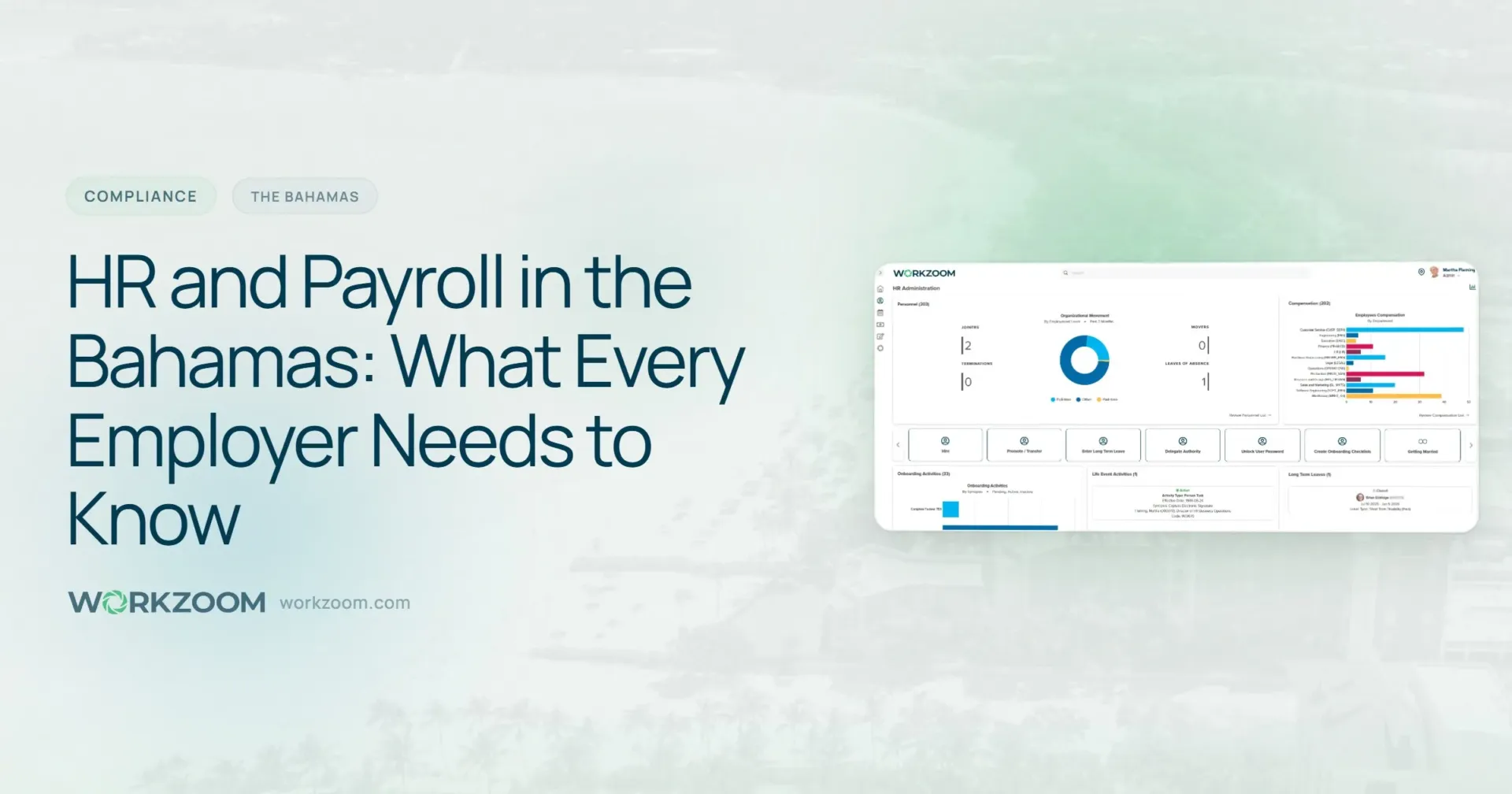
HR and Payroll in the Bahamas: What Every Employer Needs to Know
Complete guide to HR and payroll in the Bahamas. Employment Act, minimum wage, overtime, leave, NIB contributions, termination, severance, and the mistakes employers keep making.
A hotel chain on Cable Beach brought in a new HR director from Miami two years ago. Smart hire. Twenty years of hospitality experience. She spent her first month trying to apply Florida employment practices to Bahamian staff: at-will termination language in offer letters, no severance calculations in the separation process, overtime calculated weekly only with no daily threshold.
By month three, they had two Industrial Tribunal cases and a J$180,000 NIB penalty for late contributions. By month six, she’d rewritten every employment template and told her CEO, “This isn’t Florida. Nothing I assumed applies here.”
HR and payroll in the Bahamas is governed primarily by the Employment Act 2001, which establishes minimum wage ($260/week), overtime rules (1.5x after 8 hours daily or 40 hours weekly, 2x on public holidays), leave entitlements (2 weeks vacation, 1 week sick leave, 13 weeks maternity), notice periods, and severance formulas. Employers must also register with and contribute to the National Insurance Board (NIB) at a combined rate of 9.8% of insurable wages. The framework is specific, the penalties are steep, and the Industrial Tribunal actively enforces worker protections that are significantly stronger than what US or Canadian managers typically expect.
This guide pulls together everything an employer operating in the Bahamas needs to know: the Employment Act in practical terms, NIB obligations, the compliance mistakes that generate the most Tribunal cases, and how workforce management actually works on the ground. If you’ve read our individual guides on specific Bahamas topics, this is the hub that connects them all.
- Minimum wage is $260/week ($6.50/hour) with no tipped-worker rate, no training wage, and no seasonal carve-outs
- Overtime is 1.5x after 8 hours/day or 40 hours/week, and 2x on public holidays and rest days. Maximum daily hours: 12.
- NIB contributions total 9.8%: employer 5.9%, employee 3.9%, on insurable wages up to $740/week
- Severance for non-managerial staff: 2 weeks’ pay per year of service (capped at 24 weeks). Managerial: 1 month per year (capped at 48 weeks).
- 10 public holidays per year, all compensated at double time if worked
- Cable Bahamas (850 employees) and Island Luck (850 employees, 60+ locations) run HR and payroll on Workzoom
The Employment Act 2001: The Framework That Governs Everything
The Bahamas Employment Act 2001 is fifty-three sections of specific, enforceable employment law. Not guidelines. Not recommendations. Statutory requirements with defined penalties.
It replaced a patchwork of older legislation and brought Bahamian labour law broadly in line with International Labour Organization (ILO) conventions. It covers every employer and employee in the Bahamas, with limited exceptions for the Defence Force and police. Hotels, resorts, banks, construction companies, gaming operations, domestic workers. All covered.
The notice periods are specified by tenure. The overtime multipliers are fixed in the statute. The severance formula is arithmetic. The leave entitlements are tiered with specific accrual dates. There is very little room for interpretation, which means there is very little room for excuses when you get it wrong.
We’ve written a comprehensive breakdown of the Employment Act covering every section in detail. This guide focuses on how the Act’s requirements translate into day-to-day HR and payroll operations.
Minimum Wage and Overtime: The Numbers That Matter
The current minimum wage in the Bahamas is $260 per week, effective January 1, 2023. That’s $6.50/hour for a standard 40-hour week. No separate tipped-worker rate. No training wage. No seasonal exemption. The $260 floor is universal.
The National Tripartite Council has signalled another increase is coming, possibly before end of 2026. With only two increases in twenty-two years (from $150 to $210 to $260), the next adjustment could be significant.
Overtime Calculations
Standard workweek: 40 hours. Standard workday: 8 hours. Maximum daily hours: 12, hard cap.
- Beyond 8 hours/day or 40 hours/week: 1.5x regular hourly rate
- Public holidays or scheduled rest days: 2x regular hourly rate
This is where hospitality employers bleed money. A front desk clerk earning $300/week works a 50-hour week during peak season. Their regular hourly rate is $7.50. Overtime rate: $11.25/hour. Those 10 extra hours cost $112.50, not the $75.00 a flat calculation would produce. Across a 200-person resort, the difference between correct and incorrect overtime adds up to tens of thousands per season.
Leave Entitlements: Vacation, Sick Leave, and Maternity
Leave entitlements under the Employment Act are tiered by tenure. They’re mandatory, and the accrual dates are specific enough that getting them wrong by even a few weeks can change an employee’s entitlement.
Annual Leave
- After 6 months: 1 week paid
- After 1 year: 2 weeks paid
- After 2 years: 3 weeks paid
One detail that catches employers: vacation pay must be paid at least one day before the leave starts. Not on the next regular payday. Before the employee walks out the door.
Sick Leave
After 6 months: 1 week (7 days) paid sick leave per year. First sick day doesn’t require a medical certificate; every day after does. No carryover.
Maternity Leave
After 12 months of continuous service:
- 13 weeks total maternity leave
- At least 1 week before expected delivery, 8 weeks after
- 12 weeks paid for NIB contributors (NIB maternity benefit plus employer top-up)
- Dismissal due to pregnancy is automatically unfair, regardless of tenure, from day one of employment
The pregnancy protection is absolute. No qualifying period. No probation exception. No “performance-based” workaround. The Industrial Tribunal has heard every version of that argument and rejected them all.
The 10 Public Holidays
The Bahamas observes 10 public holidays per year: New Year’s Day, Majority Rule Day (January 10), Good Friday, Easter Monday, Whit Monday, Labour Day (first Friday in June), Independence Day (July 10), Emancipation Day (first Monday in August), National Heroes Day (second Monday in October), and Christmas Day.
Any employee required to work on a public holiday earns double time. Not time-and-a-half. Double. For hotels and resorts operating 365 days a year, this is a significant payroll line item that needs to be budgeted, not discovered after the fact.
NIB Contributions: The Payroll Obligation That Never Pauses
Every employer must register with the National Insurance Board and contribute on behalf of every employee. The current rates:
- Employer: 5.9% of insurable wages
- Employee: 3.9% of insurable wages
- Total: 9.8%
- Insurable wage ceiling: $740/week ($38,480/year)
NIB contributions fund sickness benefit, maternity benefit, invalidity benefit, retirement pension, and survivors’ benefit. The employer portion is not optional, and late contributions attract a 10% surcharge plus 1.5% monthly compound interest.
New employers must register with NIB within 7 days of hiring their first employee. New hires must be registered individually. The C10 form (monthly contribution schedule) is due by the 15th of the following month.
We’ve written a complete guide to NIB compliance and C10 forms covering the full mechanics of Bahamian payroll, including the filing process, late payment penalties, and the benefits employees can access through their contributions.
Termination and Severance: Where the Money Is
This is the section of the Employment Act that generates the most Industrial Tribunal cases. The reason is almost always the same: employers either don’t know what they owe or don’t follow the process.
Notice Periods
- Less than 6 months: 1 week
- 6 to 12 months: 2 weeks
- 12+ months (non-managerial): 2 weeks
- Managerial/supervisory: 1 month regardless of tenure
Pay in lieu of notice must include the full wage package: base salary, housing allowance, vehicle allowance, regular benefits. Base salary only is a short payment, and it will be challenged.
Severance Calculation
Any employee with 12+ months of continuous service gets severance upon termination, unless dismissed for serious misconduct (theft, fraud, gross insubordination, gross negligence).
- Non-managerial: 2 weeks’ basic pay per year of service, capped at 24 weeks
- Managerial: 1 month’s basic pay per year of service, capped at 48 weeks
The calculation uses the employee’s average weekly wage over the 12 months preceding termination. Not their current rate. The 12-month average.
Key Takeaway
A manager earning $1,200/week with 8 years of service is owed roughly $41,600 in severance alone, plus notice pay. Miscalculate and the Industrial Tribunal can add up to 26 weeks of additional compensation on top. The 2017 Employment Amendment also blocks the practice of terminating employees and re-engaging them as contractors within 12 months.
For a deeper look at the specific termination mistakes that land employers at the Tribunal, including the redundancy trap and unfair dismissal claims, we’ve covered that in our employer mistakes guide.
Probation: Not a Compliance-Free Zone
The Employment Act allows for probation periods, but probation doesn’t exempt you from minimum wage, overtime, or the prohibition on pregnancy discrimination. Probation employees still have rights. If the probation period isn’t specified in the written statement of employment, the default notice rules apply.
Most employers set probation at 3 to 6 months. Unreasonably long probation periods (12 to 18 months) can be challenged as an attempt to avoid statutory entitlements.
Why Hotels and Resorts Keep Getting This Wrong
The pattern is specific and it repeats. Large hospitality operations managed by executives who built their careers in the US or Canada bring management playbooks from Marriott or Hilton corporate. Those playbooks assume at-will employment, FLSA overtime rules, and a legal environment where termination is relatively frictionless.
The Bahamas is not an at-will jurisdiction. Every termination requires proper notice or pay in lieu. Every employee with 12 months of tenure is entitled to severance. The Industrial Tribunal can order reinstatement or substantial compensation for unfair dismissal.
A 300-room resort running 200 staff during peak season might have 50 employees in overtime every week. If the payroll system calculates overtime using US FLSA rules (weekly threshold only, no daily threshold), it’s underpaying on every shift that exceeds 8 hours, even if the weekly total stays under 40. That liability builds quietly, pay period by pay period.
Running HR in the Bahamas shouldn’t mean guessing at compliance
Workzoom handles payroll, leave tracking, NIB contributions, overtime calculations, and termination workflows for some of the largest Bahamian employers. Cable Bahamas (850 employees) and Island Luck (850 employees across 60+ locations) both run their entire people operation on one platform. $4/employee/month, no implementation fees, month-to-month.
Workforce Management: Scheduling, Time Tracking, and the Data Gap
Everything in this guide, overtime calculations, leave accruals, holiday pay, NIB contributions, depends on accurate time and attendance data. If you don’t know exactly how many hours each employee worked, which days they worked, and whether those days included public holidays, your payroll calculations are estimates.
For hospitality employers with rotating shifts, split shifts, and seasonal fluctuations, manual time tracking creates the exact kind of data gaps that produce NIB underpayments and overtime miscalculations. Our workforce management guide for the Bahamas covers how integrated time-to-payroll systems eliminate these gaps.
The connection between workforce management and compliance isn’t theoretical. When a housekeeper picks up an extra 4-hour shift on Independence Day, that data needs to flow into payroll as double-time hours. If it doesn’t, because it’s written on a paper timesheet that gets transcribed incorrectly, you have an underpayment. Multiply that across a season, and you have a Tribunal case.
Operating Across Multiple Caribbean Markets
Many employers operating in the Bahamas also have operations in Jamaica, Trinidad and Tobago, or Antigua and Barbuda. Each market has its own employment legislation, contribution structures, and filing requirements. The NIB system in the Bahamas, the NIS system in Jamaica, and the NIS in Trinidad all calculate differently, with different rates, different ceilings, and different penalty structures.
Running parallel payroll processes across Caribbean jurisdictions using disconnected systems or spreadsheets is how errors compound across borders. One platform that handles each jurisdiction’s rules natively is the difference between compliance infrastructure and compliance luck.
What’s Coming: Expected Changes to Bahamian Labour Law
The Bahamian government has signalled amendments to the Employment Act expected by mid-2026. Based on National Tripartite Council discussions:
- Statutory paternity leave for the first time
- Expanded maternity benefits
- Alignment with additional ILO conventions
- A further minimum wage increase under active consideration
The pattern with Caribbean labour law is consistent: protections expand, they don’t contract. Employers who build compliance infrastructure now are ready when the rules change. Employers who rely on manual processes will scramble after.
Key Takeaway
The Bahamas Employment Act isn’t ambiguous. The notice periods, overtime multipliers, severance formulas, and leave entitlements are all specified in the statute. Employers don’t end up at the Industrial Tribunal because the law is unclear. They end up there because the systems they use to apply it are inadequate. Cable Bahamas and Island Luck stopped treating compliance as something in someone’s head and started treating it as infrastructure. The Employment Act doesn’t reward good intentions. It rewards consistent execution.
Frequently Asked Questions
Stay in the loop
Canadian HR, payroll, and workforce insights. No spam.
You’re subscribed!
There’s a Fix for This
One platform for HR, workforce, payroll, and talent. $4–$16/employee/month depending on which suites you need. No setup fees, no contracts.
More from the Blog