 Canada
 United States
 Bahamas
 Jamaica
 Trinidad & Tobago
 Antigua & Barbuda
 Barbados
 Anguilla
Trinidad and Tobago Payroll Compliance: NIS, NIB, CPP Synced

Here is what most Trinidad and Tobago payroll guides bury in a footnote: the rates are the easy part. NIS is now 16.2%, with further scheduled increases confirmed by NIBTT. PAYE follows the BIR schedule. None of that is hard to look up, which is why rate tables alone never deliver real payroll compliance.
The actual problem is a reconciliation problem. The moment a Caribbean employer runs payroll in more than one territory, NIS in Trinidad, NIB in the Bahamas, CPP in Canada, the real work becomes proving that three systems agree about the same employee on the same pay date. The errors almost never come from a misread rate table. They come from three spreadsheets drifting apart between pay runs.
Most T&T employers don't lose sleep over the contribution rate. They lose it at month-end, when three payroll systems have to agree about the same employee on the same pay date. That's not a compliance problem. That's a data-architecture problem wearing a compliance problem's clothes. The pattern we see on discovery calls is consistent: the rate table was never the thing that broke.
So this guide covers both halves: the 2026 T&T rates and filing deadlines you need, and the architecture question that decides whether multi-territory payroll is routine or a monthly headache.
Trinidad and Tobago payroll compliance for 2026 requires NIS contributions at 16.2% total, calculated on NIBTT weekly earnings bands, plus PAYE withholding where 70% of the employee NIS is deductible before the tax calculation applies. The challenge for multi-territory Caribbean employers is not understanding the rates but keeping separate payroll systems synchronized without monthly reconciliation errors.
- NIS contributions: 16.2% total in 2026 (employer ~10.8%, employee ~5.4%). Further scheduled increases are published at nibtt.net. Calculated on NIBTT weekly earnings bands, not a flat percentage. Max insurable: TT$13,600/month.
- 70% of the employee NIS contribution is deductible before PAYE applies. Skip this step and you over-withhold on every pay run.
- BIR and NIS remittances: both due by the 14th/15th of the following month
- Multi-territory employers need a unified system to avoid monthly reconciliation errors across jurisdictions
Trinidad and Tobago NIS Contribution Rates for 2026
The Board of Inland Revenue (BIR) administers PAYE in Trinidad and Tobago, while the National Insurance Board of Trinidad and Tobago (NIBTT) administers NIS. As of January 2026, the combined NIS contribution rate is 16.2% of insurable earnings. This is a jump from the previous 13.2%. NIBTT publishes a schedule of future increases. Verify the next planned change at nibtt.net before each plan year.
The employer-employee split is two-thirds employer, one-third employee: approximately 10.8% from the employer and 5.4% from the employee. That two-thirds/one-third ratio is a detail that payroll operations transferring knowledge from other markets routinely miss.
The more important detail: NIBTT does not use a flat percentage of gross earnings. It uses a schedule of weekly earnings bands (insurable earnings classes). Each band maps to a fixed weekly contribution amount. Maximum insurable earnings are capped at TT$13,600 per month. Earnings above that ceiling are not subject to NIS contributions.
You cannot multiply an employee's gross pay by 10.8% and get the correct employer NIS amount. You need to identify the correct earnings class for that pay period and apply the corresponding fixed contribution. Every pay cycle. For every employee.
PAYE Calculation Sequence: Where Employers Make the Costly Mistake
PAYE in Trinidad and Tobago is 25% on chargeable income up to TT$1,000,000 per year, and 30% above that. Personal allowance is TT$90,000 per year (TT$7,500 per month).
The calculation that trips up every spreadsheet-based operation: 70% of the employee's NIS contribution is tax-deductible. The correct sequence is NIS first, then deduct 70% of the employee NIS from gross income along with the personal allowance, then apply the PAYE rate to the remainder.
Reversing this order, or skipping the 70% NIS deduction entirely, produces incorrect PAYE withholding on every single pay period. Employees notice when their net pay is consistently wrong. The BIR notices at year-end TD4 reconciliation.
Health Surcharge and Filing Deadlines
Beyond NIS and PAYE, employers must deduct a weekly Health Surcharge: TT$8.25 per week for employees earning above TT$469.99 per month, and TT$4.80 per week for those earning at or below that threshold. The employer matches the employee deduction. At roughly TT$430 per employee per year for most workers, it is easy to underestimate in budget projections. Auditors will check it.
The Health Surcharge is remitted to the Board of Inland Revenue alongside PAYE. It must appear on employee pay slips as a distinct line item. Missing it or folding it into PAYE creates a reconciliation problem at year-end TD4 preparation.
Filing calendar:
- NIS remittance to NIBTT: by the 14th of the following month
- PAYE and Health Surcharge to BIR: by the 15th of the following month
- Quarterly BIR summaries: 15 days after each quarter-end
- Annual TD4 returns: summarizing each employee's earnings, deductions, and tax withheld for the calendar year
Running T&T Payroll Alongside the Rest of the Caribbean
Most multi-territory employers run a separate payroll system per country, then reconcile the figures by hand every month. That is where the errors live. The unified approach works differently. One employee record spans all territories. When someone gets promoted or changes pay rate, it updates everywhere at once. NIS for Trinidad and Tobago, NIB for the Bahamas, CPP for Canada, all calculated from the same source.
Cable Bahamas, a roughly 850-person telecom operation in the Bahamas, cut payroll processing from 5 days to 1.5 days after consolidating onto a single platform, a 70% reduction in cycle time. That is a Bahamas result, not a T&T result, and it is worth naming it honestly as that. The mechanism behind it, one employee record, one calculation engine, no cross-system reconciliation, is what removes the monthly reconciliation problem from any multi-territory Caribbean operation.
T&T HR, Workforce, and Talent available on Workzoom today
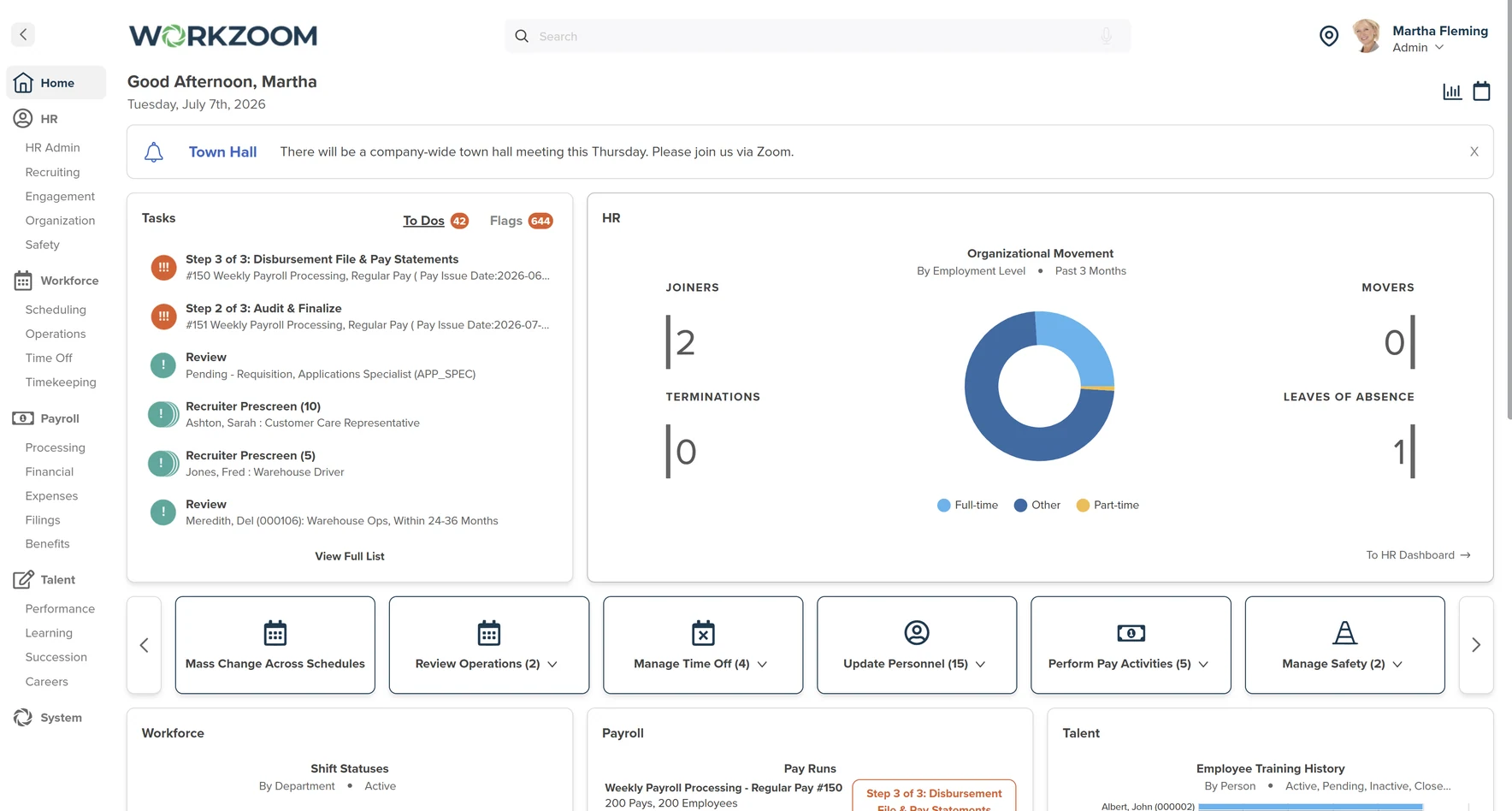
Workzoom is capable of handling NIBTT earnings bands, the NIS-to-PAYE deduction sequence, Health Surcharge, and BIR filings. HR, Workforce, and Talent are available for T&T employers today; contact us about payroll for Trinidad and Tobago and your timelines. Starting at $4/employee/month, no setup fees, no contracts.
Book a 30-Minute WalkthroughCommon Compliance Mistakes
The same errors appear across Caribbean payroll operations. They are predictable and preventable.
Applying a flat NIS percentage instead of using earnings bands. The NIBTT contribution table maps weekly earnings ranges to fixed contribution amounts. Using a flat 10.8% or 5.4% split produces incorrect amounts for most employees. The error is small per pay period but compounds across the workforce over time.
Forgetting the 70% NIS deduction before PAYE. Seventy percent of the employee's NIS contribution reduces chargeable income before the tax rate applies. Skipping this step means over-withholding income tax from every employee on every pay period.
PAYE allowance timing errors. Personal allowances are annual amounts converted to monthly withholding. Systems that do not track year-to-date allowances create incorrect withholding amounts, particularly for employees hired mid-year.
Filing deadline confusion. NIS is due by the 14th. BIR PAYE by the 15th. BIR quarterly summaries 15 days after quarter-end. Different schedules, different authorities. Paper-based tracking cannot flag approaching deadlines across multiple compliance calendars.
Multi-territory employee classification gaps. Someone works in Trinidad for six months, transfers to Bahamas operations for six months. Which country's tax residency rules apply? Manual tracking loses this context and creates exposure in both jurisdictions.
What T&T Payroll Compliance Requires at the System Level
Effective T&T payroll compliance requires more than a rate table. The system needs to handle:
- NIBTT earnings band lookups and fixed contribution amounts per employee per pay period
- PAYE calculation with the correct NIS deduction sequence built in
- Year-to-date allowance tracking so mid-year hires are calculated correctly
- Health Surcharge with employer-match tracking
- TD4 generation without days of manual reconciliation at year-end
- Effective-dated changes that cascade across all downstream calculations
For multi-territory employers, those same requirements multiply across jurisdictions. The architecture question is whether each territory runs on its own system (and requires monthly reconciliation) or whether one employee record handles all of them. Our complete T&T HR and payroll guide covers the employment law layer: leave entitlements, the 14 statutory public holidays, termination obligations under the Retrenchment and Severance Benefits Act, and the Industrial Court's role in resolving disputes.
T&T payroll compliance is a sequence of interdependent calculations: NIBTT earnings bands first, then 70% of employee NIS deducted from gross income, then PAYE applied to the remainder, then Health Surcharge on top. At 16.2% and with further scheduled increases ahead, every miscalculation in that sequence is more expensive than it was two years ago. The employers who stay clean are not more careful. They have systems that encode the rules instead of relying on someone remembering them. That is a living calculation that updates itself, as opposed to a spreadsheet someone has to remember to fix every pay period.
If you want the layers underneath this guide, our 2026 NIS and BIR filing breakdown goes deeper on the remittance mechanics, and our guide to T&T termination notice and severance covers the obligations that sit alongside the payroll calculation.
See Workzoom in 30 minutes.
Real product, real questions, no slides. Starts at $4 per employee per month, CAD or USD, with $0 setup fees.
What readers ask after this post on Trinidad Tobago payroll compliance.
Our clients
The teams that run their people on Workzoom.













Workzoom handles HR, payroll, workforce, and talent on one employee record. Book a 30-minute walkthrough.