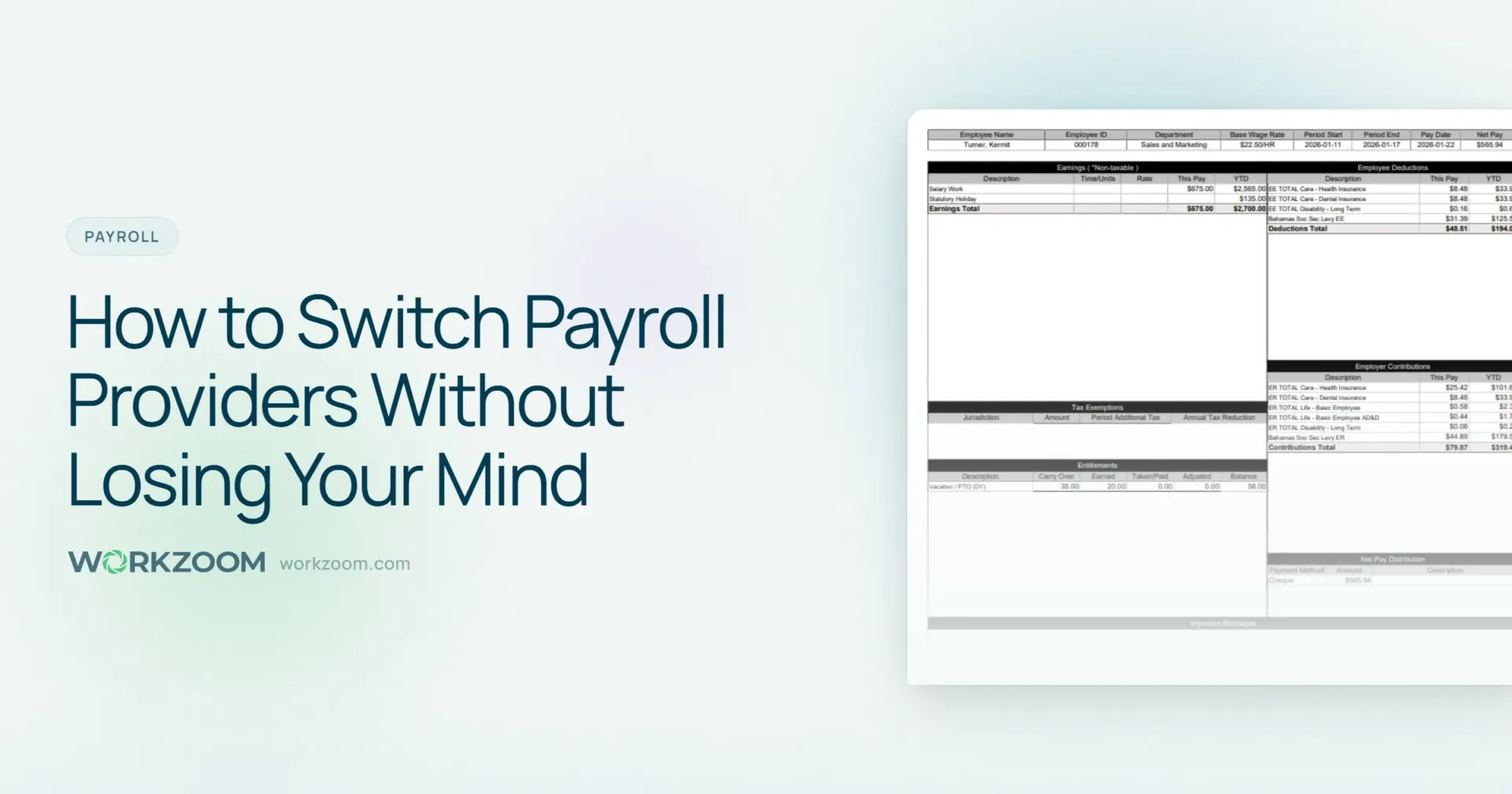
Your Payroll Passed. Your Configuration Didn’t.
A clean payroll run doesn’t mean compliant payroll. Here are six configuration errors that pass every audit and cost Canadian employers thousands.
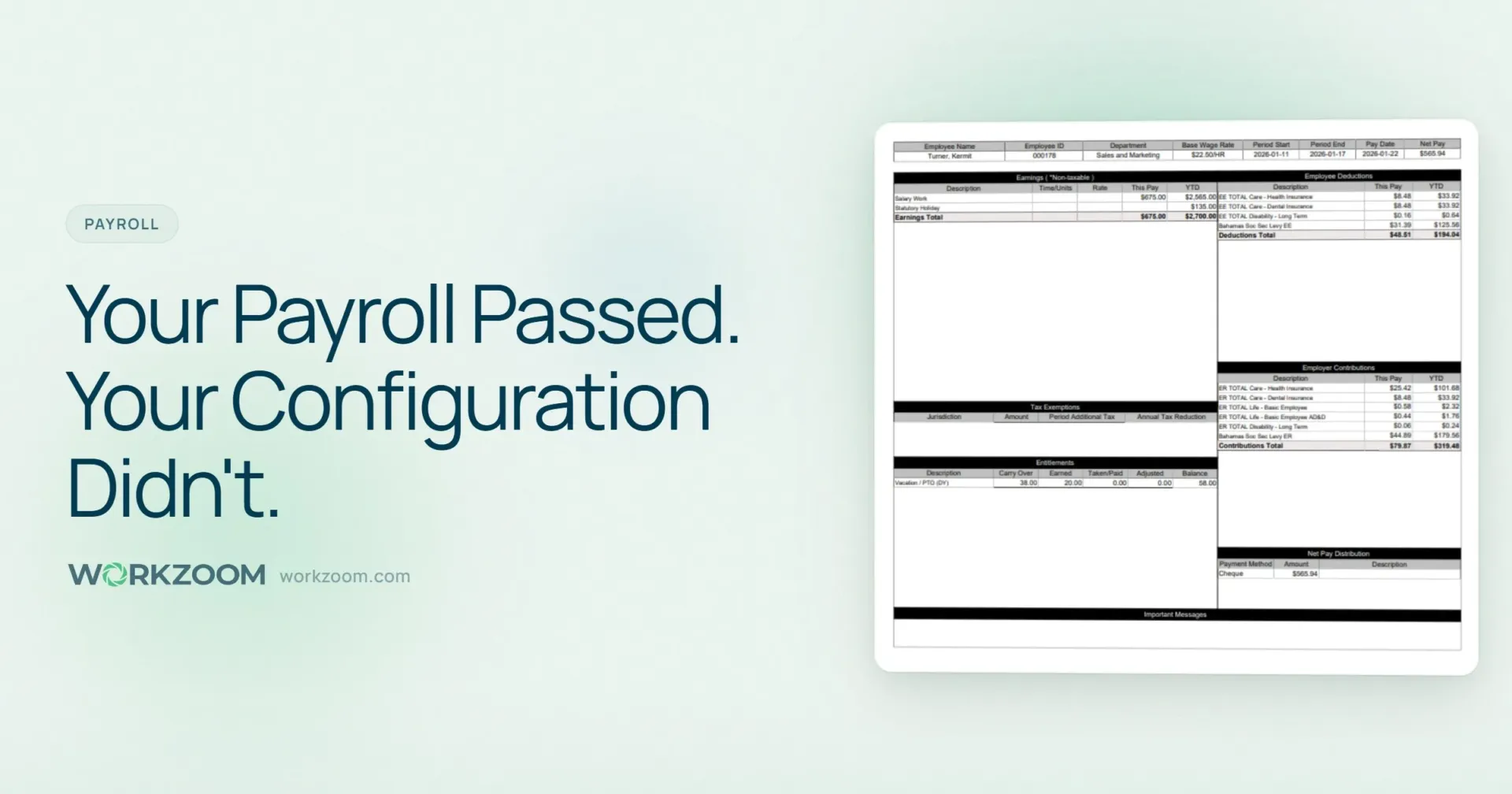
The pay run completed at 11:47 AM on a Thursday. Zero errors. Zero warnings. The system sent the confirmation email and your payroll admin closed the tab.
Nobody looked closer. Why would they? The system said it passed.
Three months later, a department manager flagged that her team’s overnight differential had been calculating at the 2022 rate since a contract renewal nobody updated in the system. Forty-three employees. Fourteen months of under-calculation. The number, when someone finally ran it, was not small.
The payroll had “passed” every single run.
What “No Errors” Actually Means
Payroll software is very good at catching math errors. If an employee is configured to receive a deduction that exceeds their net pay, the system flags it. If a tax code is formatted incorrectly, you’ll hear about it. If a remittance schedule doesn’t balance, the run won’t complete.
What payroll software cannot do is tell you whether the numbers it started with were right.
“No errors” means the calculation executed. It does not mean the inputs were accurate. It does not mean the rules matched your current collective agreement. It does not mean the overtime threshold reflects the role reclassification you did in Q3. It does not mean anything about correctness. It just means the math ran cleanly.
This distinction matters more than most Canadian payroll guides will tell you. Configuration drift, the slow divergence between what your system thinks is true and what is actually true, is invisible to error logs. It doesn’t trigger warnings. It compounds quietly, pay run by pay run, until someone manually checks or an employee complains.
Running payroll across disconnected systems?
When scheduling, HR records, and payroll share one database, a rate change applies everywhere at once. No export, no reimport, no gap. Workzoom is $4/employee/month per suite, no implementation fees, month-to-month billing.
The Six Things That Drift
These are the configuration settings that organizations most commonly let go stale. Each one passes every payroll audit. Each one costs real money.
1. Overtime thresholds after a role reclassification
An employee moves from hourly to salaried, or from one employment classification to another. Someone updates the title and pay rate. Nobody updates the overtime configuration. The system keeps applying daily overtime rules to a role that’s now exempt, or misses overtime on a role that isn’t. Either way, the run passes. The underpayment or overpayment accumulates.
2. Statutory holiday banks that never reset
Many Canadian payroll systems track stat holiday entitlements in a running bank. That bank needs to reset at the right time, calculated the right way, using the right look-back period for your province. When it doesn’t, employees either carry phantom credits or lose entitlements they earned. Your employment standards obligation doesn’t care what your software bank says.
3. Tax provinces on remote workers
This one accelerated post-pandemic. An employee who used to commute to your Toronto office now works from New Brunswick full time. Their province of employment for tax purposes changed. If nobody updated it in the system, they’ve been withholding at the wrong provincial rate for however long they’ve been remote. CRA considers this the employer’s problem, not the employee’s.
4. Benefit deductions tied to a plan that changed
Your group benefits provider updated plan costs in January. Someone updated the master plan document. The payroll deduction amount, sitting in a configuration table that nobody thinks to audit, still reflects the old split. Your employees are either being under-deducted or over-deducted, and neither they nor you have noticed because the run passes clean.
5. Differential rates from an expired collective agreement
This is the scenario from the opening. A collective agreement renews. The new rates get communicated to management and filed in the labour relations folder. The payroll configuration, which is a separate system maintained by a separate team, doesn’t get updated. This is not a theoretical risk. It happens constantly in unionised environments because the people who negotiate agreements and the people who configure payroll systems almost never sit in the same room.
6. Termination tax not configured for a new operating province
You expanded operations into Alberta. You hired staff there. Someone set up the location, the cost centre, the reporting structure. The termination pay configuration for Alberta, which has different rules than Ontario on several points including vacation pay on termination, was never set up. The first time you terminate an Alberta employee, the system processes it using whatever default it found. Sometimes that default is another province’s rules. Sometimes it’s nothing at all.
The pattern here
Every one of these errors has the same root cause: payroll configuration lives in a separate system from the HR events that should trigger updates to it. A role changes in your HRIS. A contract renews in your labour relations folder. An employee moves provinces in an email to IT. None of those events automatically touches payroll configuration unless someone manually bridges the gap. And that bridge gets missed more often than anyone wants to admit.
Why Integrated Systems Change This
The argument for connected HR and payroll isn’t efficiency. Efficiency is a nice side effect. The argument is accuracy.
When scheduling rules, HR records, and payroll configuration live in the same database, a collective agreement rate update applies everywhere at once. You change the differential in the labour agreement module and it is immediately the rate the pay run uses. There is no export, no reimport, no email to the payroll team, no gap between when the change is authorised and when the calculation reflects it.
Remote work status is part of the employee record. When it changes, the provincial tax configuration follows. Benefit plan updates flow from HR to deductions without a separate data entry step. Overtime rules attach to the role, so when the role changes, the overtime configuration changes with it.
This isn’t magic. It’s just what happens when the system of record for employment information is also the system of record for payroll inputs. The drift that accumulates in disconnected stacks can’t accumulate if there’s nothing to drift between.
We built Workzoom this way because the alternative, asking organizations to manually maintain configuration parity across separate HR, scheduling, and payroll tools, is a process that requires perfect execution every time, at every event, by every person involved. That’s not a reasonable operational expectation. At some point, something gets missed.
Read: 7 Signs Your Payroll System Is Failing
The Audit You’re Not Running
If you’re running payroll on a system that doesn’t connect to your HR records, here’s what an honest configuration audit looks like. Most payroll teams have never done this formally.
Quarterly: Pull your active differential and premium rates and compare them line by line against your current collective agreements or compensation policies. Not the old ones. The current ones.
Annually: Review every employee’s province of employment for tax purposes. Cross-reference against their actual work location as it currently stands, not as it was when they were hired.
On every role change: Audit the overtime classification, benefit deduction, and any position-specific pay rules attached to the old role. Don’t assume they transfer correctly to the new one.
On every benefit renewal: Treat it as a payroll event, not just an HR event. The person who handles the renewal should have a checklist item that says “update payroll deductions.” Not “ask payroll to update deductions.” That ask gets lost.
When you expand to a new province: Before the first hire, configure termination pay, statutory holiday rules, and overtime thresholds for that province. Not after. Before.
None of this is complicated. It’s just not automatic. And if your systems require it to be manual, it will eventually not happen.
Worth saying plainly
A clean pay run is not evidence of correct payroll. It’s evidence that the math worked. Those are different things. The question to ask your payroll team isn’t “did the run pass?” It’s “when did we last verify the configuration it ran on?”
If the answer is “we’ve never done that formally,” that’s where the audit starts.
For more on what compliance actually requires, the Canadian payroll deductions guide covers the CRA requirements in detail. And if you want to stress-test your current setup, the HR compliance checklist for 2026 has a section specifically on payroll configuration review.
If your system requires manual bridges between HR events and payroll configuration, we should probably talk about whether that’s a sustainable arrangement for your organization’s size and rate of change. Not a pitch. Just a conversation worth having.
Frequently Asked Questions
Stay in the loop
Canadian HR, payroll, and workforce insights. No spam.
You’re subscribed!
See What $4/Employee Gets You
One platform for HR, workforce, payroll, and talent. $4–$16/employee/month depending on which suites you need. No setup fees, no contracts.
More from the Blog