Payroll in Antigua and Barbuda: What Every Employer Must Know
Complete guide to Antigua payroll compliance: NIB, ABST, income tax withholding, pay periods. Everything employers need to avoid penalties and stay compliant.
The pattern shows up in IRD audits across Antigua with regularity. Payroll processed the same way for fifteen years. Paper timesheets, manual calculations, cash payments to a portion of staff. It worked, until the Inland Revenue Department started asking questions the old system couldn’t answer.
Payroll compliance in Antigua and Barbuda requires employers to navigate multiple statutory obligations: National Insurance Board (NIB) contributions, Antigua Barbuda Sales Tax (ABST), income tax withholding, and specific pay period requirements. Penalties for non-compliance can reach 25% of unpaid amounts plus interest, making accurate payroll processing essential for business operations.
- NIB contributions: 5% employee, 5% employer on wages up to $7,200 monthly
- ABST applies at 15% on taxable supplies and services
- Income tax withholding required for all employees earning above $20,000 annually
- Monthly pay periods are standard, but weekly and bi-weekly are permitted
- Penalties for late filing start at $500 and escalate to 25% of outstanding amounts
That conversation captures the reality for many Antiguan employers. You’ve built a successful business, created jobs, contributed to the economy. But payroll compliance? That’s become a moving target with consequences that can shut down operations.
The challenge isn’t just understanding the rules, it’s implementing systems that keep you compliant as those rules change. And in Antigua, they’re changing faster than most employers realize.
Understanding Antigua’s Payroll Tax Structure
Antigua and Barbuda operates a multi-layered payroll system that catches many employers off guard. Unlike countries with simple percentage-based taxation, Antigua requires employers to calculate and remit across four distinct categories: National Insurance Board contributions, income tax withholding, Antigua Barbuda Sales Tax obligations, and various statutory deductions.
The National Insurance Board contribution forms the foundation of Antigua’s social security system. Both employers and employees contribute 5% of monthly wages, but only up to the $7,200 ceiling. This means an employee earning $10,000 monthly pays NIB on $7,200, creating a regressive structure that affects high earners less than middle-income workers.
Here’s where it gets complicated: the NIB ceiling applies monthly, not annually. An employee who earns $6,000 in January and $8,000 in February pays NIB on the full $6,000 in January but only on $7,200 in February. Most payroll systems calculate this incorrectly because they’re built for annual caps, not monthly ones.
The Antigua Barbuda Sales Tax adds another layer of complexity. ABST applies at 15% on taxable supplies and services, but determining what constitutes a taxable service in the context of employment can be murky. Employee benefits, company vehicles, and accommodation allowances may all trigger ABST obligations, often without the employer realizing it.
Income tax withholding operates on a progressive scale starting at $20,000 annual income. But the brackets aren’t straightforward. The first $20,000 is tax-free, the next $20,000 is taxed at 10%, and income above $40,000 faces a 25% rate. Sounds simple until you factor in allowances, overtime calculations, and the interaction with NIB contributions.
Tired of calculating Antigua payroll by hand?
Workzoom handles NIB, ABST, and income tax calculations automatically for Caribbean employers, starting at $4/employee/month with no implementation fees and month-to-month billing.
See Caribbean payroll compliance in actionNIB Contributions: The Foundation You Can’t Ignore
The National Insurance Board isn’t just another deduction, it’s the bedrock of Antigua’s social safety net. And getting it wrong doesn’t just trigger penalties; it affects your employees’ future benefits calculations.
NIB contributions fund old age pensions, disability benefits, survivor benefits, and unemployment assistance. The 5% employee and 5% employer contributions (10% total) apply to all wages up to $7,200 monthly. But the devil lives in the details of what constitutes “wages.”
Base salary is straightforward. But overtime, bonuses, commissions, allowances, and benefits in kind all require careful consideration. The NIB includes most forms of remuneration in the contribution calculation, but certain statutory payments are excluded. Severance pay, for instance, doesn’t attract NIB contributions. Neither do reimbursements for actual expenses incurred.
NIB audits regularly surface this exact error: employers who excluded overtime from contribution calculations because that was always the practice. Back-contributions assessed across three years of payroll, plus penalties, can be devastating for a small operation.
The monthly ceiling creates interesting scenarios for employers with seasonal operations. A hotel worker who earns $4,000 during the slow season and $9,000 during peak months will have varying NIB obligations. Most manual payroll systems struggle with this variability because they’re not built to track monthly vs. annual caps.
NIB filing requirements are strict: contributions must be remitted by the 15th of the following month. Late filings incur immediate penalties, starting at $25 per day and escalating to $500 after thirty days. For employers with 100+ employees, those daily penalties add up faster than most realize.
The National Insurance Board also requires detailed reporting on new hires, terminations, and wage changes. Form NIB-1 must be filed within seven days of hiring any employee. Form NIB-2 reports wage changes within 30 days. Miss these deadlines, and you’re looking at additional penalties on top of any contribution shortfalls.
Income Tax Withholding: Progressive Rates, Complex Calculations
Antigua’s income tax structure appears simple on paper but becomes complex in practice, especially for employers managing diverse workforces with varying pay structures.
The tax-free threshold of $20,000 annually means employees earning less face no income tax withholding. But for seasonal businesses, this creates monthly calculation challenges. An employee earning $1,500 monthly ($18,000 annually) pays no income tax. But if they earn $2,000 in any given month due to overtime, that month’s calculation becomes more complex.
The progressive brackets create withholding complexity:
- $0 – $20,000: 0% tax rate
- $20,001 – $40,000: 10% tax rate
- Above $40,000: 25% tax rate
But these are annual figures applied to monthly paychecks. An employee earning $50,000 annually should have income tax withheld on $30,000 of their income (the amount above the $20,000 threshold). The first $20,000 of that taxable income is taxed at 10%, and the remaining $10,000 at 25%.
Translating this to monthly withholding requires employers to either annualize each paycheck or maintain running totals throughout the year. Most employers attempt the monthly approach, leading to over-withholding early in the year and under-withholding later, creating cash flow issues for both employer and employee.
Allowances complicate the calculation further. The Inland Revenue Department allows certain deductions that reduce taxable income: professional dues, union fees, and pension contributions. But determining which allowances qualify requires careful interpretation of the Income Tax Act.
Income tax withholding errors compound throughout the year. A $50 monthly mistake becomes a $600 annual discrepancy that triggers penalties and requires employee tax adjustments.
Bonus payments create additional withholding challenges. The Inland Revenue Department treats bonuses as supplemental income, but the withholding method depends on timing and amount. Bonuses paid in separate checks are typically subject to flat-rate withholding. Bonuses included in regular paychecks require aggregate method calculations that many employers handle incorrectly.
ABST Obligations: Beyond Simple Sales Tax
The Antigua Barbuda Sales Tax affects payroll in ways most employers don’t anticipate. While ABST primarily applies to goods and services, certain employment-related benefits trigger tax obligations that catch payroll administrators off guard.
ABST applies at 15% to taxable supplies and services. In the employment context, this includes company-provided vehicles, accommodation allowances, and certain fringe benefits. The challenge lies in determining when an employment benefit becomes a taxable service subject to ABST.
Company vehicles present the most common ABST trap. When an employer provides a vehicle for business and personal use, the personal use component may constitute a taxable service. The ABST applies to the imputed value of personal use, requiring employers to track business vs. personal mileage and calculate appropriate tax obligations.
IRD audits consistently identify ABST owed on company vehicle personal use. Employers often have no idea the exposure exists until the assessment arrives, covering multiple years of back-tax plus penalties.
Housing allowances create similar complexity. When an employer provides accommodation or pays housing allowances, the arrangement may trigger ABST depending on the structure. Direct rental payments to landlords are typically exempt, but cash allowances to employees may be considered taxable services.
Meal allowances, training expenses, and professional development funding all require ABST analysis. The key test is whether the benefit constitutes a taxable service under ABST regulations. Unfortunately, the line between exempt employment benefit and taxable service isn’t always clear.
ABST filing requirements are monthly, with returns due by the 15th of the following month. Like NIB contributions, late filing triggers immediate penalties. But ABST penalties are more severe: 5% of the tax due for the first month, escalating to 25% for extended non-compliance.
Pay Period Requirements and Timing
Antigua’s Labour Code doesn’t mandate specific pay periods, but it does establish minimum payment frequency requirements that affect payroll administration and compliance timing.
Most employers operate on monthly pay periods, paying employees on the last working day of each month. This aligns with statutory filing requirements for NIB contributions, income tax withholding, and ABST obligations, all due by the 15th of the following month.
But weekly and bi-weekly pay periods are permitted and sometimes necessary for hourly workers or seasonal operations. The challenge with more frequent pay periods is maintaining compliance with monthly reporting requirements while managing cash flow.
Weekly payroll creates particular challenges for NIB calculations. Remember, NIB contributions apply to monthly wages up to $7,200. With weekly pay periods, employers must track cumulative monthly wages to ensure proper NIB calculations. An employee earning $2,000 weekly should pay NIB on only $7,200 of their $8,000+ monthly wages.
The timing of statutory remittances doesn’t change based on pay period frequency. Whether you pay employees weekly or monthly, NIB contributions, income tax withholding, and ABST obligations are still due by the 15th of the following month. This creates cash flow planning requirements that many employers underestimate.
Overtime calculations add complexity to pay period management. Antigua’s Labour Code requires overtime pay for work beyond 40 hours per week at 1.5x the regular rate. But calculating overtime across different pay periods requires careful tracking of work hours and pay period boundaries.
Pay period frequency affects payroll complexity but not compliance deadlines. Weekly payroll with monthly NIB caps requires more sophisticated tracking than many manual systems can handle reliably.
Holiday pay presents another timing challenge. Antigua recognizes multiple public holidays throughout the year, and the Labour Code requires premium pay for holiday work. But determining which holidays apply to which employees (based on religious affiliation or employment terms) requires advance planning and systematic tracking.
Common Compliance Pitfalls and How to Avoid Them
After working with dozens of Antiguan employers, certain compliance mistakes appear repeatedly. Understanding these patterns can save thousands in penalties and administrative headaches.
The NIB ceiling trap: Most employers understand the $7,200 monthly NIB ceiling but fail to implement it correctly. They either apply an annual ceiling (incorrect) or forget to reset the calculation each month. The result is under-withholding that creates employee benefit issues and penalty exposure.
The overtime classification error: Antigua’s overtime laws seem straightforward, 1.5x regular rate for work beyond 40 hours per week. But determining who qualifies for overtime (non-exempt vs. exempt employees) and calculating the “regular rate” for employees with varying pay structures trips up many employers.
The ABST blind spot: Most employers focus on NIB and income tax while ignoring ABST implications of employee benefits. Company vehicles, housing allowances, and meal programs can create significant ABST liability that compounds over time.
Employers who file NIB and income tax on time often have no awareness that company vehicles and housing allowances create separate ABST exposure. By the time an audit surfaces the issue, multiple years of back-tax have accumulated alongside the penalties.
The filing deadline cascade: Miss one filing deadline, and the penalties often trigger cash flow problems that make subsequent filings late. The 15th-of-the-month deadline for multiple obligations means one bad month can create a penalty spiral.
The seasonal calculation error: Tourism-dependent businesses with seasonal employees often struggle with annualized tax calculations. Employees who work six months at high wages face different withholding requirements than year-round employees earning the same total amount.
Avoiding these pitfalls requires systems thinking, not just compliance checking. Each payroll cycle should include verification steps for NIB ceiling calculations, overtime classification reviews, and ABST benefit analysis. Manual processes make this verification time-consuming and error-prone.
Record Keeping and Audit Preparation
The Inland Revenue Department and National Insurance Board conduct regular employer audits, particularly for businesses with 50+ employees. Proper record keeping isn’t just good practice, you need to for surviving these audits without catastrophic penalties.
Required payroll records include:
- Employee wage records: Base pay, overtime, bonuses, allowances, and benefits for each employee
- Time and attendance records: Hours worked, overtime hours, holiday time, and leave taken
- Tax withholding calculations: Monthly and year-to-date withholding for income tax, NIB, and any other deductions
- Benefit valuation records: Documentation of how employee benefits were valued for tax purposes
- Filing confirmations: Proof of timely filing for all monthly returns and remittances
The retention period for payroll records is seven years from the date of filing. But practical audit preparation requires organizing records for easy retrieval and analysis. Auditors typically request three years of data initially, expanding the scope based on their findings.
Electronic record keeping offers advantages beyond storage efficiency. Digital records allow for rapid data analysis, trend identification, and cross-referencing that can identify compliance issues before they become audit findings. But digital systems must include backup procedures and audit trails to maintain credibility.
Common audit triggers include:
- Significant changes in employment levels or wage structures
- Late or inconsistent filing patterns
- Industry-wide audits (particularly tourism and construction)
- Cross-referencing with other employers or industry data
- Whistleblower complaints from current or former employees
Audit preparation should be ongoing, not reactive. Monthly reconciliation of payroll records against filed returns can identify discrepancies early. Quarterly reviews of benefit valuations and ABST calculations help ensure consistency. Annual reviews of employee classifications and overtime calculations catch systematic errors before they compound.
Technology Solutions for Compliance Management
Manual payroll processing might work for very small employers, but businesses with 50+ employees need systematic approaches to manage Antigua’s compliance requirements reliably.
Spreadsheet-based payroll systems create multiple failure points. NIB ceiling calculations require monthly tracking that spreadsheets handle poorly. Income tax withholding across different pay periods requires complex formulas that are difficult to audit and update. ABST calculations on employee benefits require ongoing benefit valuation that manual systems rarely handle consistently.
The question isn’t whether to automate payroll compliance, it’s how to choose systems that handle Antigua’s specific requirements correctly.
Key system requirements for Antiguan payroll compliance:
- Monthly NIB ceiling calculations: Automatic tracking of monthly wages against the $7,200 ceiling
- Progressive income tax withholding: Proper calculation of withholding across Antigua’s three-bracket system
- ABST benefit tracking: Systematic valuation and taxation of employee benefits subject to ABST
- Multi-period overtime calculations: Accurate overtime calculations regardless of pay period frequency
- Statutory filing integration: Automatic generation of required forms and returns
- Audit trail maintenance: Complete record keeping with historical data access
Payroll compliance technology should eliminate calculation errors, not just speed up manual processes. The right system makes compliance automatic rather than requiring constant attention.
We’ve worked with Antiguan employers ranging from 50-employee hotels to 500-employee resort chains. The compliance challenges scale with employee count, but the underlying requirements remain consistent: accurate calculations, timely filing, and comprehensive record keeping.
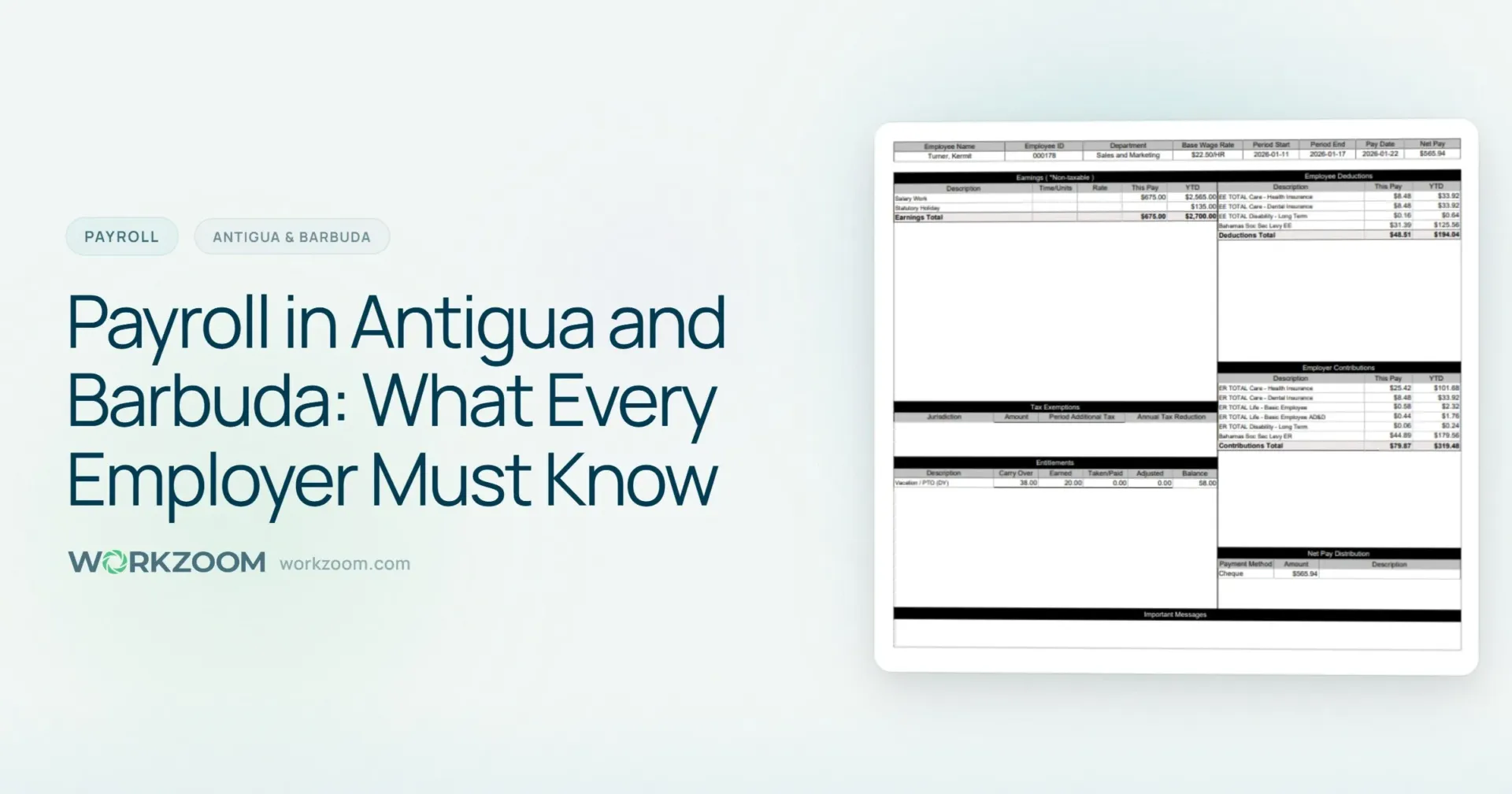
Workzoom’s Caribbean payroll suite handles Antigua’s specific compliance requirements, including monthly NIB ceiling calculations, progressive income tax withholding, and ABST benefit tracking. The system automatically generates required filings and maintains complete audit trails, making compliance management systematic rather than reactive.
Planning for Compliance Success
Sustainable payroll compliance requires planning beyond monthly filing requirements. Successful employers build compliance management into their operational rhythms, creating systems that maintain accuracy under pressure.
Monthly compliance routines should include:
- Pre-payroll verification: Review employee status changes, overtime calculations, and benefit valuations before running payroll
- Post-payroll reconciliation: Verify NIB ceiling calculations, income tax withholding, and ABST obligations after payroll processing
- Filing preparation: Prepare statutory returns immediately after payroll to avoid end-of-month deadline pressure
- Payment scheduling: Schedule statutory remittances to ensure timely payment by the 15th deadline
Quarterly reviews provide opportunities to catch systematic errors before they compound:
- Employee classification review: Verify overtime eligibility and benefit entitlements
- Benefit valuation analysis: Review ABST implications of employee benefits and allowances
- Calculation methodology audit: Verify that payroll calculations align with current regulations
- Record keeping assessment: Ensure payroll records meet audit requirements and retention standards
Annual planning allows employers to prepare for regulatory changes and compliance improvements:
- Regulatory update review: Stay current with changes to NIB rates, income tax brackets, and ABST requirements
- System capability assessment: Evaluate whether current payroll systems meet growing compliance needs
- Training and development: Ensure payroll staff understand current requirements and system capabilities
- Audit preparation: Organize records and procedures for potential regulatory audits
The goal isn’t perfect compliance, it’s sustainable compliance. Systems and procedures that work under normal conditions but fail during busy periods or staff changes create more problems than they solve. The best compliance strategies are those that function reliably even when everything else is chaotic.
Antiguan employers face complex payroll compliance requirements, but the consequences of getting them wrong are predictable: penalties, back-tax assessments, and administrative burdens that distract from business operations. The solution isn’t working harder at compliance, it’s building systems that make compliance automatic.
Whether you’re managing payroll for 50 hotel employees or 500 resort workers, the underlying principle remains the same: invest in systems that handle complexity so you can focus on running your business. Your employees, your bottom line, and your peace of mind will all benefit from getting payroll compliance right the first time.
Frequently Asked Questions
Get insights like this in your inbox
Practical HR, payroll, and workforce tips for employers across Canada and the Caribbean. No spam, unsubscribe anytime.
See Automated Payroll in Action
One platform for HR, workforce, payroll, and talent. $4–$16/employee/month depending on which suites you need. No setup fees, no contracts.
Get a WalkthroughMore from the Blog