 Canada
 United States
 Bahamas
 Jamaica
 Trinidad & Tobago
 Antigua & Barbuda
 Barbados
 Anguilla
BambooHR Alternatives: Four Options With Canadian Payroll

Most buyers don't leave BambooHR because they found something better. They leave because the renewal email finally costs more than the workaround was hiding. Most BambooHR comparisons get it wrong: it's not a features race, it's a total-cost question. Every "alternatives" list ranks platforms by feature count, then quietly skips the integration tax, the implementation fee, and the second payroll vendor you need the day you hire in Canada. This shortlist does the math the other lists skip. Full disclosure before you read a word of it: Workzoom is one of the alternatives on this list, and we'll be upfront about that throughout. We'll still cover what BambooHR does well, why people leave, and who the realistic alternatives are, with actual pricing wherever it is published. We would rather you pick the right system than pick us.
The strongest BambooHR alternatives for mid-market buyers are Workzoom (Canadian and US payroll native, $4/employee/month), Rippling (tech-forward, modular), Paylocity (US payroll-first), and HiBob (engagement-focused). The honest differentiator is payroll: BambooHR has no native Canadian payroll, which forces a second vendor contract. For organizations that need HR and payroll in one system, that gap is the deciding factor.
- Companies leave BambooHR over price increases (some report 30%+ at renewal), no native payroll outside the United States, limited reporting, and limits past 200-300 employees
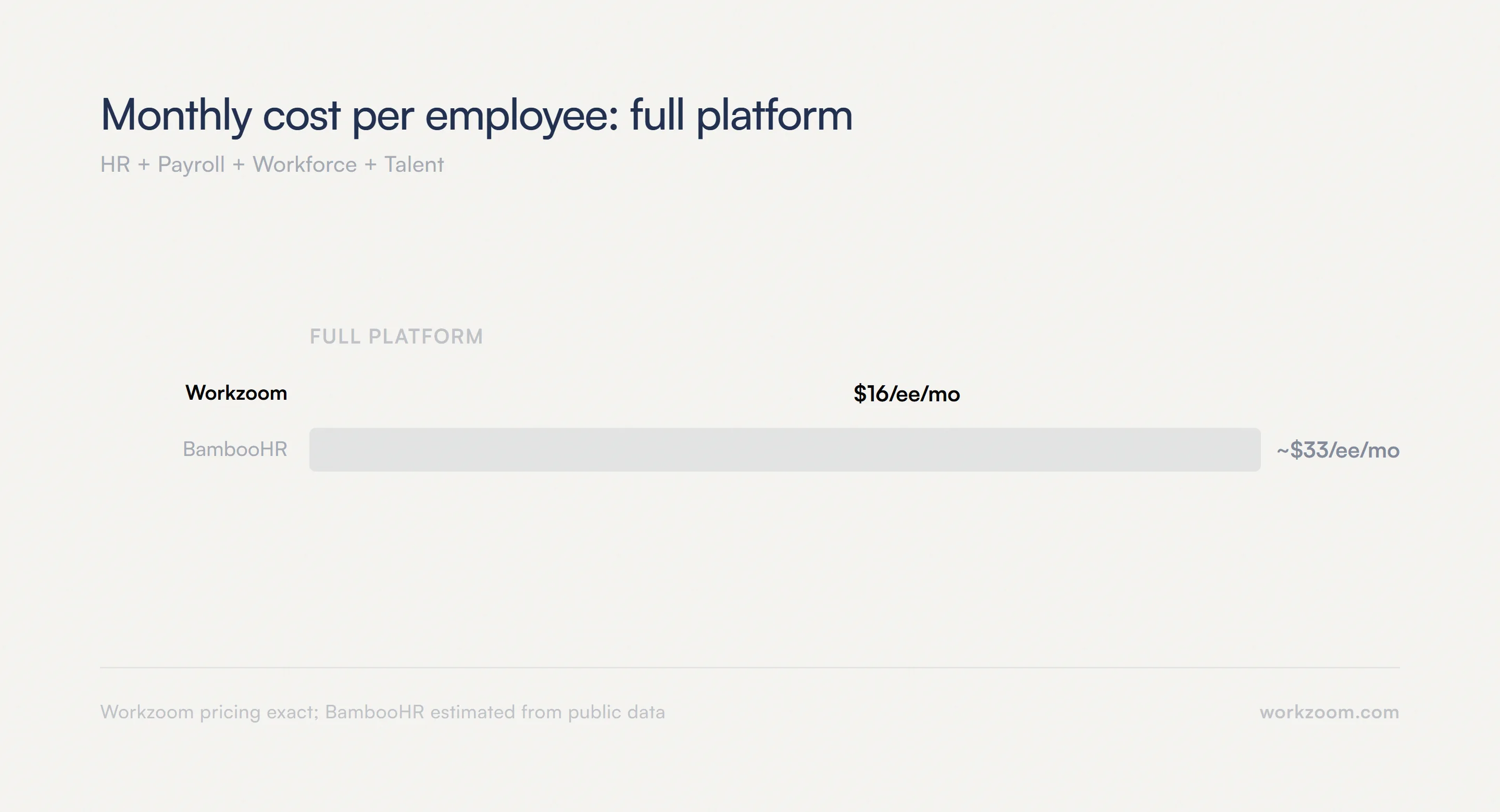
- Industry estimates put BambooHR at $12 to $22 per employee per month, before payroll, time, or performance add-ons
- For Canadian buyers, BambooHR requires a third-party payroll partner. Workzoom processes Canadian and Caribbean payroll natively at $4 per employee per month per suite
- This shortlist covers four realistic alternatives with actual pricing where it is published, and where each fits
What BambooHR Gets Right, and Why People Leave Anyway
Let's be genuinely fair. BambooHR built its reputation on making HR software that people actually enjoy using. That's an impressive achievement in an industry where "intuitive" usually means "fewer than twelve clicks to find a pay stub." The platform earns a 4.6 out of 5 on both G2 and Capterra. Users praise the clean interface, painless onboarding, and solid applicant tracking. For companies with fewer than 150 employees running primarily in the United States, it's a genuinely solid system.
But across nearly 2,700 reviews, 135 mention customer-support frustration, and the rest of the reasons people leave cluster around four themes.
- Pricing that creeps upward
- BambooHR doesn't publish its pricing, and quite frankly, that alone tells you something. Industry estimates put the cost at $12 to $22 per employee per month, before add-ons.1 Multiple G2 reviewers report renewal increases of around 30%.
- No native payroll outside the U.S.
- This is the big one for Canadian buyers. BambooHR does not process payroll in Canada. Full stop. They integrate with partners like Payroll Harmony and ADP Workforce Now, but that means a second vendor, a second contract, and data flowing between systems that weren't built together. Same limitation applies in the Caribbean and the UK. If a BambooHR exit is on your roadmap, our guide to how to cancel BambooHR walks through the contract terms before you commit.
- Reporting that hits a wall
- Standard metrics are fine. But the moment you need cross-module analytics, correlating turnover with compensation bands and engagement scores, you'll feel the limitations. "Limited advanced reporting" is one of the most common G2 complaints.
- Growth ceiling
- Reviewers at companies with 300+ employees consistently mention workflow limitations and missing approval chains. When your workarounds need workarounds, it's time to look around.
The Shortlist: Four BambooHR Alternatives Worth Evaluating
We've excluded enterprise-only systems (Workday, SAP SuccessFactors) and micro-business tools (Gusto, Homebase) to keep this relevant. For each alternative, we'll cover what they do best, where they fall short, and what they actually cost.
1. Workzoom
- Best for
- Canadian and Caribbean organizations that want HR, payroll, workforce management, and talent management in a single system without paying enterprise prices.
- What it does well
- Workzoom is a genuinely all-in-one platform. HR, workforce management, payroll, and talent management are all built into the same system, not bolted on through acquisitions or integrations. It processes payroll natively in Canada, the United States, and the Bahamas. HR, workforce management, and talent are also available for employers in Jamaica, Trinidad and Tobago, Barbados, Antigua, and the United Kingdom. The payroll engine is capable of handling Jamaica, Trinidad and Tobago, and Barbados's statutory stacks. Contact us about payroll for those countries and your timelines.
- Pricing
- $4 per employee per month per suite. No implementation fees. No annual contract, it's month-to-month. For a 250-employee company using all four suites, that's $4,000/month. The pricing is published, which is increasingly unusual in this space.
- Where it falls short
- Workzoom is a smaller company than BambooHR. It doesn't have the same brand recognition, the same volume of G2 reviews, or the same library of third-party integrations. If you need dozens of marketplace apps connecting to your HRIS, Workzoom's integration library is more focused.
- What it looks like in practice
- Cable Bahamas, an 850-employee telecom, cut payroll processing time by 70%, from 5 days to 1.5 days, after moving to Workzoom. Three payroll staff now run payroll for roughly 1,000 people. That result came from running time, HR, and payroll on a single system with no exports between them.
- Honest take
- We're biased, obviously. But we built Workzoom for the gap BambooHR leaves open: mid-market organizations that need payroll and HR in the same system, don't want Workday prices, and operate outside the United States. The month-to-month contract is deliberate. If we're not earning your business every month, you should be able to leave.
2. Rippling
- Best for
- Tech-forward companies that want HR and IT management unified in one platform, especially those managing devices, apps, and access alongside people data.
- What it does well
- Rippling treats employees as a node connecting HR, IT, and finance. Onboard someone and their laptop gets shipped, apps get provisioned, and payroll gets set up in the same workflow. No other platform does this as smoothly. Rippling also offers native payroll in Canada and the US, plus global payroll through its own infrastructure.
- Pricing
- Starts at $8 per employee per month for the core platform, but modular pricing means real-world costs land between $15 and $25 per employee per month for a typical HR + payroll + time tracking setup. A 250-employee company should budget $3,750 to $6,250/month. Pricing isn't published.
- Where it falls short
- The modular approach means the final bill can surprise you. Reviewers note uneven customer support, particularly during complex implementations. The platform is US-centric in design, with Canadian capabilities feeling like additions rather than native features.
- Honest take
- Impressive technology. If you're a 200-person tech company with heavy device management needs and primarily US-based employees, it's hard to beat. For Canadian organizations, evaluate the Canadian payroll module carefully. It exists but isn't as mature as purpose-built Canadian payroll systems.
3. Paylocity
- Best for
- US-based mid-market organizations (100-1,000 employees) that prioritize payroll accuracy and workforce management above all else.
- What it does well
- Paylocity was built payroll-first, and it shows. The platform handles complex payroll scenarios, multi-state, multi-entity, union environments, with a reliability that BambooHR's bolted-on payroll can't match. The workforce management module is also stronger than what you'll find in most HR-first platforms.
- Pricing
- Estimated at $22 to $32 per employee per month, with implementation fees typically running 10-20% of annual software costs. For a 250-employee company, expect roughly $5,500 to $8,000/month plus a one-time implementation fee of $13,000 to $19,000.
- Where it falls short
- Paylocity is US-only for payroll. If you have Canadian employees, this isn't your platform. The HR module doesn't have the polish or ease of use that BambooHR is known for, and the learning curve is steeper than expected.
- Honest take
- If you're US-based with 200+ employees and payroll complexity is your primary driver, Paylocity belongs on your shortlist. But the price point is significantly higher than BambooHR, so make sure the payroll capabilities justify the premium. Not an option for Canadian organizations.
4. HiBob
- Best for
- Fast-growing companies with distributed or international teams that prioritize employee engagement and modern UX.
- What it does well
- HiBob (branded as "Bob") has the most consumer-grade interface in the category. It feels more like a modern collaboration tool than traditional HR software. Strong multi-country support with local compliance built in for dozens of countries, and genuinely excellent onboarding workflows and culture features.
- Pricing
- Typically $16 to $25 per employee per month, with implementation fees of 10-20% of the first-year contract. A 250-employee company should budget $4,000 to $6,250/month.
- Where it falls short
- HiBob does not process payroll natively. It integrates with payroll providers, but you're back in the same integration dance that drives people away from BambooHR. Several G2 reviewers also note that the reporting, while visually appealing, lacks depth for complex workforce analytics.
- Honest take
- Strong choice if employee experience and culture tools are your top priority. But if the reason you're leaving BambooHR is the lack of native payroll, HiBob doesn't solve that problem.
The Pricing Reality Check
Let's put this in plain numbers. For a 250-employee company, here's what each platform will likely cost per month (software only):
- Workzoom: $1,000-$4,000/month ($4/employee/month per suite)
- BambooHR: $3,000-$5,500/month ($12-$22/employee, estimated)
- Rippling: $3,750-$6,250/month ($15-$25/employee with typical modules)
- HiBob: $4,000-$6,250/month ($16-$25/employee)
- Paylocity: $5,500-$8,000/month ($22-$32/employee)
Over a three-year period, the difference between the least and most expensive option on this list is roughly $200,000 for a 250-person organization. Quite frankly, that's not rounding error. That's headcount. Anchoring on the monthly sticker price instead of the three-year total is one of the most common HR software buying mistakes we see.
The Canada Question
If you're reading this from a Canadian organization, your shortlist got significantly shorter. Of the four alternatives above, only two process Canadian payroll natively: Workzoom and Rippling. Paylocity is US-payroll-only. HiBob doesn't process payroll at all. BambooHR itself requires third-party Canadian payroll partners.
This matters more than most buyers realize upfront. Running Canadian payroll through an integration partner means two vendor contracts, two support teams, data syncing between systems that weren't built together, and a significantly higher total cost of ownership. SHRM research consistently shows HR teams running disconnected payroll spend more time on reconciliation and generate more errors than those on a unified system.
What that looks like in practice
County of Renfrew, an Ontario municipal government with roughly 900 employees, onboarded 32 employees in 3 months with zero paper through Workzoom. That result came from HR and payroll sharing a single employee record. When a change is made in HR, it flows to payroll through the person-position model without a re-entry step. There's no integration tax because there's no integration.
What We'd Tell You Even If You Don't Pick Workzoom
In our 25 years of HR and payroll software, the pattern we see across Canadian deployments is consistent: the buyers who get this right are not the ones who picked the longest feature list. They are the ones who counted the systems. Here's what organizations who make this decision well have in common: you got into HR to build the team, not to broker data between three vendors who each insist their record is the true one. If the renewal math feels like a trap, it's not your judgment that failed: it's a contract built to make leaving harder than staying. The fix is the same one this whole shortlist points at: fewer systems, fewer errors.
- They prioritize total cost of ownership over feature count. The platform with 400 features and a $20,000 implementation fee isn't better than one with 200 features and no implementation fee. Not when you'll use maybe 50 features in the first year. Do the three-year math.
- They insist on seeing Canadian payroll in the demo. Not on a slide. Actually processing a sample paycheque with CPP, EI, provincial tax, and vacation accrual. The number of platforms that claim "Canadian payroll" but actually mean "we integrate with someone who does Canadian payroll" is honestly higher than you'd expect.
- They ask about the exit. Can we export our data? Is there a cancellation penalty? How much notice? A vendor who's confident in their product won't flinch at these questions.
The Bottom Line
BambooHR is a good product that serves a specific segment well: small to mid-size, US-centric organizations that need core HR with a clean interface. The 4.6-star ratings are earned.
But if you've outgrown it, because of pricing, payroll limitations, or the creeping complexity of managing five integrations to do what one platform should handle, there are legitimate alternatives. Run a tight evaluation. Focus on total cost, not sticker price. And pick a vendor whose contract structure tells you they plan to earn your business every month, not lock you in and hope you don't notice the gaps until renewal.
Workzoom processes payroll natively in Canada, the US, and the Bahamas. The payroll engine is capable of handling the wider Caribbean's statutory stacks. Contact us about payroll for those countries and your timelines. HR, workforce, and talent management are all built into the same system. No integrations, no second contract. Starting at $4/employee/month, month-to-month.
See how Workzoom handles Canadian payroll →- BambooHR pricing estimates based on G2 reviews, Capterra reviews, and industry pricing surveys. Workzoom pricing is exact and published at workzoom.com/pricing.
See Workzoom in 30 minutes.
Real product, real questions, no slides. Starts at $4 per employee per month, CAD or USD, with $0 setup fees.
What readers ask after this post on Bamboohr alternatives.
Our clients
The teams that run their people on Workzoom.













Workzoom handles HR, payroll, workforce, and talent on one employee record. Book a 30-minute walkthrough.