Succession Planning for Companies That Aren’t Fortune 500
Succession planning advice is written for enterprises with 50,000 employees. Here’s what it actually looks like for a 200-person company: the 3-person framework, critical role identification, and development plans that don’t require a corporate university.
A manufacturing company outside Calgary called us last year after their plant manager retired. He’d been there 22 years. Knew every supplier. Knew every piece of equipment by sound. Had relationships with the municipal inspectors that kept permits moving. He gave six weeks’ notice, which felt generous.
It wasn’t. Six weeks wasn’t close to enough. Three months after he left, they were still finding things he’d been doing that nobody knew about. Vendor agreements stored in his email. Maintenance schedules in a personal spreadsheet. Safety protocols he’d adapted over two decades that never made it into the official documentation.
The replacement took eight months to find. The institutional knowledge took longer to rebuild. Some of it never came back.
This is what happens when you don’t have a succession plan. And it happens at companies of every size, in every industry, every single day.
Succession planning is the process of identifying critical roles in your organization, developing internal candidates to fill those roles, and creating knowledge transfer systems so that no single departure can destabilize the business. For mid-market companies (50 to 500 employees), this doesn’t require a corporate university or a dedicated talent team. It requires identifying your 8-12 most critical roles, naming 2-3 potential successors for each, and building simple development plans that prepare those people over 12-24 months.
- Only 35% of organizations have a formalized succession plan (SHRM). The other 65% are one retirement letter away from a crisis.
- Succession planning isn’t just for CEOs. Your payroll manager, your lead developer, and your top sales rep might be higher-risk departures than your VP.
- The 3-Person Framework: for each critical role, identify one person ready now, one ready in 12 months, and one ready in 24 months.
- You don’t need a corporate university. You need job shadowing, stretch assignments, and documented processes.
- Knowledge transfer is the hardest part. If the knowledge lives in someone’s head, it leaves when they do.
Why Mid-Market Companies Avoid Succession Planning
I’ve asked dozens of HR leaders at companies between 100 and 500 employees why they don’t have a succession plan. The answers are remarkably consistent.
“We’re not big enough for that.” Yes, you are. If losing one person would disrupt your operations for more than a month, you need a plan. That threshold kicks in around 30 employees.
“It feels political.” This is the real reason, and I understand it. Naming successors feels like you’re either picking favourites or signalling that someone’s about to be pushed out. Neither has to be true. Succession planning isn’t about predicting who leaves. It’s about being prepared when anyone does. And it starts with having performance reviews that actually produce useful data about who’s ready for more responsibility.
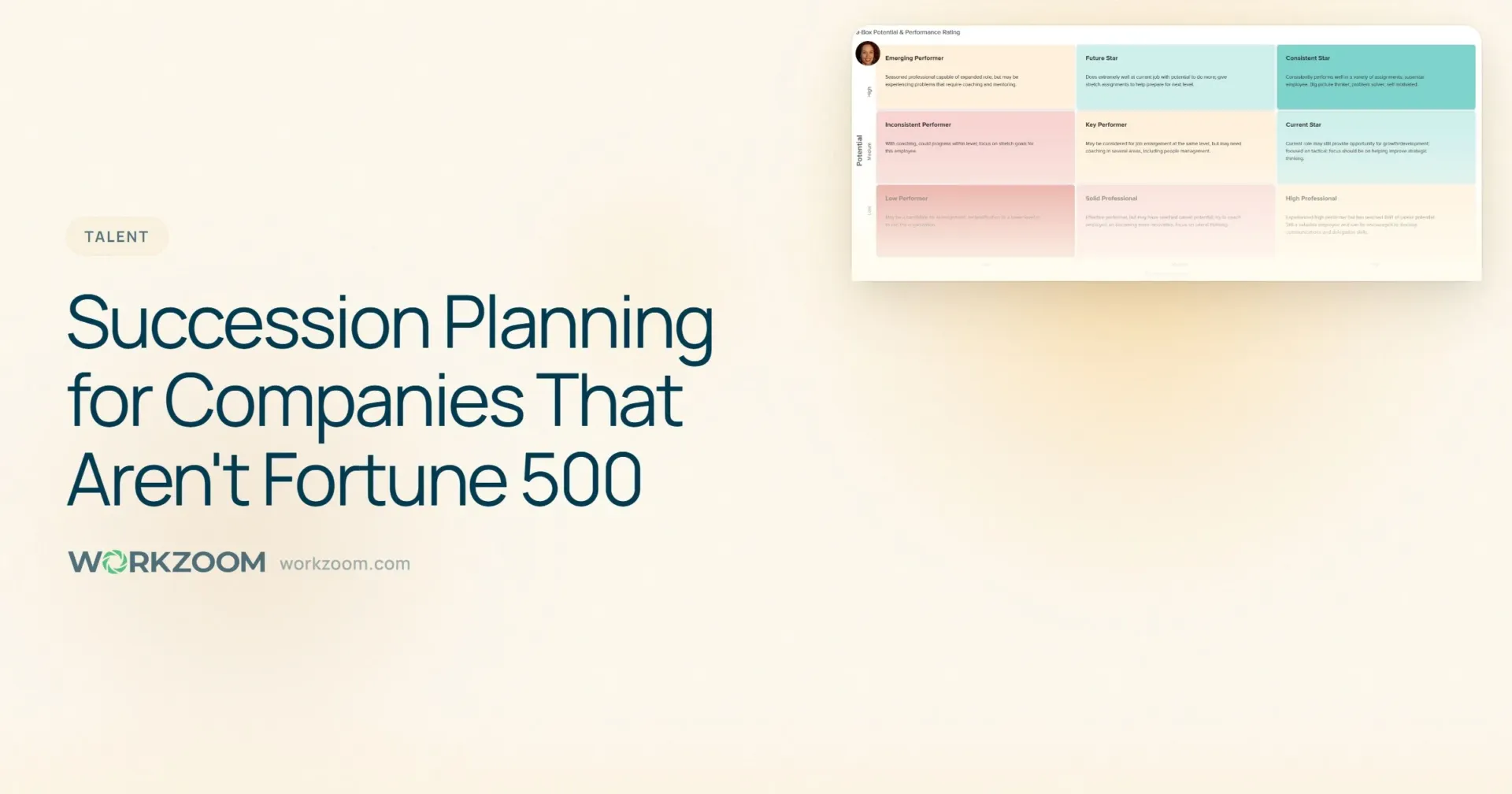
“We don’t have the resources.” Succession planning at the enterprise level involves dedicated talent teams, nine-box grids, development centres, and executive coaching programmes. At the mid-market level, it involves a spreadsheet, quarterly conversations, and intentional job shadowing. The resources required are a fraction of what most people imagine.
“Our people aren’t going anywhere.” People always go somewhere. Retirement, relocation, illness, a competitor’s offer, burnout, a career change. The average tenure at Canadian companies is 8.6 years (Statistics Canada). That means roughly 12% of your workforce turns over annually just through natural attrition. If you haven’t planned for it, you’re not stable. You’re lucky. And luck runs out.
Step 1: Identify Your Critical Roles
Not every role needs a succession plan. A mid-market company with 200 employees probably has 8-12 roles that genuinely qualify as critical. The rest are important but replaceable through normal hiring within a reasonable timeframe.
Critical roles meet two criteria:
High impact of vacancy. If this person left tomorrow, what would break? Would clients notice? Would revenue stop? Would compliance lapse? Would other employees be unable to do their jobs? If the answer to any of these is yes, the role is critical.
High difficulty of replacement. Could you fill this role from the external market within 60 days? If the role requires deep institutional knowledge, specialized skills, or relationship capital that takes years to build, external replacement is slow and expensive. That makes it a succession planning priority.
Here’s a practical exercise. List every role in your organization. Score each one from 1-5 on impact of vacancy and difficulty of replacement. Any role that scores 4 or higher on both dimensions goes on your critical role list.
For a typical 200-person Canadian company, the critical role list usually includes:
- CEO/President (obvious, but often unplanned)
- CFO or Controller
- Head of Operations/Plant Manager
- Payroll Manager (the person who actually runs payroll, not just the department head)
- Top 2-3 sales reps by revenue
- Lead developer or IT manager
- Regulatory/Compliance lead
- Key client relationship managers
Notice that some of these are mid-level roles. The payroll manager might be the most critical person in your organization. If they leave and nobody else knows how to process CRA remittances, you have a compliance crisis within two weeks. Title doesn’t determine criticality. Function does.
Step 2: The 3-Person Framework
For each critical role, identify three people:
Ready Now. This person could step into the role within 30 days if needed. They have most of the required skills, understand the responsibilities, and would need minimal ramp-up. They might not be the long-term answer, but they can stabilize the function.
Ready in 12 Months. This person has high potential but needs specific development. Maybe they need cross-functional exposure, or leadership experience, or a technical certification. With a targeted development plan, they’ll be a strong successor within a year.
Ready in 24 Months. This is your long-term pipeline. Often a high-performing individual contributor who hasn’t managed people yet, or someone in an adjacent role who shows aptitude. They need the most development, but they also represent the deepest investment in your leadership pipeline.
Some roles won’t have three internal candidates. That’s fine. If you can only identify one or two, that tells you something important: you have a development gap. Either you need to start building capability internally, or you need to accept that this role will require an external hire. Both are valid, but you should know which one you’re planning for.
Key Takeaway: The 3-Person Framework works because it eliminates single points of failure. One successor is a backup plan. Three successors is a pipeline. And pipelines survive the unexpected.
Step 3: Development Plans That Don’t Require a Corporate University
Enterprise succession planning involves multi-year leadership development programmes, executive coaching, and rotation assignments across business units. Mid-market companies don’t have the infrastructure for any of that. And they don’t need it.
Here are development strategies that work at any scale:
Job shadowing. Have the successor spend a half-day per month shadowing the incumbent. Not observing passively. Actively participating. Sitting in on vendor calls. Attending the meetings they wouldn’t normally attend. Understanding the decisions that get made and why. This costs nothing except calendar coordination.
Stretch assignments. Give the successor responsibility for a project or task that’s one level above their current role. The IT manager’s successor leads the next system implementation. The controller’s successor prepares the quarterly board report. The stretch doesn’t have to be permanent. It just needs to build the muscle.
Cross-training. The most basic and most neglected development tool. If only one person can do a critical task, train a second person. Then a third. This isn’t succession planning in the formal sense, but it eliminates the immediate operational risk while you build the longer-term pipeline.
External development. Send high-potential employees to conferences, workshops, or certification programmes relevant to their target role. In Canada, many of these qualify for provincial training tax credits or grants through programmes like the Canada Job Grant. A $2,000 conference investment in your future operations leader is the highest-ROI development spend you’ll make.
Mentoring partnerships. Pair the successor with the incumbent for a formal mentoring relationship. Monthly conversations about the role, the challenges, and the skills required. This works best when the incumbent knows they’re part of the succession plan and is actively invested in developing their successor. Some incumbents resist this (it can feel like being replaced). Frame it as legacy-building, not replacement.
You don’t need a leadership academy. You need a manager who says, “Come sit in on this meeting with me. I want you to see how this decision gets made.”
Knowledge Transfer: The Part Everyone Underestimates
Development builds skills. Knowledge transfer preserves institutional memory. They’re different problems, and most succession plans only address the first one.
Here’s the challenge. In a 200-person company, an enormous amount of critical knowledge lives in people’s heads. The CFO who knows the bank’s requirements for the operating line renewal. The sales director who knows which clients will leave if they feel neglected. The IT manager who knows the workaround for that legacy system bug that nobody documented.
When those people leave without transferring that knowledge, it’s gone. Not temporarily misplaced. Gone. And you don’t even know what you’ve lost until something breaks.
Knowledge transfer requires deliberate effort:
Process documentation. Every critical role should have documented procedures for their key responsibilities. Not a 200-page manual. A practical, step-by-step guide that someone competent could follow. “How to run month-end close.” “How to process CRA remittances.” “How to handle the annual insurance renewal.” If the process lives only in someone’s head, it’s not a process. It’s a dependency.
Relationship mapping. Who are the key external relationships this person manages? Clients, vendors, regulators, partners. Document them. Introduce successors to those contacts while the incumbent is still there. A warm handoff is worth a hundred cold introductions.
Decision history. Why do we do things this way? The answer to that question is often the most valuable knowledge an experienced employee holds. Documenting the “why” behind decisions prevents successors from making mistakes that were already made and solved years ago.
What Succession Planning Actually Looks Like at a 200-Person Company
Let me make this concrete. Here’s what a functional succession plan looks like at a mid-market Canadian company. Not a theoretical framework. An actual implementation.
The document: A single spreadsheet (or better, a system) with four columns: Critical Role, Ready Now, Ready in 12 Months, Ready in 24 Months. Twelve rows. That’s the entire plan.
The cadence: The leadership team reviews the succession plan quarterly. Who’s progressed? Who’s stalled? Has anyone left who was on the plan? Has a new role become critical? This meeting takes 90 minutes, four times a year. Six hours total annual investment for your organization’s continuity insurance.
The development budget: $500 to $2,000 per successor per year. Conferences, certifications, books, external courses. For 20-30 identified successors, that’s $10,000 to $60,000 annually. Compare that to the cost of an emergency external hire for a critical role ($50,000 to $150,000 including recruiter fees, onboarding, and lost productivity).
The conversation: Each successor has an annual development conversation with their manager. Not a promise of promotion. A discussion about growth. “Here are the capabilities we’d like to see you build. Here’s how we’ll support that. What are your career goals?” Some successors will tell you they don’t want the bigger role. That’s valuable information. Better to know now than after you’ve invested two years in someone who plans to leave for a different path.
Workzoom’s Talent suite tracks succession plans, development goals, and readiness assessments in a single system. No more spreadsheets that go stale between quarterly reviews. Starting at $4 per employee per month, with goal tracking and performance reviews included. See how it works.
Common Mistakes That Derail Succession Plans
Only planning for the C-suite. If your succession plan covers the CEO and nobody else, you’ve missed the point. The roles most likely to cause operational disruption when vacated are often two or three levels below the executive team.
Confusing high performance with high potential. Your best individual contributor is not necessarily your best future leader. Some people are exceptional at their current role and would be miserable in a management position. Promoting them into a succession role they don’t want is how you lose a great employee and gain a bad manager.
Keeping it secret. Some companies treat succession plans like classified documents. This is counterproductive. Successors who know they’re being developed for future roles are more engaged, more likely to stay, and more motivated to build the required capabilities. Transparency doesn’t mean making promises. It means making investments visible.
Setting it and forgetting it. A succession plan that’s reviewed once a year is barely better than no plan at all. People develop. People leave. Roles change. The plan needs to be a living document, reviewed quarterly and updated as circumstances shift.
Key Takeaway: Succession planning for mid-market companies is simpler than most people think. Identify 8-12 critical roles. Name 2-3 successors for each. Build basic development plans. Review quarterly. Total time investment: roughly 6 hours per quarter for the leadership team. Total cost: a fraction of one emergency external hire.
The Bottom Line
Every company is one resignation letter away from a crisis. The only variable is whether you know it.
That plant manager in Calgary? His departure cost the company roughly eight months of disruption, $120,000 in recruiting and onboarding for his replacement, and an unknowable amount of institutional knowledge that simply disappeared. All preventable with a plan that would have taken six hours to build.
You don’t need a Fortune 500 talent management programme. You need a spreadsheet with twelve rows, quarterly conversations, and the discipline to develop people before you desperately need them.
Sixty-five percent of organizations don’t have a succession plan. That’s not a statistic to feel comfortable about. That’s a market full of companies waiting for a crisis that’s entirely predictable.
Start with your critical role list. Build it this week. The rest of the framework follows from there.
Workzoom Talent manages succession planning, performance reviews, goal tracking, and development plans for Canadian employers. One system for the entire talent lifecycle. $4 per employee per month, no contracts. Get a walkthrough.
Frequently Asked Questions
Stay in the loop
Canadian HR, payroll, and workforce insights. No spam.
You’re subscribed!
See What $4/Employee Gets You
One platform for HR, workforce, payroll, and talent. $4–$16/employee/month depending on which suites you need. No setup fees, no contracts.
More from the Blog