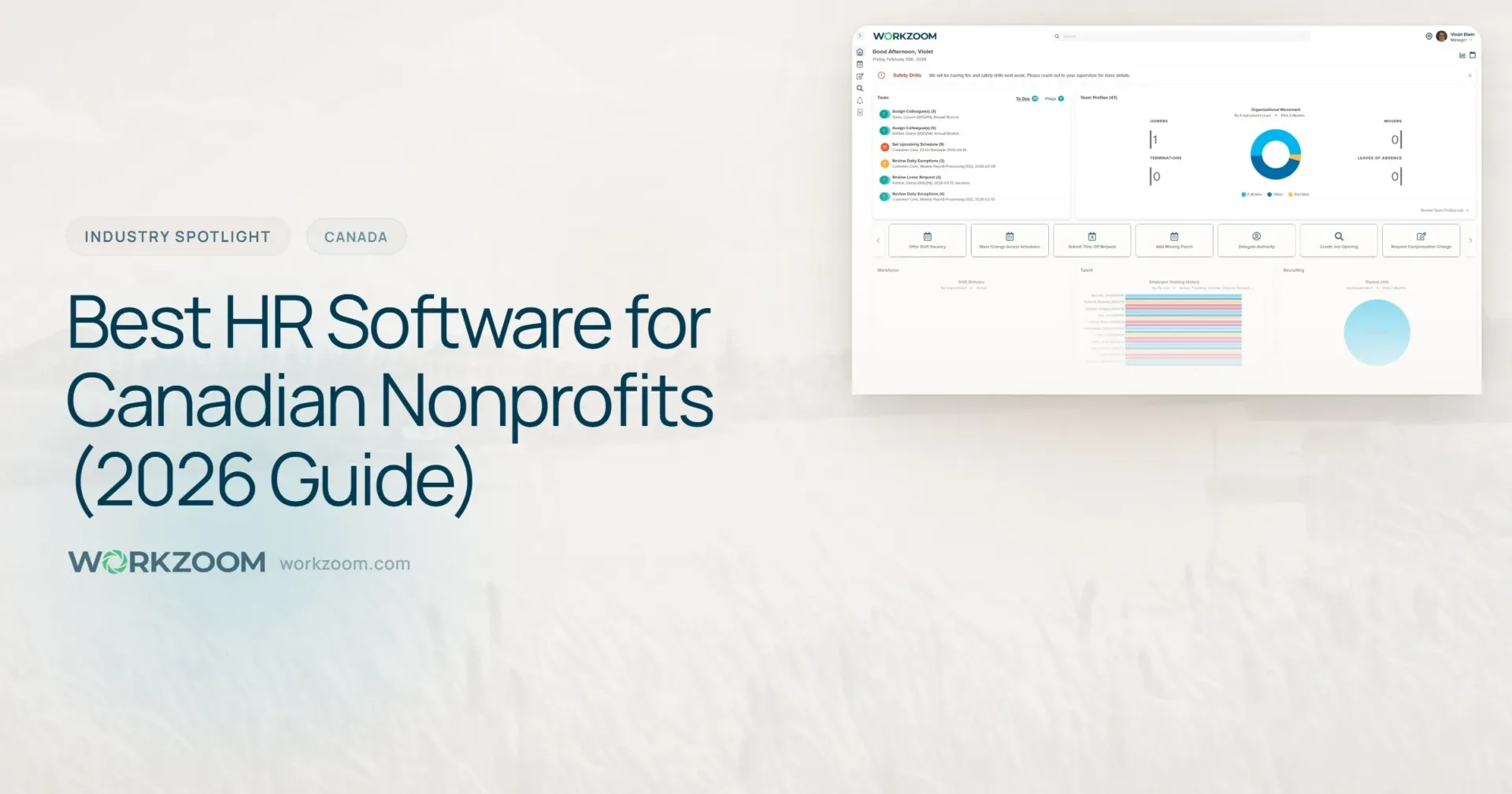
Best HR Software for Canadian Nonprofits (2026 Guide)
HR software built for Canadian nonprofits, streamlined payroll, volunteer tracking, compliance. Cost-effective from $4/employee/month. No setup fees, no contracts.
The best HR software for Canadian nonprofits needs to do something most platforms struggle with: deliver enterprise-grade compliance on a budget that has no room for enterprise pricing. Nonprofits face the same payroll obligations as any for-profit employer. CRA remittances, T4 slips, ROE filings, provincial employment standards. But they often have smaller HR teams, more varied employment types, and boards that scrutinize every operational dollar.
The right platform handles all of it without the setup fees and annual contracts that make enterprise software impractical for mission-driven organizations.
HR software that fits a nonprofit budget without cutting corners on compliance
Workzoom is trusted by Canadian nonprofits, Indigenous governments, and public-sector organizations. $4/employee/month, no setup fees, no annual contracts, full Canadian payroll compliance.
HR Challenges Specific to Canadian Nonprofits
Nonprofits are not just smaller versions of for-profit employers. They have a distinct workforce structure that creates HR challenges that most business-oriented software was not designed to address.
Budget Constraints and Cost Sensitivity
Every dollar spent on administration is a dollar not spent on mission delivery. Nonprofit boards and funders expect administrative costs to be lean, and HR software is not exempt from that scrutiny. Platforms priced for enterprise corporate clients, with six-figure implementation fees and annual contracts, simply do not fit the nonprofit context, regardless of how good the features are.
The pricing model matters as much as the price. Month-to-month with no setup fee means a nonprofit can start, pause, or scale without financial risk. Annual contracts with upfront implementation costs create obligations that small nonprofits cannot confidently take on when their funding year-to-year is not guaranteed.
Mixed Workforce: Employees, Part-Time Staff, and Volunteers
Most Canadian nonprofits operate with a mix of full-time employees, part-time or seasonal staff, and volunteers. These groups have completely different management and compliance needs. Employees require full payroll processing. Volunteers require different tracking, coordination, and recognition workflows. Part-time staff may have variable hours that require careful tracking for benefit eligibility and overtime purposes.
HR software that handles only full-time salaried employees covers one part of the nonprofit workforce. A platform that manages diverse workforce types from a single system covers the whole picture.
T4 Complexity and Multiple Employment Types
Nonprofits frequently have employees working across different roles, departments, and funding streams. T4 reporting for staff whose compensation comes from multiple grant sources requires accurate cost-centre tracking throughout the year. Getting this wrong creates reconciliation problems at year-end that cascade through financial reporting and grant reporting simultaneously.
Limited IT and HR Staff
Most small and mid-size nonprofits do not have an IT department. The HR function is often carried by one or two people who also handle other operational responsibilities. This means the software needs to be genuinely simple to use, not just simple to demo. If onboarding a new employee requires navigating 12 screens and remembering which fields are mandatory, the system will be used inconsistently.
The nonprofit HR challenge is not complexity for its own sake. It is genuine workforce diversity (employees, part-time, volunteers) combined with tight budgets, limited HR staff, and full compliance obligations. The right platform handles all three without requiring a dedicated implementation team to set it up.
What Nonprofits Need from HR Software Versus For-Profit Employers
Nonprofits share the same core compliance requirements as for-profit employers but have several additional needs that most general-purpose HR platforms handle poorly:
Funding source tracking. Employees whose salaries are funded by multiple grants need their time and compensation tracked against the correct cost centres. This is not just an accounting requirement; it is a grant reporting requirement. Funders often need to see proof that their dollars were spent on the staff they were allocated to fund.
Volunteer management. Volunteer coordination (scheduling, tracking hours, managing roles and availability) is a core operational function for most nonprofits. This is distinct from employee HR and requires different workflows. Platforms that treat volunteers as unpaid employees in the payroll system create compliance risks. Platforms that have a separate volunteer module handle the distinction correctly.
Affordable, transparent pricing. Per-employee, per-month pricing with no hidden fees is the only model that works for nonprofits. Implementation fees that scale with organization size make it impossible to budget. Annual contracts that lock in a price for future headcounts that may fluctuate with project funding are a financial risk that nonprofits cannot absorb.
Simple onboarding for non-technical staff. If the HR generalist who handles payroll also manages donor relations and event planning, the software needs to work without IT support. This means clear workflows, sensible defaults, and support that does not assume technical knowledge.
Workzoom for Canadian Nonprofits
Workzoom’s pricing model was built for organizations that cannot afford enterprise pricing: $4 per employee per month per suite, no setup fees, no annual contracts. A 100-person nonprofit using HR and Payroll pays $800 per month. If funding drops and headcount shrinks, the software cost adjusts accordingly.
Beyond pricing, Workzoom is currently trusted by two types of mission-driven Canadian organizations that represent the nonprofit use case well:
County of Renfrew
The County of Renfrew is a public sector organization in Ontario with approximately 900 employees. While not a charity, the County represents the kind of budget-conscious, community-serving employer that shares the nonprofit operational profile: diverse employment types, limited IT resources, and a compliance burden that is identical to any private-sector employer of the same size.
The County onboarded 32 employees in a three-month period, a high-volume scenario for any HR team. Workzoom’s onboarding automation handled the documentation, orientation scheduling, and systems access workflows for all 32 without requiring proportional increases in HR staff time.
Ktunaxa Nation
Ktunaxa Nation is an Indigenous government in British Columbia with over 200 employees. Indigenous governments and band councils share the nonprofit profile in several important ways: community-serving mandate, funding that comes from government agreements rather than commercial revenue, and a workforce that often includes a mix of employed staff and community members in roles that do not fit a standard employment model.
Workzoom’s flexibility in handling diverse employment types and its Canadian compliance coverage, including BC provincial employment standards, made it the right fit for Ktunaxa Nation’s workforce management needs.
Payroll for Canadian Nonprofits: CRA Remittances, T4s, and Multiple Employment Types
Nonprofits are exempt from income tax on organizational earnings, but they are fully subject to payroll compliance obligations. There is no nonprofit exemption from CRA payroll remittances, ROE filing, or T4 generation.
CRA Remittances
Every nonprofit with employees must remit CPP contributions, EI premiums, and income tax withholdings on schedule. The remittance frequency depends on average monthly withholdings (under $25,000: monthly; above $25,000: accelerated). Missing a deadline triggers penalties that start at 3% and climb quickly.
T4 Slips
T4 slips for all employees must be filed by the last day of February. For nonprofits with employees funded across multiple grants or cost centres, the T4 totals need to reconcile with the organization’s payroll records and financial statements. Discrepancies trigger CRA review. HR software that tracks cost-centre allocation throughout the year makes year-end T4 preparation significantly faster and less prone to error.
ROE Filing
Record of Employment must be filed within five days of an employee’s last day of work or within five days of the end of the pay period in which the interruption of earnings occurs. For nonprofits with project-based staff and seasonal employees, ROE filings are frequent. A payroll system that generates ROEs automatically reduces the administrative burden significantly.
Volunteer vs Employee: Workforce Management Without the Confusion
The single most common HR software mistake Canadian nonprofits make is trying to manage volunteers inside their employee payroll system. Volunteers are not employees. They do not receive T4s. They do not generate ROEs. Putting them in a payroll system creates phantom employment records and compliance confusion.
The right approach: a volunteer management module that tracks volunteer hours, roles, availability, and coordination, completely separate from the employee payroll system. These should live in the same platform so you have a complete picture of your workforce, but they should not share payroll data structures.
Implementation Without an IT Department
Most nonprofits implement Workzoom without any internal IT involvement. The implementation process is handled by Workzoom’s team, not by the client’s technical staff. Configuration is done through a guided setup that walks through organizational structure, pay groups, benefit plans, and compliance settings with the nonprofit’s HR contact directly.
For a 100 to 300 employee nonprofit, implementation typically takes four to six weeks from signed agreement to first live payroll run. The nonprofit’s HR team validates and approves the configuration; they do not build it.
Outbound reference: CRA: Legal Obligations for Registered Charities for payroll and employer obligations for Canadian nonprofits.
Frequently Asked Questions
Is there special nonprofit pricing for Workzoom?
Workzoom’s standard pricing of $4 per employee per month per suite is already structured to be accessible for nonprofits: no setup fees, no annual contracts, and per-employee pricing that scales with your actual headcount. For organizations with unusual funding structures or significant size, contact us to discuss your specific situation. We work with nonprofits regularly and understand the budget constraints involved.
Can Workzoom track volunteer hours separately from employee payroll?
Yes. Workzoom’s Workforce module includes volunteer tracking that is separate from the employee payroll system. Volunteer hours, roles, availability, and scheduling can be managed without creating employment records or payroll entries. This keeps your volunteer management organized without introducing compliance confusion in your payroll data.
Does Workzoom handle grant-funded payroll tracking and cost-centre allocation?
Yes. Workzoom supports cost-centre and department-level allocation for payroll expenses. Employees whose salaries are funded by multiple grants can have their compensation tracked against the correct cost centres throughout the year. This data flows through to payroll reporting in a format that supports grant reporting requirements.
How do we switch from our current system to Workzoom without disrupting payroll?
Workzoom’s implementation process includes a parallel run period where the system processes payroll alongside your existing process for one to two pay periods before go-live. This validates that the configuration is correct before you depend on it. For nonprofits with limited HR staff, we structure the implementation timeline to avoid conflict with year-end or major grant reporting periods.
How do we book a nonprofit-specific demo?
Use the link above to book a 15-minute call. Tell us your organization type, employee count, and the specific HR or payroll challenges you are trying to solve. We have worked with enough nonprofits to skip the generic pitch and get directly to what matters for your organization.
Frequently Asked Questions
Stay in the loop
Canadian HR, payroll, and workforce insights. No spam.
You’re subscribed!
See What $4/Employee Gets You
One platform for HR, workforce, payroll, and talent. $4–$16/employee/month depending on which suites you need. No setup fees, no contracts.
More from the Blog